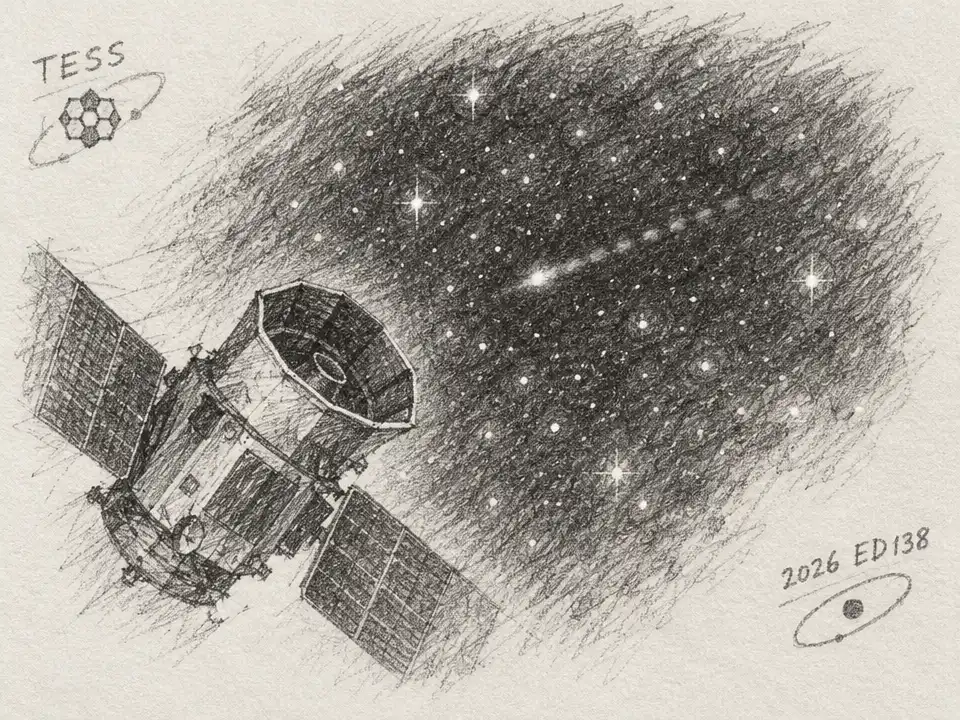
The Sun sends out a stream of particles that can slip through entire planets. Neutrinos are born in the nuclear reactions powering the solar core, then escape without the repeated scattering that traps light. That makes them messengers from the Sun’s interior—but catching them is hard. On Earth, a neutrino view of the fusion core looks almost like a point of light. What if a detector could travel much closer?
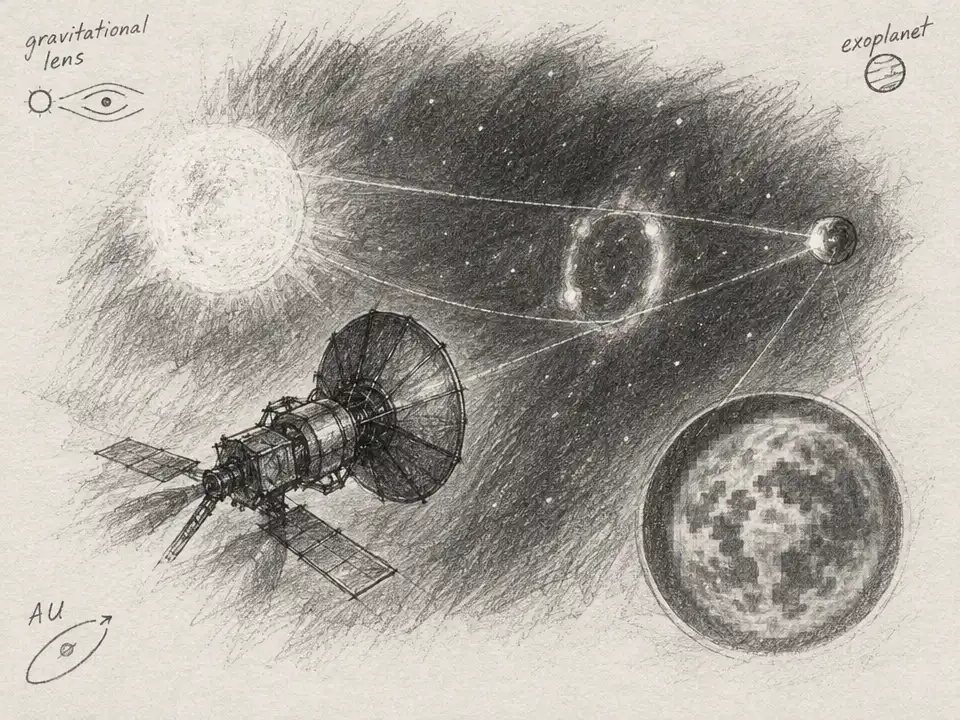
That is the long-range possibility behind νSOL, a proposed solar-neutrino mission that could operate near the Sun, perhaps at distances of 7 solar radii and potentially as close as 3 solar radii. From there, neutrinos arrive in a flux around 1,000 times greater than at Earth, according to the mission team. A closer vantage point could help researchers distinguish where in the fusion core the particles came from. It could also let them study a change in neutrinos’ quantum behavior that happens near the Sun and is already over by the time the particles reach Earth.
But before anyone tries to send a neutrino observatory toward the Sun, there is a stubborn question: can its detector tell a genuine solar neutrino from the particle noise of space? A small satellite called SNAPPY is designed to take that first, practical step. Launched on May 3, 2026, it carries a compact detector to orbit—not to map the solar core, but to test whether the detection method can work in the real space environment.
That distinction matters. The research paper describes the spacecraft, its detector, ground tests and simulations. Its central task in orbit is to measure the background that could imitate neutrinos. It does not report confirmed neutrino detections from space. The destination is a future mission; SNAPPY is a test of whether the road there is open.
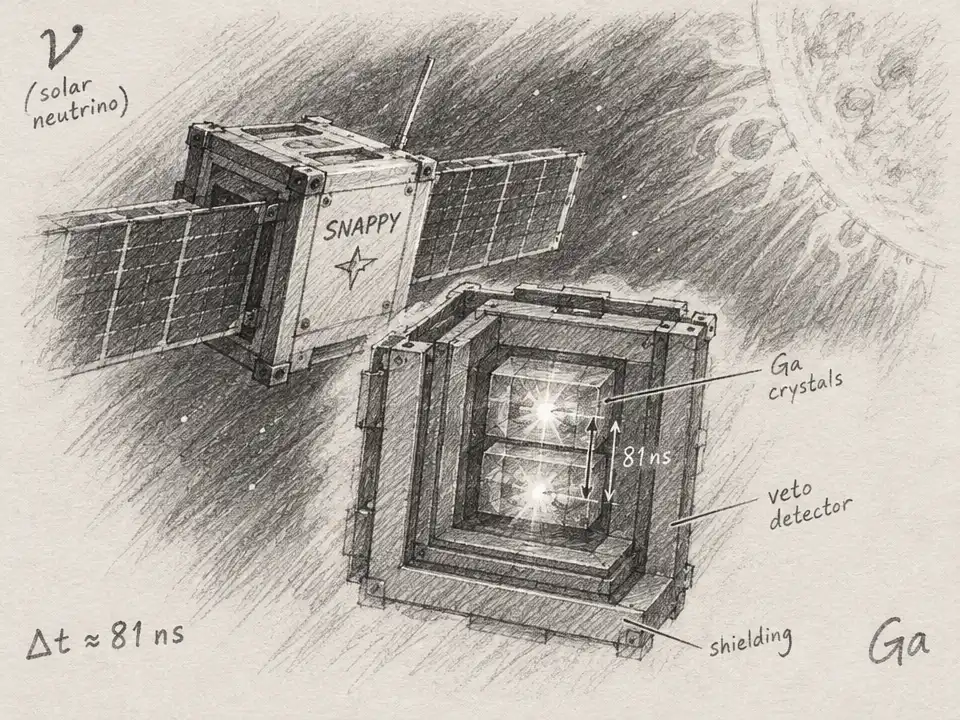
The detector’s cleverness lies in timing. At its heart are four crystals made of gallium-aluminum-gadolinium garnet, containing gallium-71. When a solar neutrino interacts with a gallium-71 nucleus, the interaction produces an electron and an excited germanium-71 nucleus. That nucleus then releases a gamma ray. In the particular signal the team hopes to use, the electron’s flash comes first and the gamma-ray flash follows about 81 nanoseconds later.
A cosmic ray passing through the detector usually makes a single burst, not that distinctive two-part signature. The trick is to spot two pulses close together and ask whether they match the expected pattern. The crystal glows when particles deposit energy in it; light sensors and fast electronics record the flashes and their timing.
SNAPPY adds another layer of defense: a plastic scintillator surrounding the central crystals. A charged particle that passes through this outer detector should leave a signal there, giving the system a reason to veto the event. The spacecraft also carries passive shielding made from tungsten powder mixed into epoxy. The design has to shield the instrument without leaving a dense metal block that might survive reentry and pose a hazard on the ground.
Even with these protections, the hardest part is not simply recognizing a pulse. It is learning how often space itself can produce a convincing imitation. Two cosmic-ray interactions might arrive close together. Some particles could be related, rather than randomly timed; and no veto detector catches every event. The paper notes that the timing structure of cosmic rays has not been measured with the needed precision to settle this background question. Until it is measured, the false-positive rate remains uncertain.
That is why a modest detector in Earth orbit has a job that a much larger, more ambitious solar probe cannot skip. If researchers cannot reliably separate a neutrino’s delayed double pulse from the space environment, a detector closer to the Sun would inherit the same problem—at greater cost and with fewer chances to fix it. SNAPPY’s central payoff is not a portrait of the Sun, but evidence about whether the instrument can tell signal from noise.
The satellite’s orbit is part of the experiment. It circles Earth at about 500 kilometers in a near-polar, Sun-synchronous orbit. The detector is meant to collect data while the spacecraft passes over the north and south poles, where it can operate above Earth’s Van Allen radiation belts, and switch off elsewhere. This gives it repeated, limited windows for measurements rather than continuous observing time.
That schedule creates a very unglamorous frontier problem: a small satellite has to make each window count. SNAPPY’s flight software cannot be freely modified to automate detector switching based on its GPS position. Instead, operators send timed commands in advance. Power is limited, eclipses interrupt sunlight, and communication competes with detector operations. Even the choice of ground stations affects how the satellite balances antenna pointing against keeping its solar panels aimed toward the Sun.
The team has tested the crystals on the ground using laboratory radioactive sources, and reports energy resolution of about 7%. Simulations also suggest the instrument could distinguish some charged-particle species, including protons and alpha particles, from the combined signals in the central detector and surrounding veto. Those are supporting capabilities, not proof that the main neutrino challenge is solved; the in-orbit background measurement is precisely what remains to be established.
If that measurement succeeds, the next step would still be formidable: build a detector suited to a much harsher journey inward and collect enough neutrinos to learn something new about the Sun. A close solar vantage could turn the fusion core from an unresolved point into a region with structure, while exposing neutrinos during a phase of their journey invisible to detectors on Earth. SNAPPY cannot deliver that view. It can test a smaller but essential proposition first: whether a tiny crystal, a pair of timed flashes and careful rejection of cosmic noise can make neutrinos detectable in space at all.
That is the price of this frontier: before the Sun’s hidden interior can come into sharper focus, researchers must first prove they can trust the faintest signal in a place full of impostors.