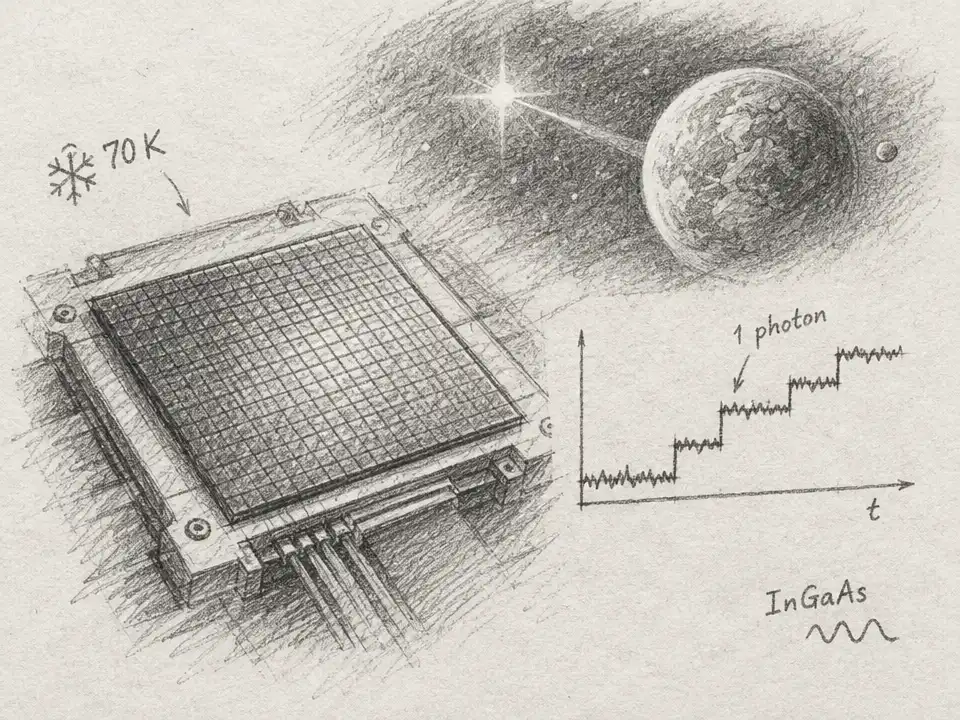
Imagine trying to read a message written in light so faint that a detector might wait an hour for a single photon in a pixel. That is the challenge facing future observations of Earth-like planets: the planet’s reflected light can be billions of times dimmer than its star, and astronomers need to spread that scarce light across a spectrum to look for signs of molecules in the atmosphere. The detector must distinguish each tiny arrival from its own electronic noise.
A research team has now demonstrated a different way to tackle that problem: a megapixel infrared semiconductor array that can resolve individual photon events. Instead of relying on a superconducting sensor chilled close to absolute zero, the device works at 70 K. It still needs cryogenic cooling, but that temperature is far less demanding than superconducting detectors typically require. The result is a promising alternative, not yet a finished instrument ready to search for life.
The design builds on mercury-cadmium-telluride, or HgCdTe, a semiconductor already used in infrared astronomy. In an ordinary detector, a photon produces an electron, and the electronics must read the small resulting charge. Readout noise can bury the signal. Here, the electron enters a strong electric field inside the pixel and triggers an avalanche: it gains enough energy to create additional electrons. The resulting charge packet is large enough to stand out from the noise added later by the readout electronics.
But turning up the gain creates a trap. A detector also produces unwanted electrons without any light, through dark current and high-field effects such as tunneling. If those electrons get amplified too, they can masquerade as photons. The team’s approach is to shape the semiconductor’s bandgap in layers, directing the strongest amplification toward photoelectrons while keeping much of the dark signal outside the high-gain region. A metal shield also blocks some stray infrared light emitted by the detector’s own readout circuitry.
The researchers did not simply measure the total charge after a long exposure. They repeatedly read each pixel without erasing its accumulated signal, a method known as up-the-ramp sampling. When a photon arrives, its amplified charge appears as a sudden step in the pixel’s growing signal. Between arrivals, the signal follows a smoother background. It is a little like watching a faintly rising line on a graph and spotting each tiny stair-step as it happens.
To separate real steps from random fluctuations, the team adapted a likelihood-based method originally developed to identify cosmic-ray hits in detector data. Rather than declaring every large jump a photon, the method checks whether treating a particular read as a sudden event makes the data fit better than a smooth background would. That matters when events are faint: a fixed cutoff can either miss real photons or mistake noise for them.
In a laboratory test, the group cooled a 1024-by-1024-pixel array to 70 K and illuminated it with 1500-nanometer light. At an avalanche gain of 78.7, the effective readout noise fell to 0.45 electrons rms. In one 66-second sequence, sampled at 1.45 frames per second, photon arrivals showed up as distinct steps in a pixel’s signal. With the light blocked, the same pixel showed a smoother trace, without comparable photon-like jumps.
The team also tested whether the events behaved like light rather than quirks of the electronics. They analyzed 1000 pixels selected from the half of the array with the lowest dark levels, using 300-frame sequences at seven illumination levels. After correcting for a small background offset, the number of detected jumps rose in proportion to the incoming light. That linear relationship is an important check: the apparent photon events tracked the source brightness.
The test also revealed what still needs work. In dark sequences, the algorithm detected an average of 0.65 jumps per pixel in 300 frames, equivalent to about 2.2 false events per thousand pixel-frames. The authors attribute most of these to residual glow from the readout circuitry. And the array-wide test used a selected subset of pixels, not a demonstration that every one of the million pixels can count photons reliably. The researchers identify pixel defects, performance uniformity, and persistence—signals that linger after illumination—as remaining challenges.
Why take on all this engineering? Because detector noise can turn a feasible observation into a punishingly long one. In a simulation for a proposed Habitable Worlds Observatory, the authors modeled spectroscopy of an Earth-Sun-like system 7 parsecs away. Under their assumed observing conditions, reducing detector noise could bring an exposure that takes several hundred hours with representative current detector performance to under 20 hours. This is a modeled example, not an observation or a guarantee: the calculation assumes that some systematic sources of starlight and dust are calibrated down to the photon-noise limit.
The broader idea is deceptively simple: make the light signal bigger before the electronics get a chance to blur it, while carefully preventing the detector’s own unwanted signals from growing along with it. The team’s array has shown that individual infrared photons can leave readable marks in a large-format semiconductor sensor. Scaling that performance across the full array, reducing false events, and meeting the demands of an observatory are still ahead. But a faint planet’s spectrum may one day be read not as a nearly invisible smear, but as a collection of individual arrivals.