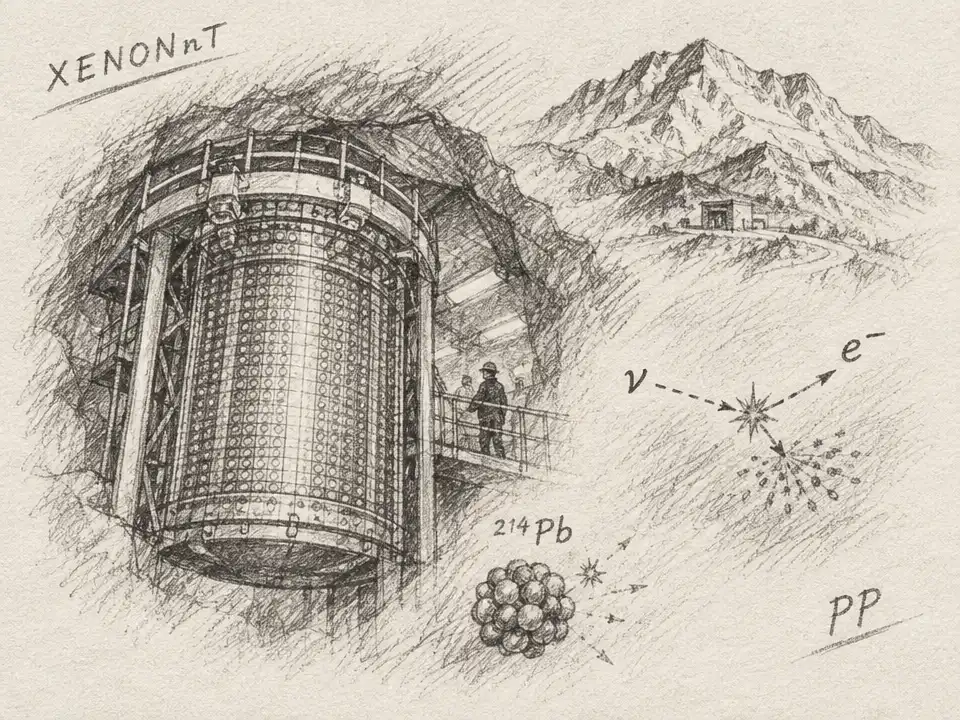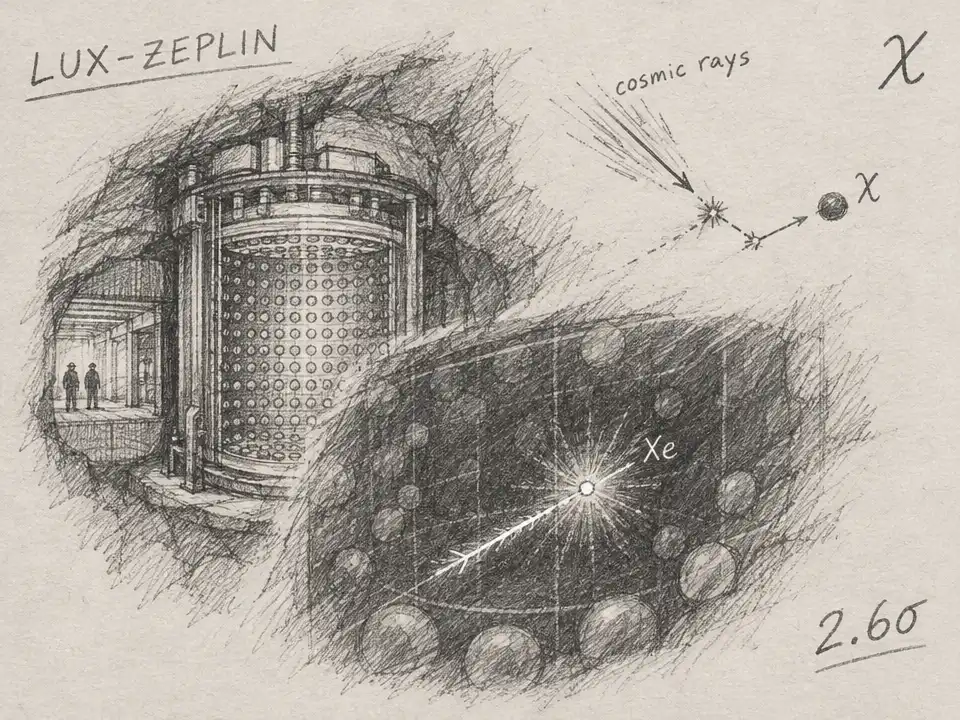
Far below South Dakota, seven tonnes of liquid xenon wait in the dark. A particle that hits a xenon nucleus can leave two traces: a brief flash of light and a spray of freed electrons. Together, those signals let physicists estimate where an impact occurred and how much energy it delivered. Most events have familiar explanations. One did not fit neatly.
The LUX-ZEPLIN experiment, known as LZ, found a candidate nuclear recoil carrying about 248 keV of energy—far above the range where many dark-matter searches focus. The event was recorded on June 16, 2023; LZ reported it in September 2026, after analyzing a 2.84-tonne-year exposure. Its character is tantalizing, but its statistical standing is modest: after accounting for the many possible signal models examined, the tension with known backgrounds is 2.6σ. That is a reason to investigate, not a discovery.
The trouble is not simply that the event is energetic. It stands alone. Ordinary dark-matter models often predict that if one collision deposits so much energy, many more should appear at lower energies. LZ saw no corresponding excess there. Any explanation has to account for both the striking hit and the missing crowd.
A proposal by physicists Matti Heikinheimo and Niklas Zimmermann offers a way to change the scene before the particle reaches the detector. Imagine dark matter drifting through the Milky Way at a crawl by particle-physics standards. A high-energy cosmic-ray proton—launched by some violent event in space—slams into one of those dark-matter particles. The collision can kick the dark matter into a much faster, “boosted” state. If it later strikes a xenon nucleus, it may deliver the unusually hard recoil LZ recorded.
The idea’s useful twist is that the kick and the detector hit can arise from the same kind of interaction between dark matter and ordinary matter. The proposal does not need an extra, specially arranged dark-sector particle to do the boosting. Instead, its authors calculate how cosmic rays could produce a fast-moving dark-matter population, then ask what that population would do inside xenon.
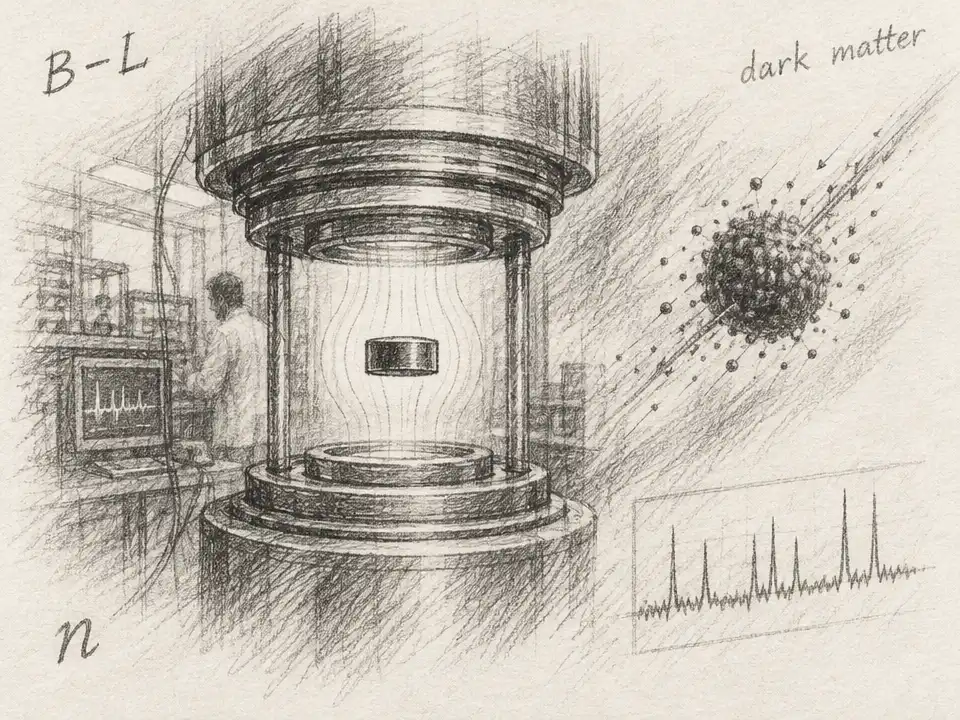
The shape of the predicted energy spectrum matters as much as the particle’s speed. In the model, certain momentum-dependent interactions make high-energy recoils relatively more likely. For one illustrative choice of interaction, a particle roughly a billion times the proton’s mass can produce a spectrum with a peak near LZ’s event, while the predicted rate below 100 keV is more than ten times smaller. That can help explain why one high-energy candidate has no obvious low-energy companions.
But matching one point on a graph is not the same as explaining a pattern. The same example produces another peak around 500 keV, beyond the top of LZ’s reported search window. The authors emphasize that a single event cannot pin down the dark-matter mass or the details of the interaction. They estimate that the dark-matter particle would need to be lighter than a few GeV to avoid constraints from the slower population that remains in the Galactic halo.
Here is the frontier, and its price: a detector designed to listen for gentle taps from slow-moving dark matter might also become a probe of particles that cosmic rays have accelerated. If such events recur, their energy distribution could reveal not just whether dark matter interacts with xenon, but how momentum shapes that interaction. Broader searches could test whether a predicted high-energy bump appears—and whether the lower-energy spectrum stays as quiet as this explanation requires.
That prospect also raises a practical challenge. A model that predicts a feature above the current analysis range is only useful if experiments can calibrate and analyze that range reliably. LZ’s paper describes a search extending to about 270 keV, while the boosted-particle example points toward a second feature near 500 keV. Extending the reach means understanding detector response, backgrounds, and selection efficiency at energies where the existing analysis cannot yet settle the question.
There are other possible explanations for the recoil, including dark-matter models that make a particle change into a heavier state during a collision. And the LZ collaboration studied rare backgrounds and detector effects without identifying a likely culprit. Still, neither the absence of an obvious background nor a theory that can reproduce the event establishes that dark matter caused it. A 2.6σ hint can fade with more data; competing models can also fit the same lonely mark.
The decisive evidence would be a repeatable pattern: more high-energy recoils, measured across a broad enough range to test the predicted shape, ideally in more than one xenon detector. Until then, the 248 keV event is less a fingerprint than a question written in a detector’s two signals. Cosmic rays may have given dark matter the shove needed to write it. The next data must show whether that unusual explanation leaves a trail.