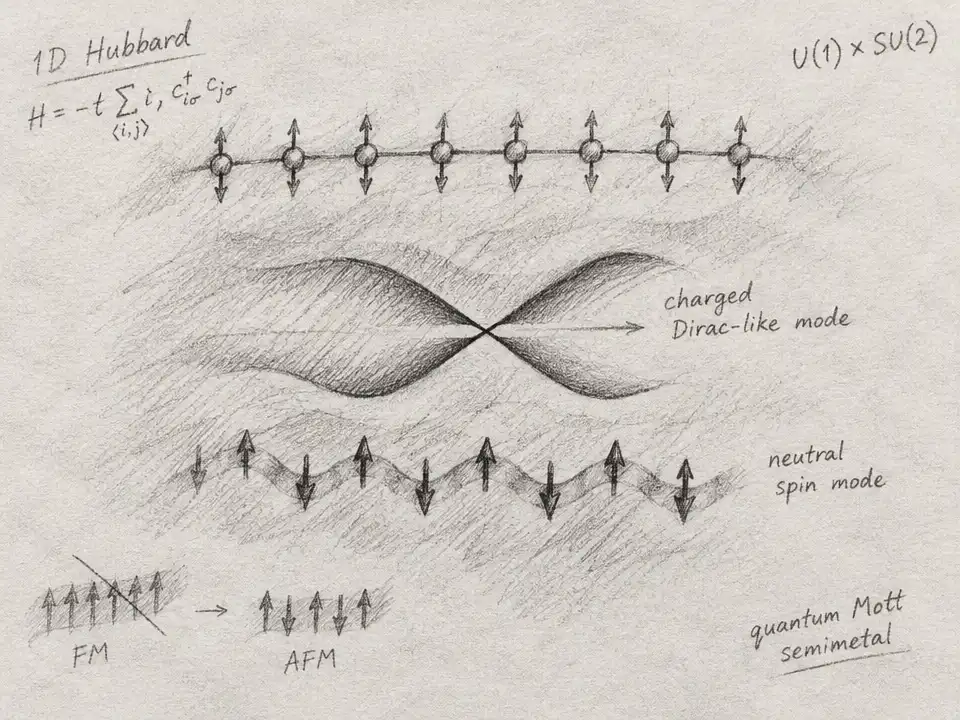
Here is the puzzle: how do you build a useful model of interacting molecules when the very forces that keep them safe also make the interactions you need almost impossible? In an optical lattice, molecules can be arranged in a repeating grid, like beads in an artificial crystal. Physicists want to use that grid to study how particles move, pair up, and organize. But a central ingredient of the familiar Hubbard model—the ability to tune the energy cost of putting two particles on one site—has been missing for polar molecules.
The obstacle begins with a protective trick. Polar molecules can react or disappear during close collisions. A microwave field can shield them by creating a repulsive barrier, turning away pairs before they reach the lossy short-range region. That shielding helps make a stable molecular gas possible. Yet it also makes ordinary double occupation prohibitively costly. In a conventional single-band Hubbard description, the energy for two molecules sharing a site can reach the MHz scale, while the spacing between the lattice’s vibrational levels is about h × 10 kHz. The supposed doublon—the model’s name for a doubly occupied site—no longer fits inside the low-energy picture.
One answer would be to abandon doublons and work only with at most one molecule per site. That hard-core limit is useful, but it shuts off a wider set of processes that depend on pairs fluctuating on and off a site. Superexchange, pair motion, and other correlated behaviors become harder to explore. The authors of a 2026 theoretical study ask whether the system can have a doublon without forcing two molecules into the forbidden, high-energy configuration. Their proposed clue is a different kind of pair: a field-linked molecular dimer.
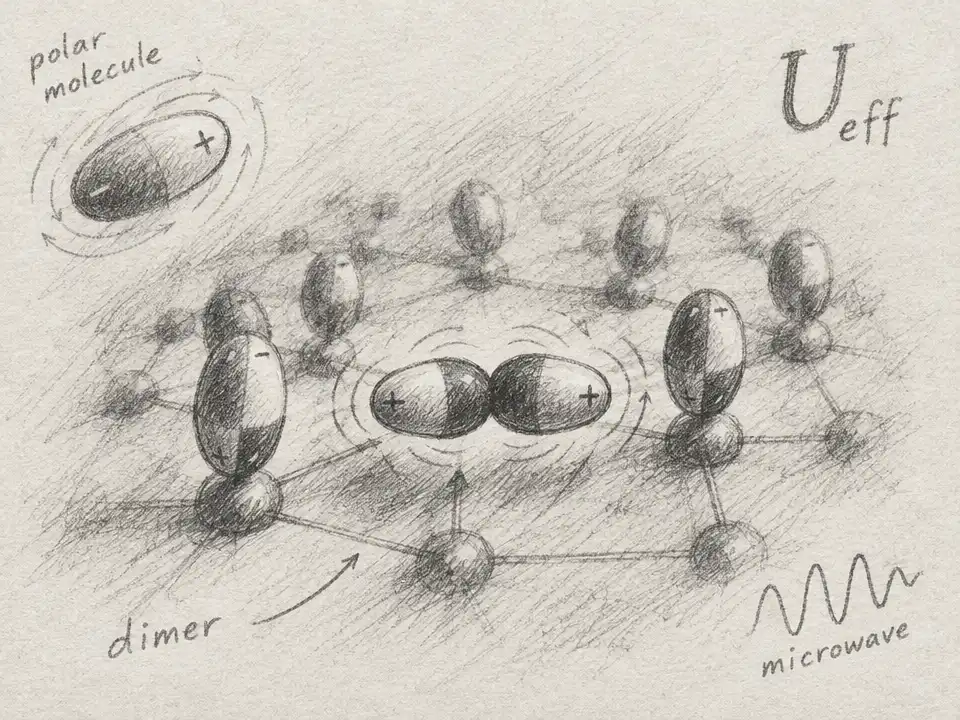
A field-linked dimer is a bound pair whose properties arise in the microwave-dressed interaction landscape. The key is that it can be treated as a distinct state, not simply as two monomers crammed into the same lowest-energy orbital. The researchers calculate how its energy shifts as the microwave coupling changes. At a particular setting, the dimer’s energy approaches that of two separate molecules in the lowest lattice states. At the crossing, the two descriptions can mix: two monomers on neighboring sites may convert coherently into a dimer on one site, and back again.
That conversion supplies the missing model ingredient. The dimer behaves as an effective doublon, with its energy relative to the two-molecule state playing the role of the on-site interaction. Change the microwave Rabi frequency and detuning, and that energy can be moved through resonance—through zero—rather than being fixed at an enormous repulsive value. The important distinction is easy to miss: the proposal does not remove the shield or claim that ordinary double occupation becomes harmless. It gives the lattice a different pair state to use as its adjustable on-site degree of freedom.
The idea has to pass a second test. A resonance that decays before molecules can tunnel is no useful ingredient for a many-body model. The team therefore calculates the dimer’s finite lifetime as well as the effective lattice parameters. For their representative 23Na40K setup, they consider a lattice spacing of 550 nm, an in-plane lattice depth of 5.1 recoil energies, and a vertical depth four times larger. At those settings, the tunneling parameter is 177 Hz × h. Across the microwave-field orientations they examine, the dimer linewidth is about 8–18 Hz × h. The paper uses Γ/t < 0.1 as a conservative condition for the dimer to remain long-lived enough for coherent lattice dynamics, and reports a broad accessible region near the resonance that meets this practical test.
There is another clue in the geometry. Polar molecules interact over long distances, and those interactions depend on direction. Rotating the microwave field relative to the lattice changes how strongly molecules on different sites affect one another. In the calculations, the microwave amplitude mainly controls the on-site dimer energy, while the field orientation adjusts off-site interactions. Near β/π ≈ 0.3, the nearest-neighbor monomer interaction crosses zero even as a diagonal coupling remains sizable and positive. The dimer resonance can still be brought into place: the required Rabi frequency varies from roughly 6 to 13 MHz with orientation, while the calculated linewidth remains small compared with the tunneling scale.
This separation of controls is what makes the proposal more than a clever way to rename a pair. If changing the on-site energy necessarily changed every interaction in the lattice, researchers would have little room to explore. Here, calculations suggest they could adjust the local pair state and the directional forces between sites nearly independently. The resulting model retains SU(N) symmetry: in plain terms, the interaction rules remain nearly unchanged when the molecules’ nuclear-spin labels are exchanged. That symmetry, combined with adjustable pairing and long-range forces, could open access to model behaviors that the hard-core version leaves out.
But the puzzle is not solved in the laboratory. This paper is a theoretical proposal built from calculations of molecular states, lattice couplings, and decay—not a report that the conversion has been observed. The dimer is metastable, meaning it can still decay into lower-energy microwave-dressed channels; a finite linewidth is part of the design, not an inconvenience that vanishes. The authors also note that a more accurate account of the on-site two-body problem would go beyond their harmonic approximation. Experiments must determine whether the predicted resonance and its lifetime can be realized with enough control in an actual lattice.
For now, the result is a carefully constructed answer to a stubborn modeling question: perhaps a lattice does not need to make ordinary double occupation safe. It may instead borrow a stable-enough molecular pair state and let that state stand in for a doublon. If experiments can make the exchange between neighboring monomers and the on-site dimer behave as predicted, the molecule’s protective barrier will have done something unexpected: not just keep particles apart, but help build a richer playground for them to interact.