Imagine releasing a tiny cloud of atoms and asking a deceptively simple question: when does each one arrive? In everyday life, a stopwatch seems to settle the matter. In quantum physics, however, several well-motivated approaches predict different distributions of arrival times. The disagreement has lingered for decades—not because atoms cannot be detected, but because the detector can disturb the very motion researchers hope to measure.
A new proposal turns that problem sideways. Instead of trying to capture a particle’s full arrival-time pattern with a detector placed close to its starting point, Pascal Naidon, Lucas Happ, and Denis Boiron suggest letting a cloud fall a long way, then moving a detector across its path. The changing number of atoms it catches at different positions could reveal which quantum prediction best matches nature.
The puzzle begins with what “arrival time” means for a quantum particle. A particle’s wave can spread and interfere, so there is no single classical trajectory that every theory agrees to track. Some approaches associate arrival with how much probability gathers at the detector. Others use the flow of probability toward it. Another, often called the Kijowski distribution, follows a distinct mathematical prescription. Stochastic-trajectory approaches add further possibilities, including a difference between a particle’s first arrival and its arrival after it may have crossed the detector more than once.
These are not merely alternative ways of drawing the same curve. For a carefully chosen cloud, they can predict different patterns. But experiments designed to compare them face a practical snag: the most revealing measurements may require a detector only a few characteristic cloud-lengths from the source. At that range, the detector’s influence becomes harder to separate from the arrival process itself. Gravity poses another complication. In a vertically falling cloud, it can overwhelm the quantum differences researchers want to see.
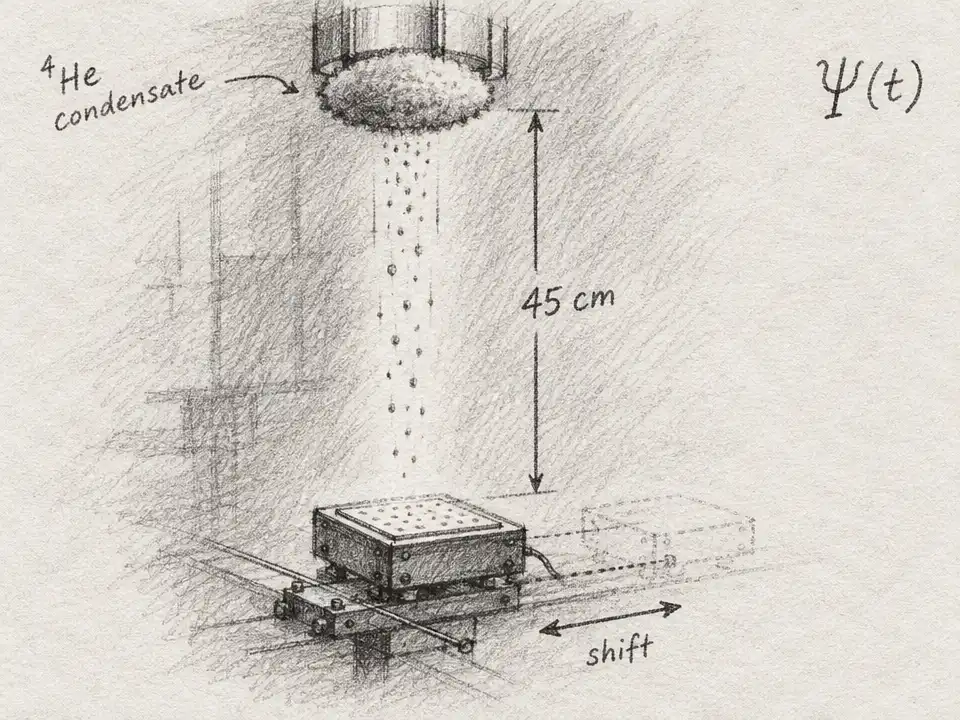
The proposed setup gives gravity a useful job while keeping it out of the key comparison. Researchers would prepare a Bose-Einstein condensate of metastable helium-4 atoms in a laser trap. When the trap is switched off, the cloud expands and falls toward a vertical microchannel-plate detector about 45 cm below. Gravity pulls the atoms downward, but the detector records their sideways spread. That horizontal motion is not driven by gravity in the same way as the fall.
There is a catch: a detector of finite size sees the cloud only during a narrow slice of its evolution, too brief to trace out the full arrival-time curve. So the researchers propose mounting the detector on a horizontal translation stage. In one run, it catches atoms at one sideways position; in another, it is shifted and catches atoms at a different position. The experiment does not reconstruct time by making the detector’s clock faster. Instead, it compares how many atoms arrive across a series of locations.
That change of viewpoint is the heart of the method. The team modeled the expected counts for a cloud containing 10,000 atoms and a detector with an estimated efficiency of 25%. For one orientation of the elongated cloud, the predicted pattern offers a particularly clear test: the density-based prescription gives a count curve that declines steadily, while the other main predictions rise to a peak. A simple spatial scan could therefore separate that family of predictions from its competitors without placing the detector right beside the source.
A second cloud orientation offers another possible clue. The Kijowski prediction produces small oscillations in the expected pattern that the other approaches do not. In the modeled setup, however, those ripples would be difficult to distinguish from counting noise in a single release. The authors estimate that repeating the experiment a few hundred times at each detector position could make the oscillations visible. That is a more patient experiment, but it turns a subtle theoretical difference into a concrete experimental target.
The proposal is not a report of a completed measurement. Its predicted patterns come from calculations, and the apparatus would still have to be built and tested. Nor does the scan promise to distinguish every version of every theory: the ordinary probability-flow prediction and the stochastic approach to first arrivals may remain too similar in this setup. If those predictions survive the first test, the authors say, a more involved experiment—such as one using interfering clouds—may be needed.
Still, the design tackles a foundational question with an unusually practical move. Rather than demand a more intimate look at a particle’s arrival, it backs the detector away, lets the cloud spread, and turns position into a readout. If the predicted differences hold up in the laboratory, a movable plate beneath a falling cloud could help reveal what quantum theory says about the moment of arrival—and where its competing answers part company.