A photon has begun to leave an excited atom. The atom is already less likely to be excited than it was a moment ago. In ordinary experience, that drift feels one-way: once the light is gone, the decay is done. But a theoretical proposal by physicists Yakir Aharonov and Avshalom C. Elitzur asks whether a quantum system could, in a carefully selected set of trials, behave as if its own clock had briefly run backward.
The answer comes with a twist. The proposal does not reverse time for the world, and it does not describe an experiment the authors have carried out. It is a thought experiment built from quantum interference, relativistic clock rates and a final measurement that keeps only certain outcomes. Its sharpest prediction is less “time travel” than a limit: the environment’s memory sets how far the apparent reversal can reach.
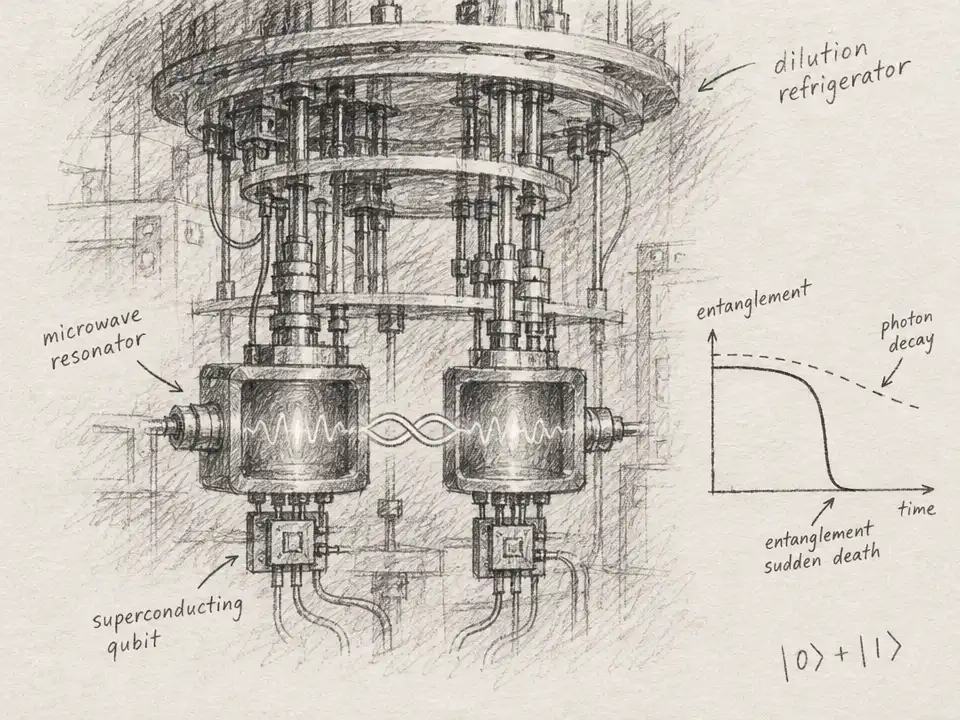
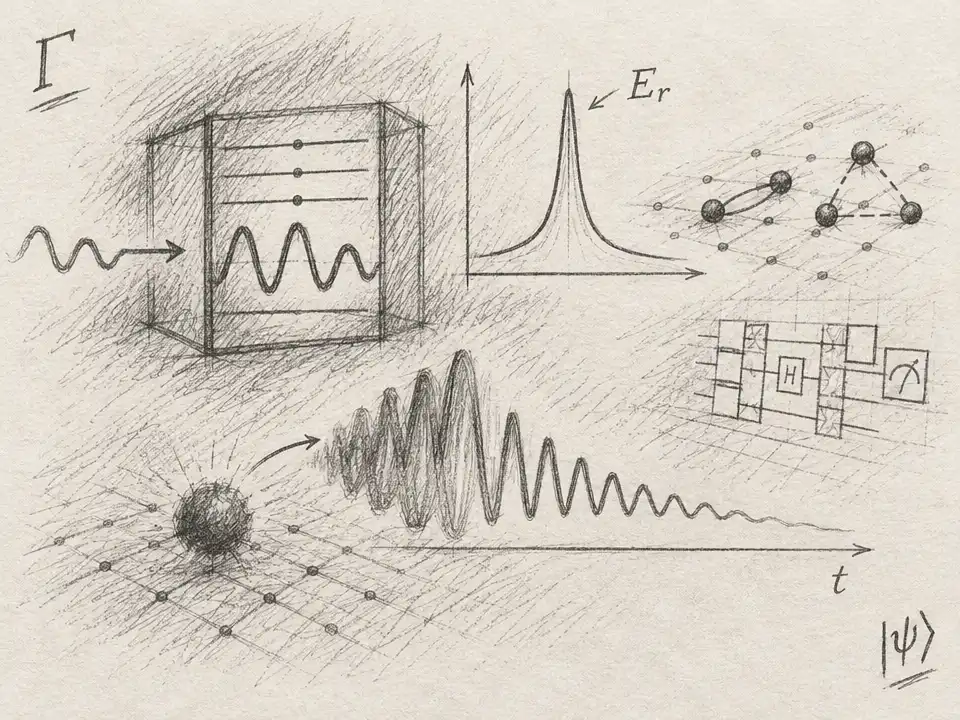
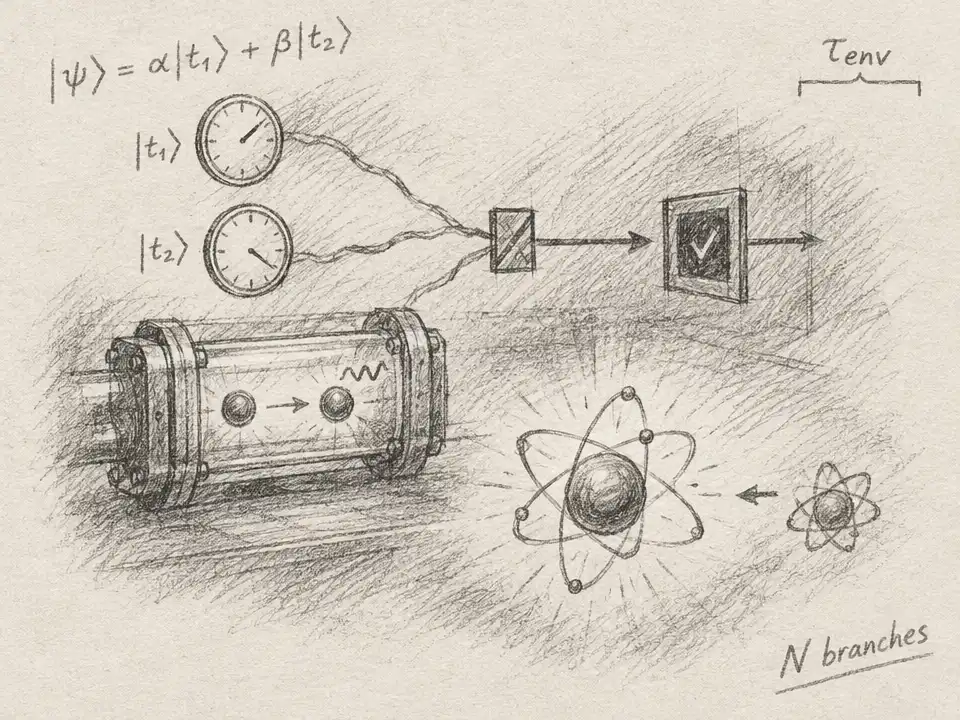
Begin with a sealed cell containing excited atoms, the light they emit and walls that can absorb that light. The whole cell—not just the atoms—must remain part of the quantum system. Otherwise, a photon escaping from one route could reveal which route the cell took, erasing the interference the proposal needs.
Now imagine the cell’s center of mass prepared in a superposition of paths or positions where its clock runs at slightly different rates. General relativity says clocks tick at different rates in different gravitational potentials; motion also changes elapsed proper time. Along each path, the atoms and their surroundings evolve forward as usual, but for slightly different amounts of proper time.
At the end, the paths are brought together and the cell is measured in a special output state that does not reveal which route it took. This is called post-selection: the researchers would sort out the rare trials that produce that particular result. In that selected group, the combined evolution can act as though the cell experienced an effective duration outside the range of the actual paths—including, in the theory, a negative duration.
The mathematical trick resembles a superoscillation. A blend of ordinary waves can, over a limited patch, behave as if it oscillates faster than any wave in the blend. Here, a carefully weighted blend of forward evolutions can mimic a system that has evolved backward. The effect appears in the selected outcomes, not in every trial. The closer the final measurement is to a result that almost never occurs, the more striking the apparent clock shift can be.
To tell whether the clock really had an effective backward stretch, the proposal needs a visible marker. Freshly excited atoms are no good: their excited-state probability falls whether time runs forward or backward from the instant of excitation. So the authors start with atoms that have already begun to decay. Let them evolve briefly, then seal the cell and put it through the clock-rate superposition.
If the selected cell’s effective time runs backward by just the right amount, the model predicts that some of the atoms will be found more excited than they were when the cell was sealed. In the idealized limit, the outgoing light would be reabsorbed and the atoms restored to their earlier state. Ordinary forward evolution—along either route, or any mixture of the two—cannot produce that increase. The test would be a direct count of excited atoms, not a delicate probe that merely assigns an unusual value to time.
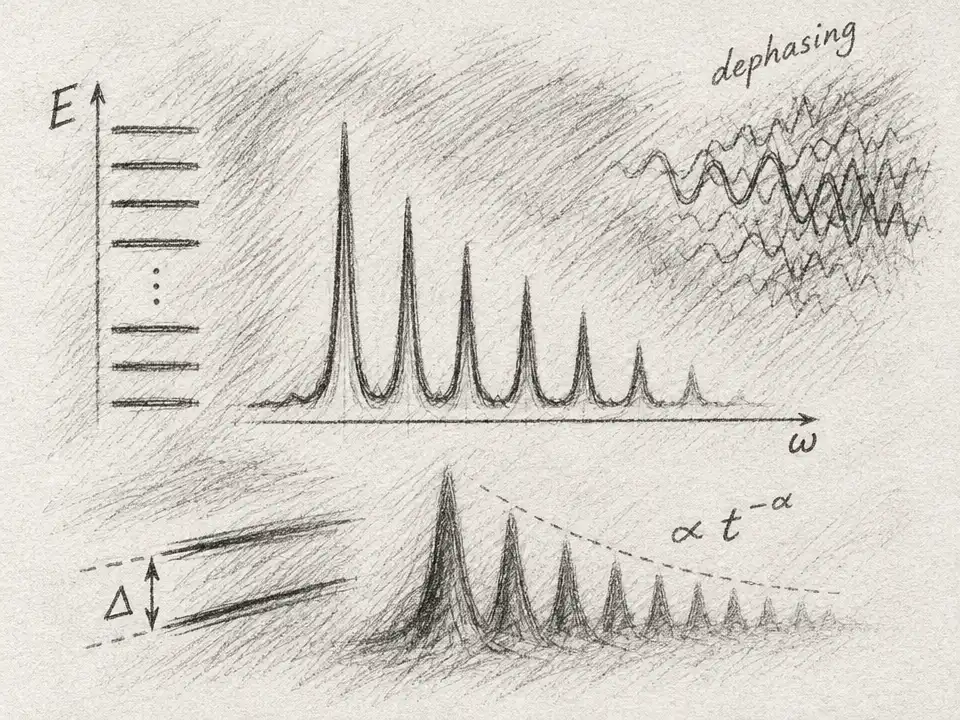
Then comes the surprise that limits the whole idea. A decaying atom is not instantly separated from its emitted light. At first, the atom and field remain coherent; the environment still has a short memory of their joint state. After that memory fades, emission becomes effectively irreversible: the photon has carried information away, and the atom’s decay proceeds in the familiar exponential way.
In the authors’ two-route calculation, the reversal can be certified only around this coherent onset of emission. For atoms radiating into free space, they estimate the relevant memory time to be about a femtosecond—roughly the time it takes light to travel a wavelength. Their model finds the witness holds up to about 1.2 times the memory time for the specific parameters they analyze, then fails as the decay becomes Markovian. The proposal does not rewind a photon that has long since escaped; it reaches only the brief interval when atom and field still share a coherent history.
Could more routes push the boundary? In principle, the paper argues, yes—but the price rises steeply. To imitate a reversal lasting a nanosecond of optical decay would require on the order of a million branches, along with an environment whose spectrum is strictly bounded. The probability of the needed post-selection would shrink exponentially with the number of environmental oscillations being undone. The authors also lay out clock-control schemes based on gravitational height, rotation and motion, but their estimated success probabilities underscore how far the proposal is from a practical device.
That rarity matters for thermodynamics. The selected trials might look as if they have undone a little decay, but the full set of trials does not run backward: on average, the expected decay still occurs and energy is still deposited in the cell’s walls. The unusual result exists only after the rare outcomes are separated from the rest. Nothing in the proposal lets an observer send a message into the past or make the second law fail for the whole ensemble.
The deeper point is about what makes a process seem irreversible. In this analysis, the decisive obstacle is not simply the entropy of an absorber. It is the breadth of the environment’s spectrum: a broad range of modes lets the environment record what happened and lose memory quickly. The very bandwidth that makes emission look one-way also limits how much of it the post-selected quantum clock can apparently undo.
For now, the cell, its walls and its emitted light must all remain coherent as one object—an extraordinary demand, and one the paper treats as a gedankenexperiment. Still, the proposed boundary is striking: the arrow of decay does not appear all at once. In the theory, it sharpens as the environment forgets. A quantum clock might briefly point backward, but only while the world around it still remembers how the story began.