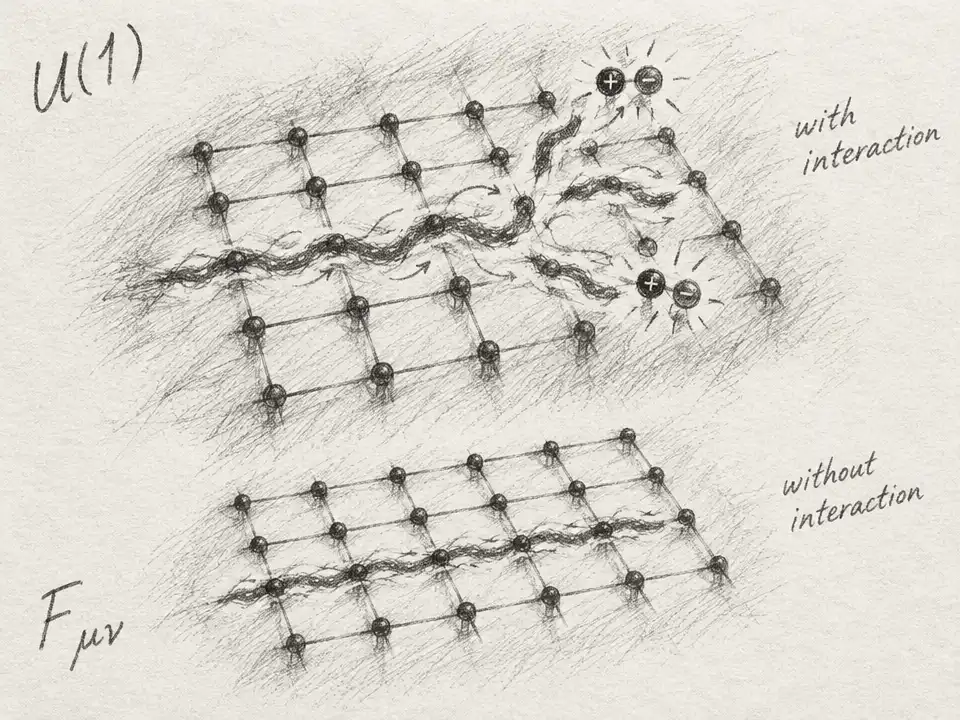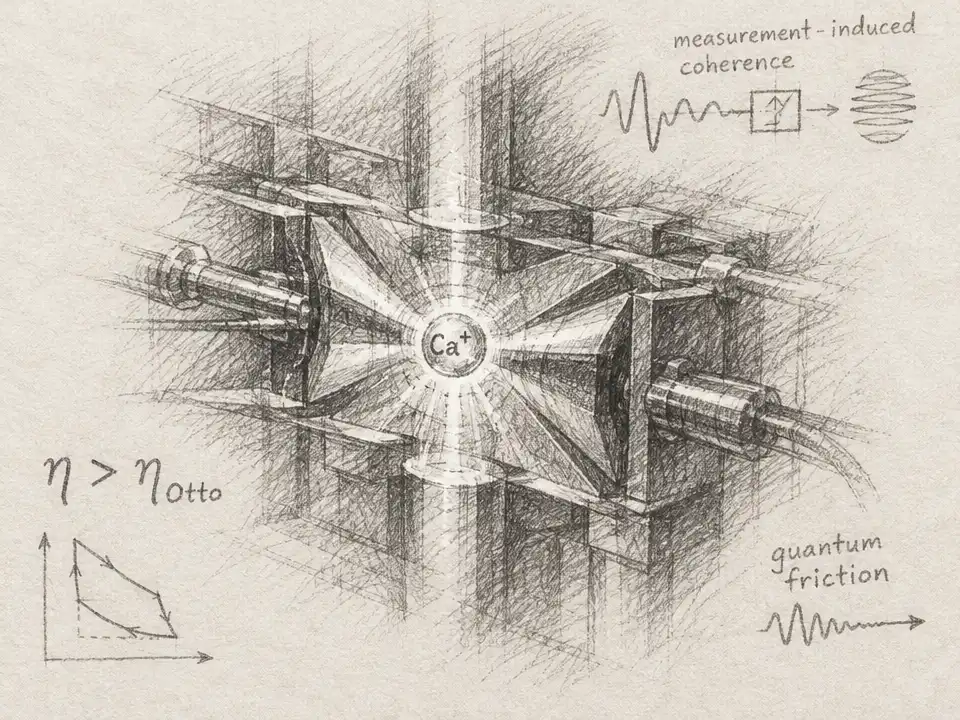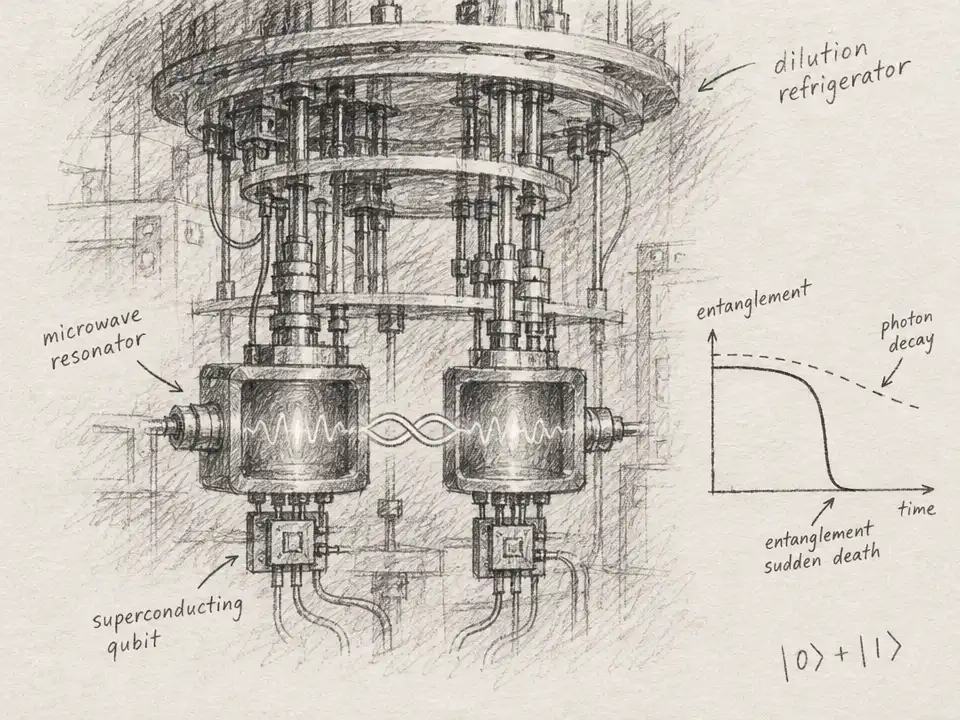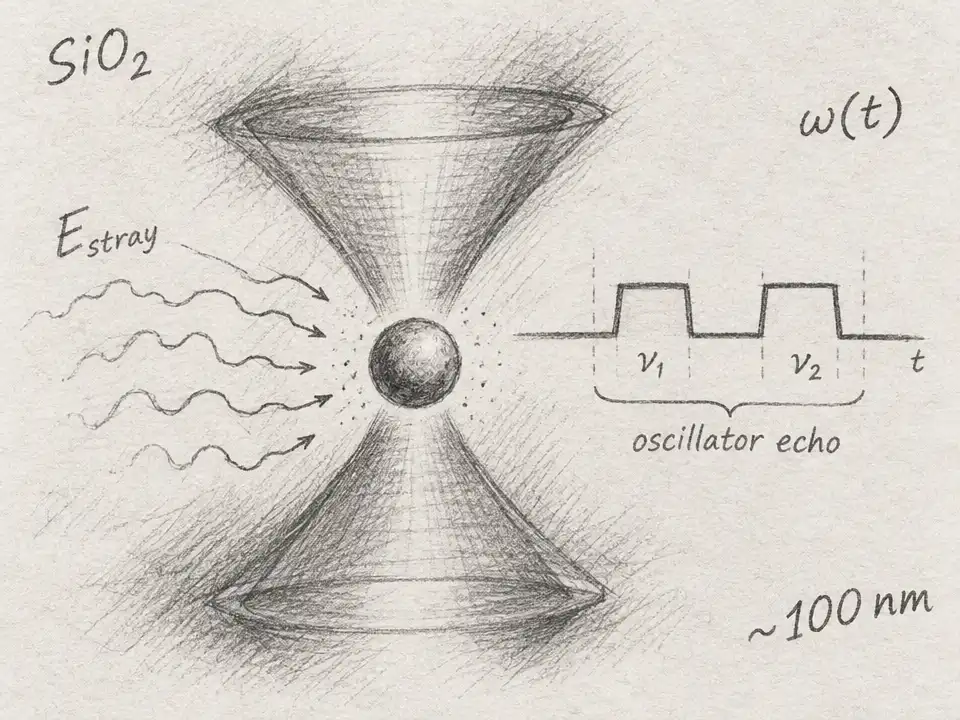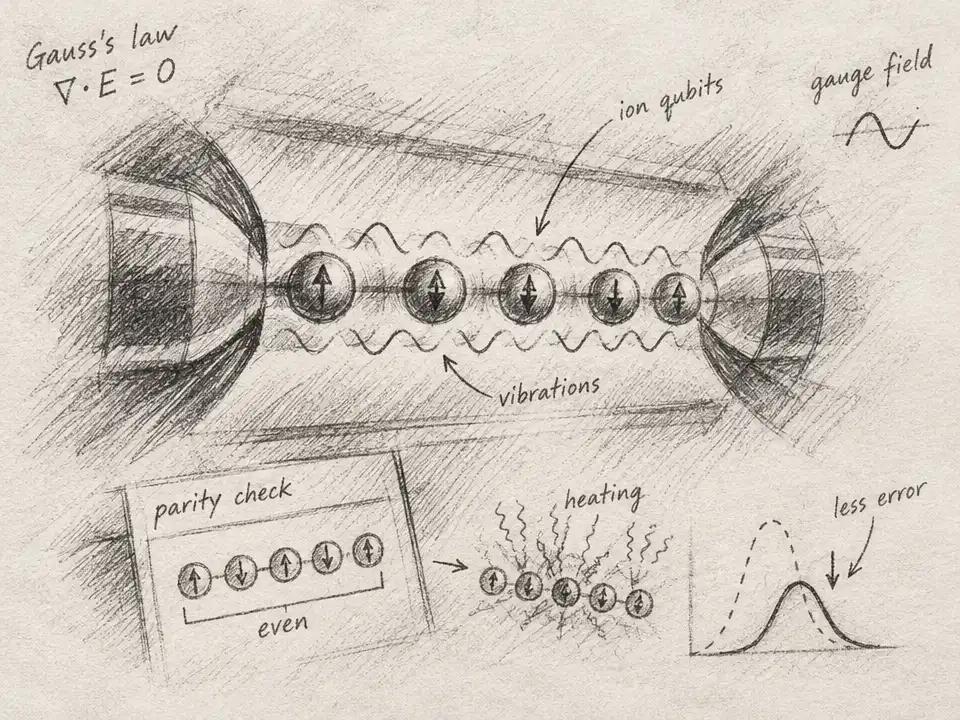
Imagine a single quantum of motion trying to cross a tiny loop. In a trapped-ion quantum simulation, that moving matter is stored in the ions’ vibrations, while the links between sites—the quantum fields that govern the motion—are encoded in the ions’ internal states. The setup can make the quantum’s route depend on the loop’s flux: interference may let it move, or nearly freeze it in place. But stray energy can add or remove a vibration quantum and scramble the result. Could the simulation tell which runs were disrupted without disturbing the physics it is meant to reveal?
A recent theoretical study takes a surprising candidate for the detector: the simulation’s own conservation law. In a lattice gauge theory, Gauss’s law ties the matter at each site to the field on the links around it. In the trapped-ion system, that local rule is represented by a parity—a distinction between even and odd numbers of vibration quanta—alongside the link states. The intended dynamics preserve this parity. Heating flips it. So a changed parity can act like a warning light: something happened that the ideal theory forbids.
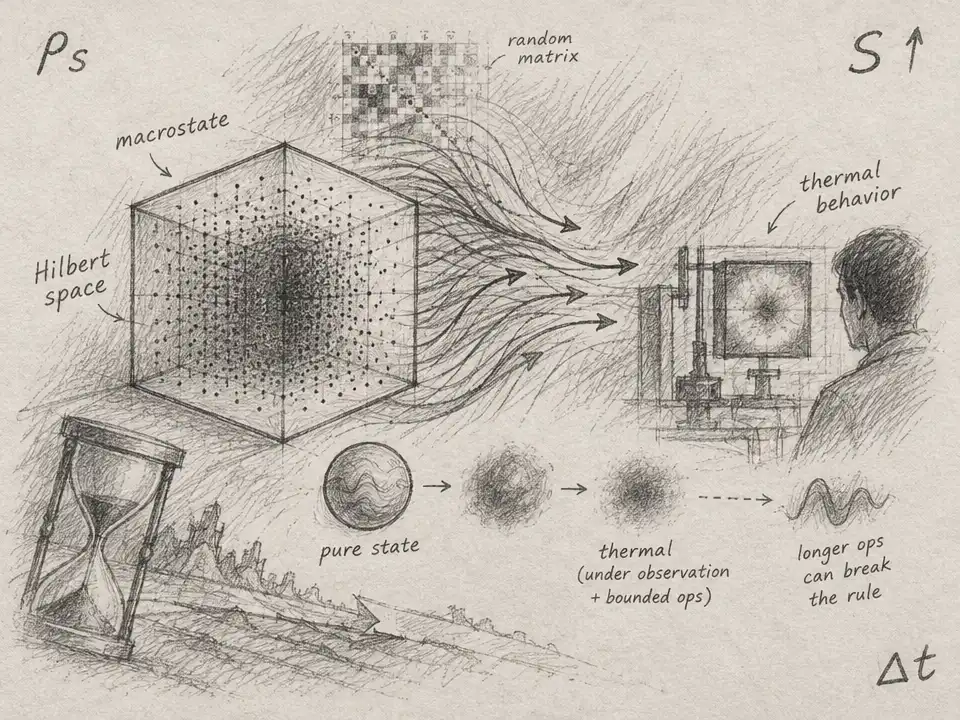
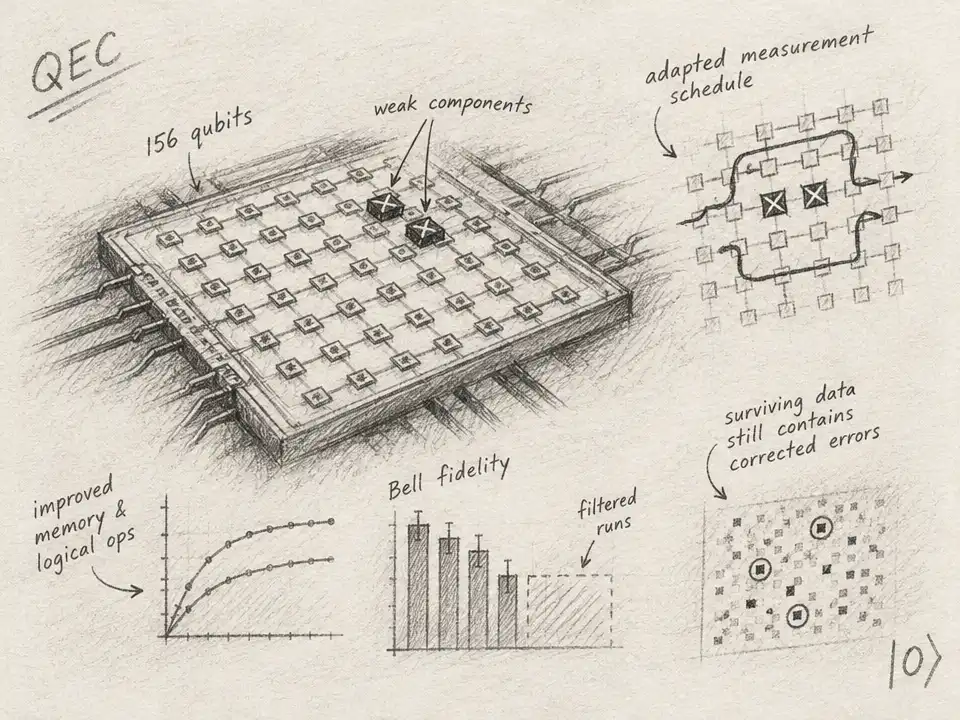
There is a catch. Checking the warning light can identify suspicious runs, but throwing those runs away does not automatically restore the right answer. For ordinary errors that simply apply reversible flips, selecting runs with no detected error can leave the survivors evolving as intended. Bosonic heating is trickier: it adds or removes quanta, and the chance of avoiding a jump can depend on the state itself. Even a run with no detected event may have been subtly reshaped by the requirement that no event occurred. Post-selection—the practice of keeping only runs that pass a check—can therefore introduce its own bias.
The paper asks when that bias disappears. Its key clue is the total number of vibration quanta. The ideal gauge-theory dynamics conserve that number. If every mode has the same total heating-and-cooling rate, then within a fixed-number sector every state has the same overall chance of surviving without a jump. Rejecting runs in which parity changed reduces the number of accepted runs, but does not favor one allowed motion over another. In that special limit, the normalized state of the survivors matches the heating-free evolution exactly.
That is a precise result, not a claim that heating vanishes. The filter pays for its cleaner sample by discarding runs. In the model, the probability of a run with no heating event falls with the observation time, the number of modes, and the number of vibration quanta. The authors checked the argument using exact numerical solutions of the equations describing the noisy quantum system. They tested a two-link loop and larger arrangements, including a chain and a triangle. Under the idealized conditions, the surviving state tracked the heating-free reference even when the unfiltered simulation was badly distorted.
But a perfect detector would need to watch continuously, and the proposed measurements happen at intervals—or only at the end. That opens a loophole. If heating adds a quantum and cooling removes one from the same mode before the next check, the parity flips twice and returns to its starting value. The run passes, although the system was disturbed in between. The authors derive how this hidden traffic biases the selected result: the bias grows with the time between checks. More frequent checks reduce the loophole, but require a way to read the gauge-law signal during the simulation without collapsing the link states.
How much difference might a check make under the reported device conditions? The study models heating rates of 5 and 17 quanta per second, a mean initial thermal occupation of 0.1, and a 2.32 ms observation window. In that calculation, the predicted departure of a matter-population measurement from its gauge-invariant target is 0.146 before filtering and 0.011 after a single final check. The modeled yield—the fraction of runs retained—is 0.80. These are numerical results, not a new hardware demonstration: the final measurement would require number-resolving readout of a vibration mode, which the device had not demonstrated.
The remaining error is not a mysterious failure of the idea. The two modes heat at different rates, so a surviving run is slightly more likely to have spent time in the slower-heating mode. That unequal-rate tilt spoils the exact cancellation that works when all modes share the same rate. Finite-time checks also miss pairs of events that cancel their parity signal. The paper estimates that checks every 0.1 milliseconds could reduce the modeled population departure further, to 0.0018, but that protocol would require a mid-run, nondemolition measurement using a probe ion. The ingredients have been demonstrated separately, the authors note, but not combined in this setup.
The puzzle’s answer is therefore conditional: a conservation law can do more than describe the intended physics. Because heating violates its parity signal, the law can also help identify damaged runs. And when the heating rates are uniform and the vibration number is definite, the act of selecting survivors need not distort their dynamics at all. Real devices miss those ideal conditions, and the proposed checks still face practical limits. Yet the study offers a useful way to turn a system’s own rules into a diagnostic—and a concrete accounting of what that diagnostic can and cannot repair.