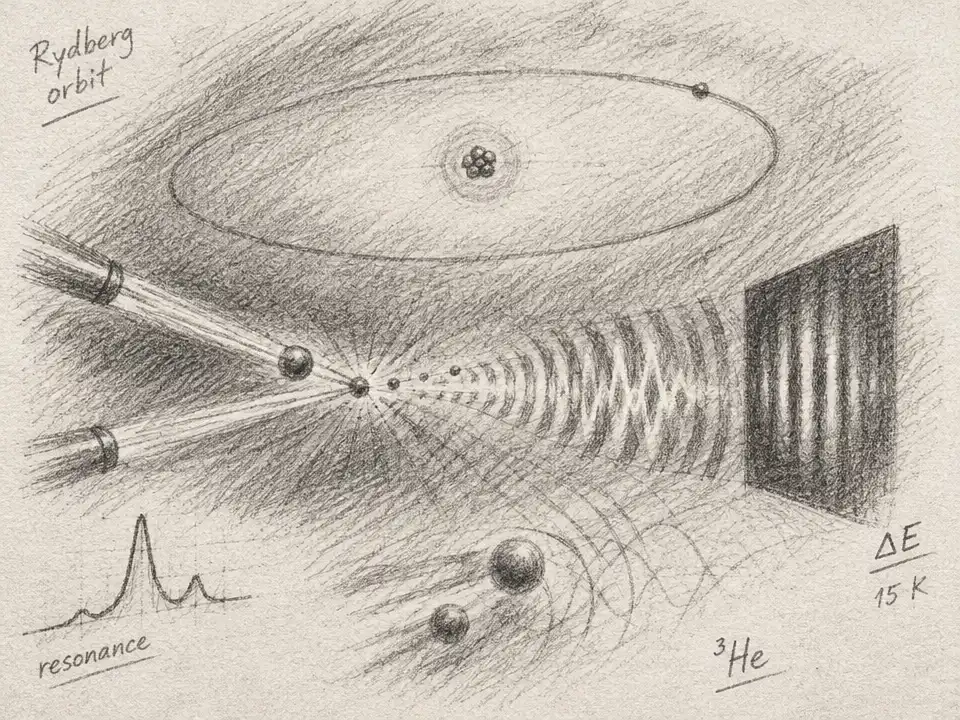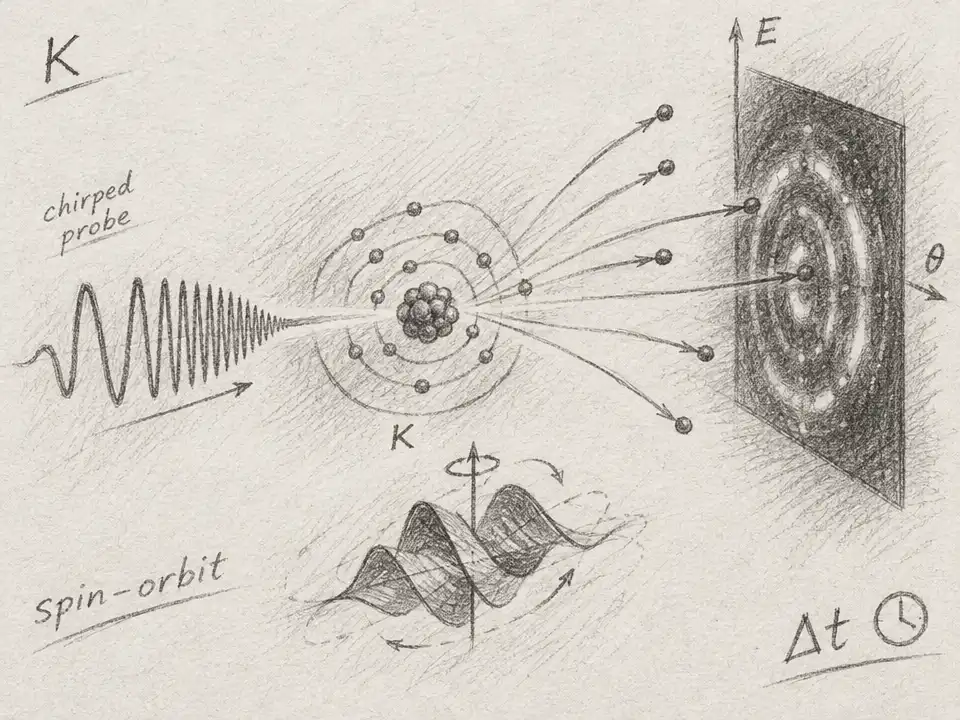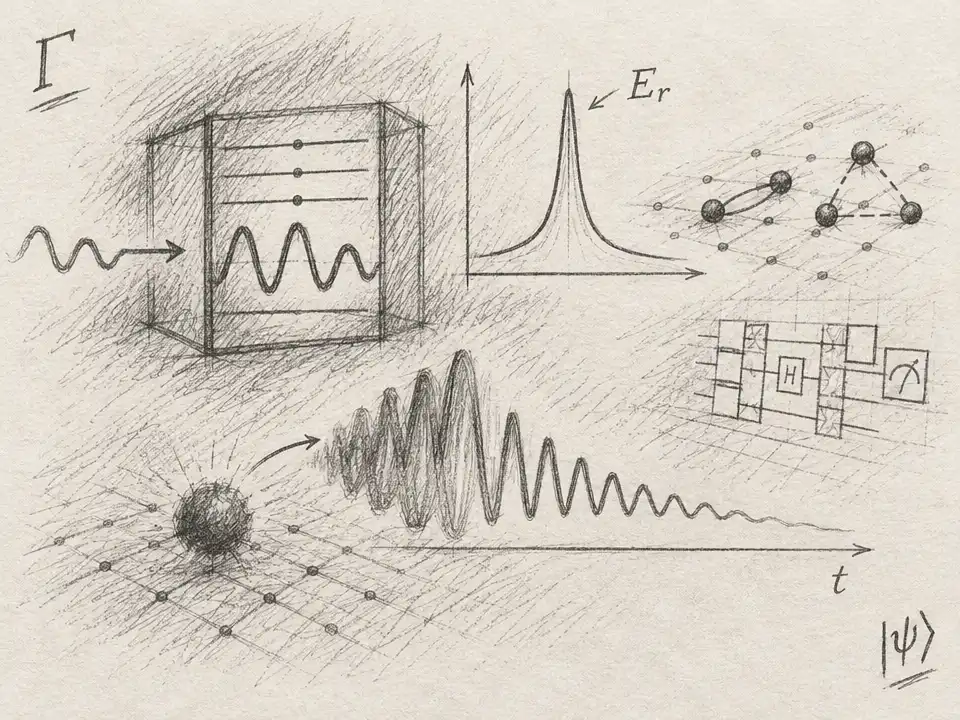
A resonance is a visitor that never quite settles in. In nuclear, atomic, and other quantum systems, it can briefly shape how particles scatter before fading away. Its energy and its rate of decay are encoded together in a mathematical signature called a pole. Finding that signature matters—but the usual ways of looking for it can turn a straightforward calculation into a delicate one.
The difficulty starts when researchers put a system on a computer. An open space, where particles can travel away indefinitely, must be represented by a finite grid or box. That box makes the possible energies discrete. Worse, a wave that reaches the edge can bounce back and interfere with the calculation. The resonance is hidden among these box effects and the broader, non-resonant background.
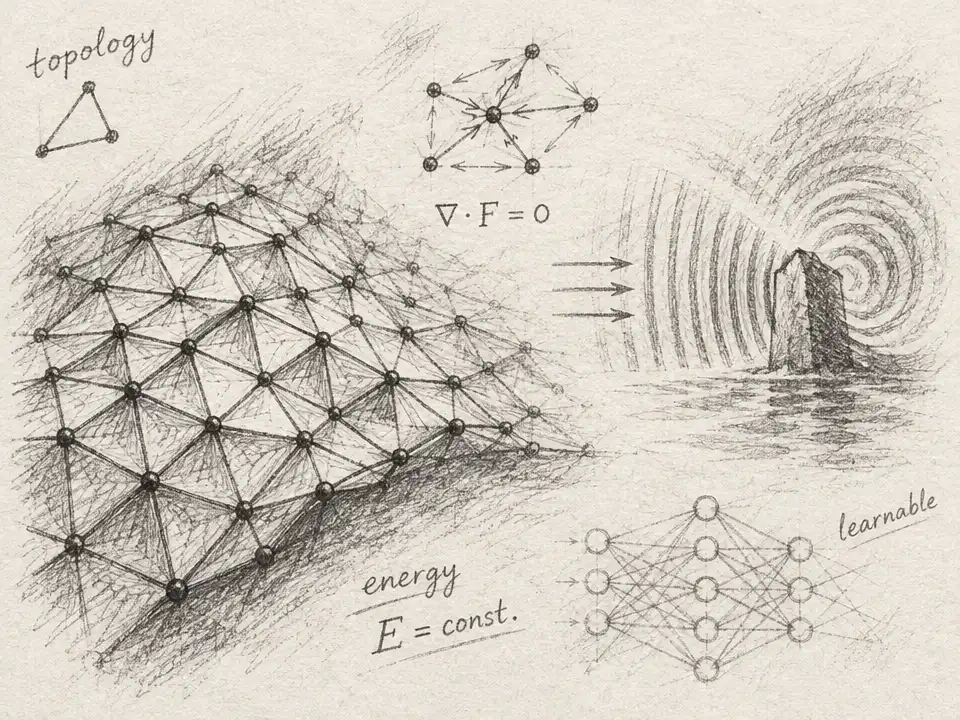
One established workaround adds an imaginary absorbing layer near the boundary, designed to swallow outgoing waves. It can work well, but it changes the Hamiltonian—the rulebook governing the system—from Hermitian to non-Hermitian. That is a useful mathematical tool, but it can be awkward to implement on a quantum computer, whose natural operations are unitary: they preserve the ordinary rules of quantum time evolution.
A team led by Cong-Wu Wang, Lukas Bovermann, Evgeny Epelbaum, Hermann Krebs, Dean Lee, Yu-Gang Ma, and Avik Sarkar proposes a different move: leave the rulebook alone and prepare a better starting state. Their persistent state method begins with a compact trial state, confined to a small region inside the larger computational box. The researchers then optimize that state so its evolution carries a clearer imprint of one resonance.
The signal they track is the survival amplitude: the complex-valued measure of how much the evolving system still overlaps with the state it started in. A resonance pole contributes a distinctive exponential pattern to this signal. But the non-resonant background can muddy the pattern. The team searches for a starting state whose signal looks as close as possible to a single exponential over a selected stretch of time. In that interval, the inferred energy settles into a plateau; the plateau reveals the resonance’s energy and width.
“Persistent” does not mean the state has become stable, or that the resonance stops decaying. The method isolates the resonance’s signature during a useful window. That distinction matters: quantum decay is not exactly exponential at every moment. At very late times, deviations from exponential decay are expected. The aim is to find an intermediate period when one resonance dominates strongly enough to read its properties.
There is another clock to watch: the box itself. The fitting window has to end before a wave can reach the boundary and return. The team estimates how quickly information can travel across each lattice, then chooses a window short enough to keep returning waves from spoiling the signal. In a one-dimensional short-range model, they found that boundary effects become exponentially smaller as the box grows, provided the window stays ahead of the fastest round trip.
The numerical tests span more than a simple two-particle setup. In one one-dimensional two-body model, particles interact through both short-range forces and an unscreened Coulomb-like tail. The method’s extracted resonance pole agreed with a reference calculation to a relative accuracy of about 3.0 × 10⁻¹¹. In a three-dimensional two-body model, the relative error was about 2.0 × 10⁻⁶. A one-dimensional three-body calculation reached about 8.3 × 10⁻⁶. These are computational benchmarks, not measurements of real particles, but they test whether the approach survives changes in interaction range, dimensionality, and number of particles.
A separate short-range benchmark offers a striking comparison. As the linear size of the lattice increased, the persistent-state method’s error fell approximately exponentially over the tested range, reaching about 1.4 × 10⁻³³ at size 150. In that model, an optimized absorbing-boundary calculation converged more slowly, with a stretched-exponential trend. That does not establish that the new method will outperform every alternative in every system: the result concerns a specific, carefully controlled benchmark, and the researchers show the broader comparisons separately.
The approach also has a plausible route to quantum hardware. A single auxiliary qubit can help measure the real and imaginary parts of the survival amplitude. In an ideal, noiseless circuit simulation, the researchers combined a filtering technique called the Rodeo algorithm with a variational circuit to refine the starting state. With ten filtering cycles, the two components of the extracted energy agreed with a reference at about the 10−7 level. The paper does not report a run on quantum hardware; exact statevectors and classical optimization were used to emulate and refine the circuit.
There are practical limits. Broad resonances can be harder to isolate because an optimizer may settle on a long-lived box state instead of the desired decaying resonance. For a broad-resonance test, the team added a guide based on a coarse estimate—not the exact answer—to keep the optimization on the right track. And while the paper outlines how the idea might extend to scattering between two clusters, that extension remains future work.
The central shift is simple to state and challenging to execute: rather than modify the physics to make a resonance easier to compute, shape the initial state so the resonance is easier to hear. If the method proves useful beyond these benchmarks, it could offer researchers a direct way to extract unstable states from numerical models while preserving ordinary quantum evolution—a potentially valuable fit for systems whose interactions are known computationally, but resist analytic shortcuts.