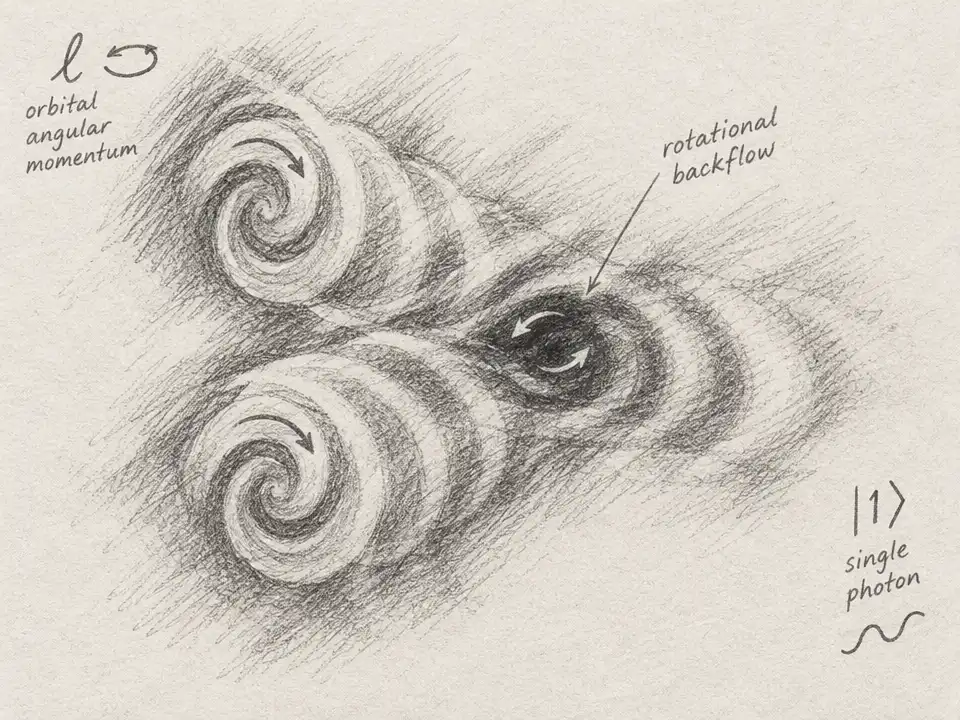
Imagine setting two tiny whirlpools spinning clockwise, then watching their combined current turn counterclockwise in a few dark pockets between them. Light can do something much like that. In a recent experiment, researchers prepared individual photons in a carefully arranged combination of two swirling light patterns—and found spots where the combined flow ran opposite to the direction carried by either pattern alone.
The effect is called azimuthal backflow. “Azimuthal” means around a circle; here, it describes a photon’s local sideways momentum as it travels through a beam. The result sounds like a photon suddenly reversing its orbit. That would be the wrong picture. The reversal appears in particular regions of an interference pattern, not as a claim that the photon’s overall angular momentum flips or that a tiny bead traces a measurable track backward.
To see why, start with a beam whose wavefront twists like a spiral staircase. Such a beam carries orbital angular momentum, a form of angular momentum associated with the shape of its wave. Researchers can make light with a clockwise or counterclockwise twist. In the experiment, the team combined two patterns that each carried angular momentum in the same direction. Alone, neither had a local flow going the other way.
But waves do not simply add their directions. Where the two patterns overlap, their peaks and troughs interfere. In some places, the waves nearly cancel, leaving very little light. The phase—the wave’s shifting rhythm—can change especially rapidly around these dark fringes. That sharp change can make the local direction of the combined wave point opposite to the direction of both ingredients. It is a small, localized reversal born from the pattern’s geometry, not a reversal of the ingredients’ overall twist.
A 2023 experiment had already shown this counterintuitive effect using a classical laser beam. The researchers shaped the light with a programmable spatial light modulator, then sent it through a microlens array. By measuring tiny shifts in the resulting spots, they mapped the local direction of the wave. In the dark fringes, the measured azimuthal flow pointed against the direction of both component beams. That was an important demonstration—but it used a bright classical beam, not a source that delivered photons one at a time.
The later team changed both the light source and the measurement. They produced pairs of photons by shining a laser into a nonlinear crystal. Detecting one photon served as a herald: it signaled that its partner was available for the experiment. The researchers shaped that partner into a superposition of two swirling patterns, each carrying negative orbital angular momentum.
Then came the delicate part: measuring local momentum without simply overwhelming the fragile state. The team used a technique called weak measurement. A thin piece of calcite coupled the photon’s momentum slightly to its polarization, a property of light that can be pictured as the direction of its electric field. Afterward, the researchers measured the polarization and recorded where photons landed on a camera. Repeating the process built up counts across the image; those counts let the team infer the local momentum direction pixel by pixel.
With one pair of patterns, labeled minus one and minus three, the researchers found regions where the reconstructed azimuthal momentum was positive even though both ingredients carried negative angular momentum. The measured map broadly matched the predicted pattern. The effect showed up in low-light regions, exactly where destructive interference was strongest. Those sparse regions were also the hardest to measure: with few detected photons, environmental noise had more influence, and the observed boundaries did not perfectly match the theory.
The researchers could reshape the backflow regions by changing the relative strength of the two patterns, their distance from the source, or their angular-momentum labels. In their tests, changing the labels changed how many backflow regions appeared; adjusting the distance altered their size and position. This controllability is part of what makes the result interesting. The dark patches are not merely an oddity to spot once—they can be moved and reshaped by tuning the light.
There is an important distinction between this result and the best-known version of quantum backflow. In the textbook puzzle, a particle with momentum directed one way can show probability flow the other way. The photon experiment measured a related, rotational optical effect in a single-photon state. The authors describe it as a step toward studying backflow in quantum systems—not as a demonstration that every obstacle to observing matter-particle backflow has been solved.
Still, the experiment reveals how much information can hide in a dim patch of an interference pattern. Where the light nearly vanishes, its local direction can become unusually revealing. Learning to map those fine-grained currents could help researchers explore structured light, including possible uses in optical trapping, imaging, or interactions with molecules. For now, the clearest achievement is more basic: a measurement precise enough to catch light locally flowing against the twist of the waves that made it.