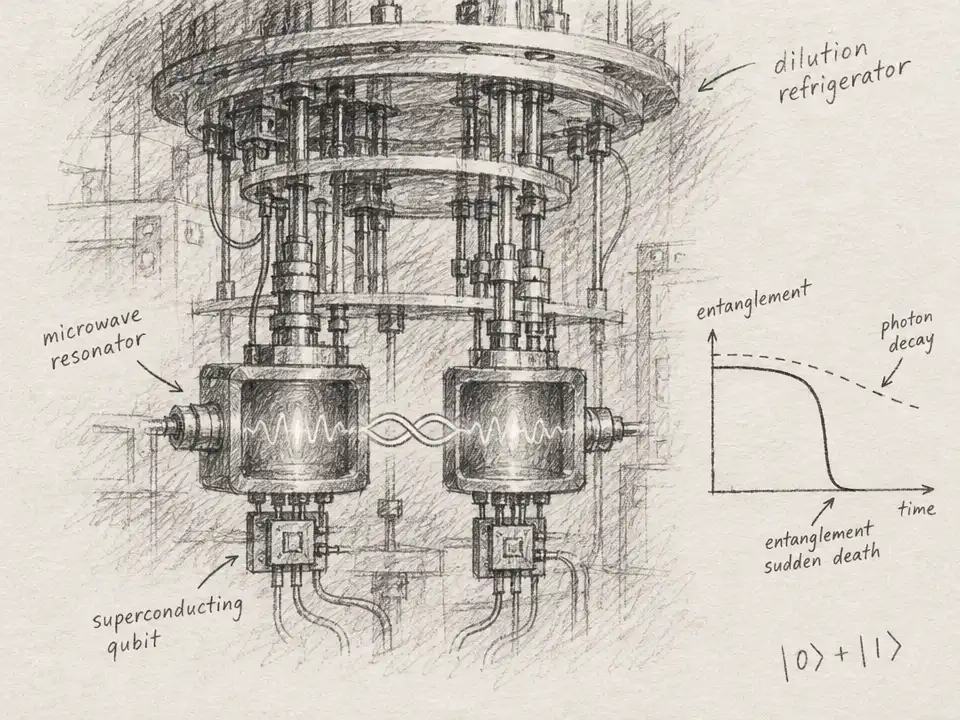
Below 20 mK, inside a dilution refrigerator, two microwave resonators held a peculiar kind of pair. Each resonator could contain zero or one photon, and the two modes were prepared in an entangled state: what happened to one was linked, in a specifically quantum way, to the other. Then the researchers let the resonators leak. The photons’ energy ebbed away gradually. But the shared quantum connection could disappear all at once.
That mismatch is the puzzle at the heart of a recent experiment. A single quantum system’s excitation can fade smoothly under ordinary loss. Entanglement—the property that makes a pair behave as a joint quantum system rather than two independent ones—can follow a different clock. Under certain starting conditions, it reaches zero after a finite wait, even while the individual modes are still decaying. Physicists call this entanglement sudden death. “Sudden” describes the mathematical measure of entanglement hitting zero, not a burst of energy or a photon abruptly vanishing.
The idea has been studied for years, and related effects have been explored using deliberately engineered noise and other experimental systems. What had not been directly demonstrated, the researchers write, was this abrupt loss driven by natural dissipation of the kind that occurs when quantum systems irreversibly release energy into their surroundings. Their test bed was a superconducting circuit: a compact way to prepare, store, and interrogate microwave photons while controlling how long they are left alone.
The apparatus contained five frequency-tunable superconducting qubits, each connected to a readout resonator, plus a bus resonator that helped link the circuit’s components. Two qubits served as helpers, or ancillas. The team first entangled those qubits, then used carefully timed couplings to transfer the quantum state into two resonators. There, the microwave field modes served as the pair under investigation. The prepared maximally entangled qubit state had a measured fidelity of 98.5%.
Next came the quiet part. The researchers switched off the drives that coupled the qubits to the resonators and let the resonators undergo their ordinary photon loss. In the paper’s model, each mode interacts with a zero-temperature Markovian reservoir: a broad continuum of electromagnetic modes that carries energy away without returning it. “Natural” here does not mean uncontrolled or outside the laboratory. The circuit was carefully built and measured; the point is that the team studied the resonators’ irreversible leakage rather than adding a separate, artificial noise sequence to force the effect.
To see what happened during the wait, the team mapped the resonator states back onto the superconducting qubits and performed quantum-state tomography. That measurement reconstructs the joint state from many repeated runs, rather than taking a snapshot of a single pair. By changing the waiting time and the initial state, the researchers could track a quantity called concurrence, which measures entanglement for this kind of two-part system.
The results showed two distinct patterns. For some initial states, concurrence declined gradually, following the slow loss of excitation. For others, it fell to zero at a finite time. The stronger the initial entanglement within the range they tested, the earlier the drop occurred. Measurements at 100, 200, 300, and 400 ns traced the changing joint state; the observed behavior agreed with the researchers’ theoretical calculations. In the state reconstruction, the sudden loss appeared when a measure of the pair’s shared quantum coherence no longer outweighed the competing populations of the possible photon states.
That balance is easy to miss if attention stays fixed on each resonator separately. Neither mode needs to be completely empty for the pair to stop being entangled. The result is not that every trace of relationship disappears, or that one photon sends a message to the other. Rather, the particular quantum property that makes the two modes inseparable can be lost while energy continues to leak away. The experiment makes that hidden distinction visible by measuring the pair as a pair.
The finding matters because entanglement is a resource for quantum technologies, including communication and computation. Knowing how long a quantum state remains locally coherent is not necessarily enough; a shared resource can fail on a different schedule. The experiment does not demonstrate a new communication device or show that all quantum links abruptly fail. It establishes the effect in a controlled superconducting circuit, for a particular family of states and a specific model of dissipation. The authors present the setup as a way to investigate more complex entangled photonic states in natural reservoirs.
Look closely at the scale of the event: not a machine breaking, but a relationship between two tiny microwave fields crossing a threshold. The resonators keep leaking at a measured pace. The entanglement measure, however, reaches a boundary and goes to zero. By following both quantities together, the experiment reveals a hidden feature of quantum decay: the fate of a connection can be sharper—and more abrupt—than the fading of the things it connects.