Imagine watching three particles move through a row of seven sites. You do not track each particle. You do not ask whether they are bosons or fermions. You simply keep measuring how many occupy one chosen site. In a new theoretical study, that modest stream of information does something unexpected: it can steer the particles into distinct patterns of exchange symmetry, including a third kind beyond the familiar bosonic and fermionic cases.
The idea turns a standard experimental nuisance into a tool. A measurement does not just reveal what a quantum system is doing; it can also change what the system is doing. Salvatore Di Lorenzo and Klaus Mølmer investigate whether a weak, continuous measurement of site occupancy can gradually select properties that the detector never directly measures. Their answer, based on numerical simulations, is yes: monitoring one site can steer the particles’ joint state into symmetry sectors.
To see why that is surprising, consider what exchange symmetry means. In quantum physics, swapping two identical bosons leaves their state unchanged; swapping two identical fermions changes its sign. These rules shape how particles can share space and energy. The researchers’ model starts instead with particles that are formally distinguishable, but whose labels are invisible to the probe. They move alike, and the detector counts their combined presence without identifying which particle it sees.
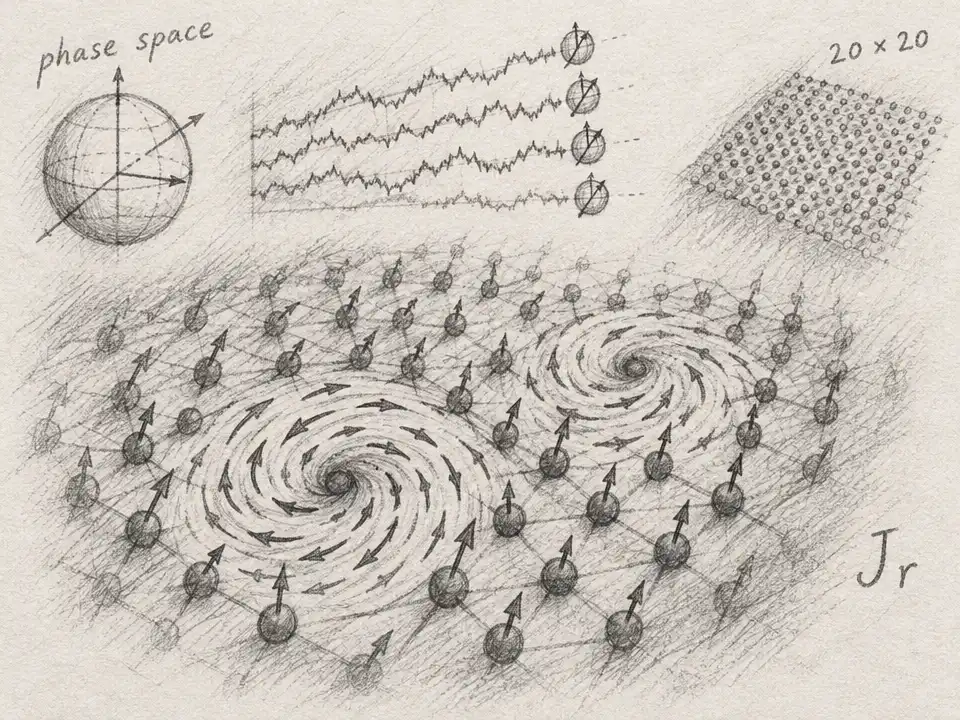
The particles tunnel between neighboring sites of a one-dimensional lattice. A weak probe continuously monitors the population of a chosen site, producing a noisy record rather than a single sharp snapshot. The researchers simulate how the state changes along with that record. Because the probe cannot tell the particles apart, it can entangle their motion: information about the shared occupancy links their possible paths, even though the particles do not need to collide.
There is a useful logic beneath the noise. The particles’ exchange symmetry is not what the detector measures, but it is compatible with both the particles’ motion and the occupancy measurement. As the record accumulates, the state can settle into a sector with a definite exchange symmetry. It is a little like learning something about a hidden arrangement by repeatedly checking a clue that depends on the arrangement but does not reveal it outright.
With two particles, the simulations show that the probe can steer the system toward bosonic or fermionic symmetry under suitable conditions. The outcome depends on which site is monitored and on which parts of the wave functions can occupy it. For example, monitoring the middle site of a symmetric seven-site chain can reveal parity—the even-or-odd structure of a particle’s wave function—without revealing the exchange symmetry in every case. Monitoring a different site can give the probe enough information to select a bosonic or fermionic sector.
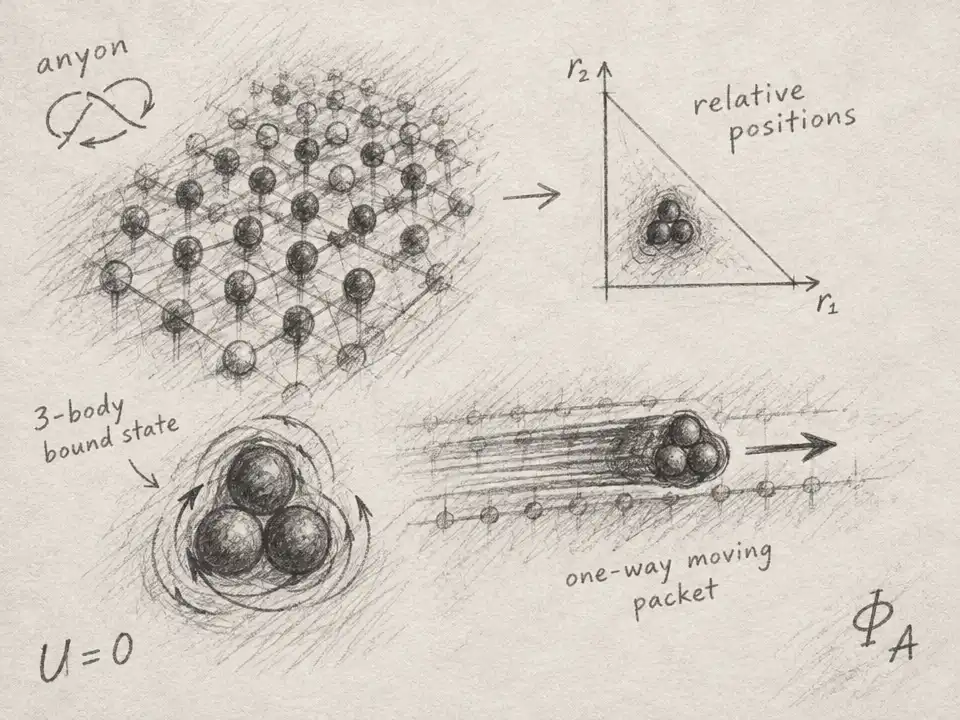
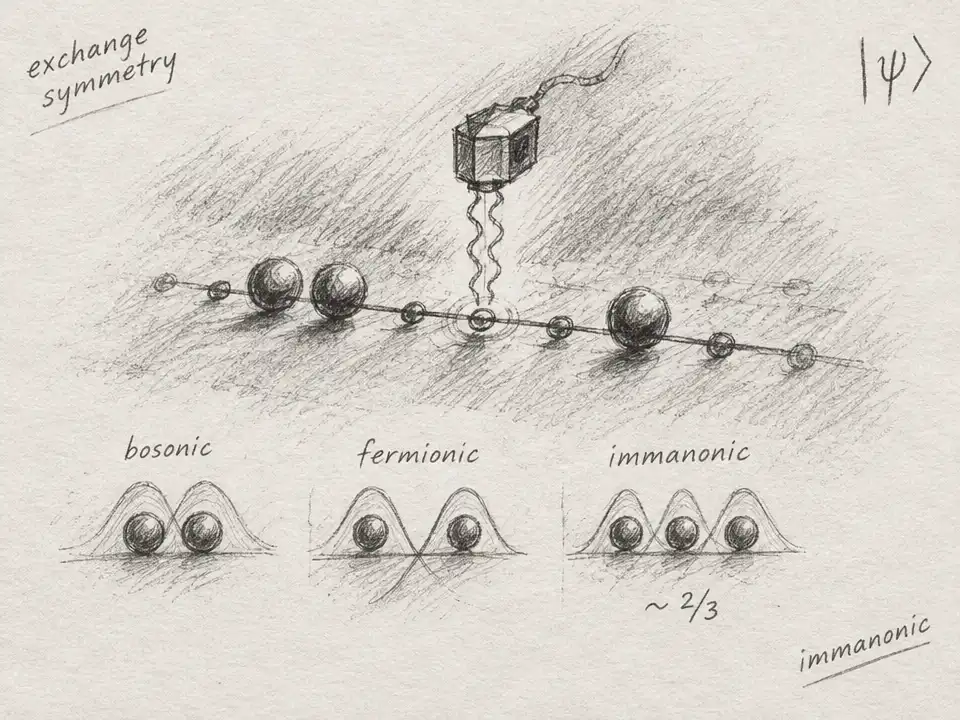
Three particles open a more surprising door. The mathematics of quantum states allows a third type of permutation symmetry, one that is neither fully symmetric like a boson’s nor fully antisymmetric like a fermion’s. The authors call its occupants immanons, following the mathematical name for the pattern of amplitudes involved. In this sector, particles obey a partial version of the Pauli exclusion principle: up to two can occupy the same single-particle state, but three cannot.
The researchers test this possibility in a specific simulated setup. They start with three particles in different energy states of a seven-site lattice and continuously monitor the central site. Across simulated measurement trajectories, the state settles into the bosonic sector about one-sixth of the time, the fermionic sector about one-sixth, and the intermediate immanonic sector about two-thirds. Those proportions match the initial state’s weights in the three sectors. The most common outcome is therefore not an exotic new particle, but a familiar quantum system sorted by measurement into a less familiar symmetry pattern.
The partial exclusion rule provides another check. In the fermionic sector, the occupation of any single-particle mode cannot exceed one. In the bosonic sector, all three may occupy the same mode. In the intermediate sector, the allowed maximum is two. The simulations test this not only through the monitored site’s population but also through a property of the particles’ reduced density matrix, which tracks how much of the state can occupy one mode. The results respect the different limits in each sector.
This is a proposed route, not a report of particles already observed behaving this way in a laboratory. The paper models continuous measurements and numerically follows their consequences. It also discusses possible setups for two particles, including atoms whose internal states are hidden from the probe, or atoms in parallel lattices monitored together. Experimentalists would still need to build and control a suitable system, then distinguish the predicted symmetry sectors from other effects.
The broader point is precise but intriguing: the familiar categories of bosons and fermions need not be the only symmetry patterns that a small quantum system can temporarily occupy. The study does not claim that nature contains a new fundamental species of particle. Instead, it shows how a carefully chosen measurement might make an unusual mathematical sector accessible in a finite system. Sometimes the way to reveal a hidden property is not to look for it directly, but to watch something simpler—and let the quantum system sort itself out.