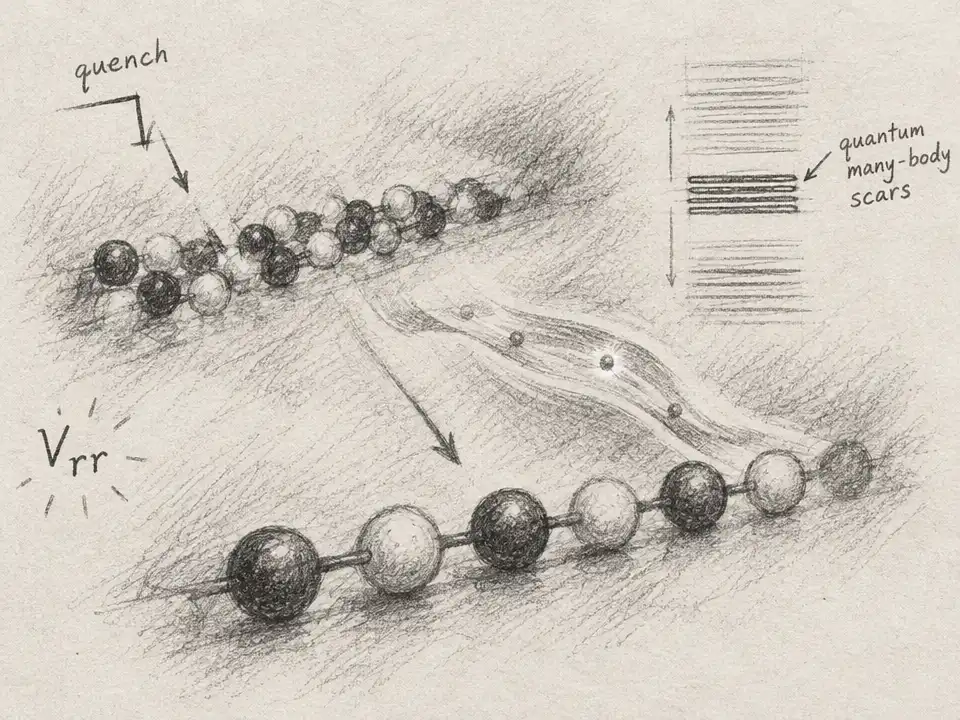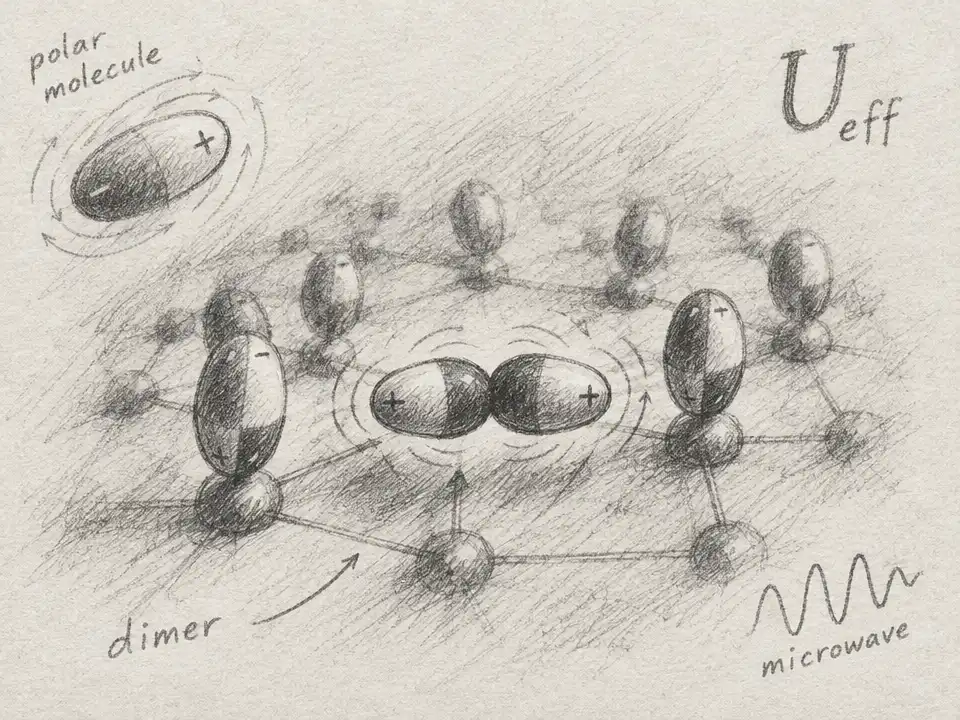
Release three particles into a lattice and the expected picture is a cloud spreading outward: each particle wanders, and the group comes apart. But in calculations of a one-dimensional quantum lattice, some three-particle states do something stranger. They stay clustered while moving in one direction at a speed comparable to that of a lone particle. The particles bind without the usual on-site attraction or repulsion that would act like glue.
The surprise is not that the system has no interactions of any kind. Instead, the researchers set the conventional on-site interaction to zero and focus on how particles hop. In their model, a hop acquires a phase that depends on how many particles occupy the destination site. That occupancy-dependent phase encodes anyon-like exchange statistics: the particles’ quantum motion remembers the order in which they pass one another.
Here, “anyon-like” describes a carefully engineered lattice model, not free-space particles braiding around each other. The model can be represented using bosons whose hopping carries a density-dependent phase. That makes the unusual statistics part of the route each particle takes across the lattice. The paper’s central move is to turn those routes into a map researchers can inspect.
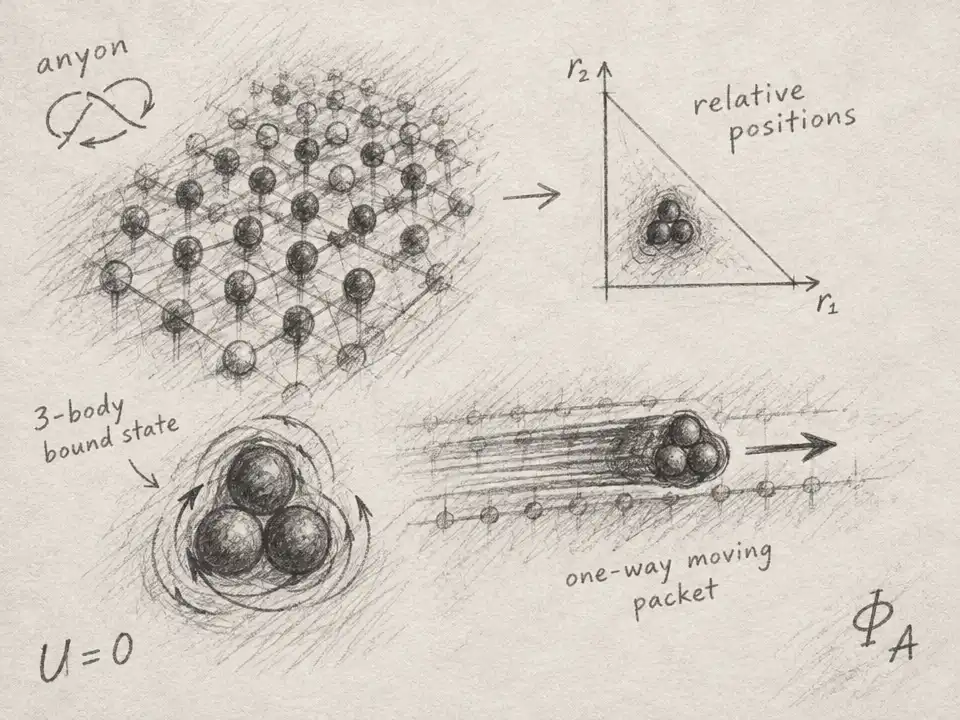
For three particles moving along a line, the team tracks two gaps: the distance between the left and middle particles, and the distance between the middle and right ones. Each possible pair of gaps becomes a point on a triangular map. A point near the map’s corner represents particles packed close together; points farther away represent wider separations. Once the researchers hold the group’s overall momentum fixed, the complicated three-particle problem becomes mathematically equivalent to one effective particle moving across this map.
This is a map of possible configurations, not a second physical lattice. Still, it makes the mechanism visible. The effective particle hops between neighboring points, and the anyonic phases act like a patterned magnetic flux through parts of the map. A cluster corresponds to the effective particle staying near the corner, where the original particles remain close. In this new view, binding is a problem of how motion through configuration space is organized.
The calculations find genuine three-particle bound states outside the energy ranges available to scattering states, where the particles can separate. They appear for statistical phases such as π/4 and π/2 when the ordinary on-site interaction is zero. At the bosonic and pseudo-fermionic endpoints, θ = 0 and θ = π, respectively, the calculations do not find these three-body bound states under the same zero-interaction conditions.
Why would a cluster be energetically favored without an on-site force pulling it together? The map offers a clue. A separated group can spread through more directions in configuration space, lowering its kinetic energy. A tightly grouped triplet has fewer ways to spread. But when its particles stay close, their hopping is enhanced by bosonic factors, while the density-dependent phases shift how the possible hops interfere. At certain overall momenta, these effects let the clustered state reach lower energy than the available scattering states. The binding comes from the structure of the motion itself.
That explanation also points toward a way to look for the effect in an experiment. The researchers simulate starting with three particles prepared in the lowest-energy state of three neighboring lattice sites. Then the confining region is suddenly opened, letting the particles expand along a larger lattice. Rather than trying to photograph a bound state directly, researchers can track the evolving density and measure whether pairs and triplets continue to be found near one another.
In the simulations, the difference shows up in both position and direction. For the phases that support three-body binding, part of the density travels together without spreading much, while the rest disperses. With positive statistical phase, the bound part moves left; reversing the sign reverses its direction. The calculated triplet travels at a speed comparable to that of a single particle, rather than behaving like a heavy clump. For phases where the calculations predict no three-body bound state, the cloud spreads more symmetrically.
The researchers also calculate three-particle correlations: a way to ask whether three particles are likely to be detected close together at once. Their simulated expansion produces a concentrated correlation signal that travels with the cluster. The authors argue that fluorescence images from a quantum-gas microscope could measure these densities and correlations. They also test a modified model that leaves out some processes restricted by existing experimental drive schemes, and find that the predicted signatures survive.
There is an important limit: this paper predicts the three-particle effect and simulates a possible measurement; it does not report an experimental observation of a bound triplet. The distinction matters especially for states whose energies fall inside a scattering continuum. The paper finds exact two-particle bound states in the continuum, where a phase-and-momentum condition shuts off their coupling to separating states. Three-particle states inside the continuum are different: the analysis finds long-lived quasi-bound resonances, not exact bound states in an infinite system. On a finite lattice, however, they can remain localized long enough to look bound.
The broader payoff is methodological. A map built from relative positions lets researchers separate compact clusters from scattering states and follow how phase-dependent hopping shapes both. It turns an abstract question about three interacting particles into a more tangible one: which paths through the map let the group stay together, and which let it escape? If a future release experiment finds a compact triplet moving steadily in one direction, it would reveal a kind of quantum knot held not by an ordinary force, but by the rules governing its possible motion.