Imagine trying to identify a pattern in a tiled floor when no single tile gives it away. The clue appears only when you consider how many tiles fit together. That is the challenge posed by a topological phase of matter: its defining order is spread across a system, not neatly stamped on each small part.
Physicists have built ways to make and study such states, but recognizing them from measurements can be hard. The usual local clues may miss the point, while reconstructing a full quantum state demands far more information than a large experiment can easily gather. A team has now tested a different route: use a quantum circuit to rearrange a state’s hidden, many-particle pattern into measurement results that a small classical neural network can sort.
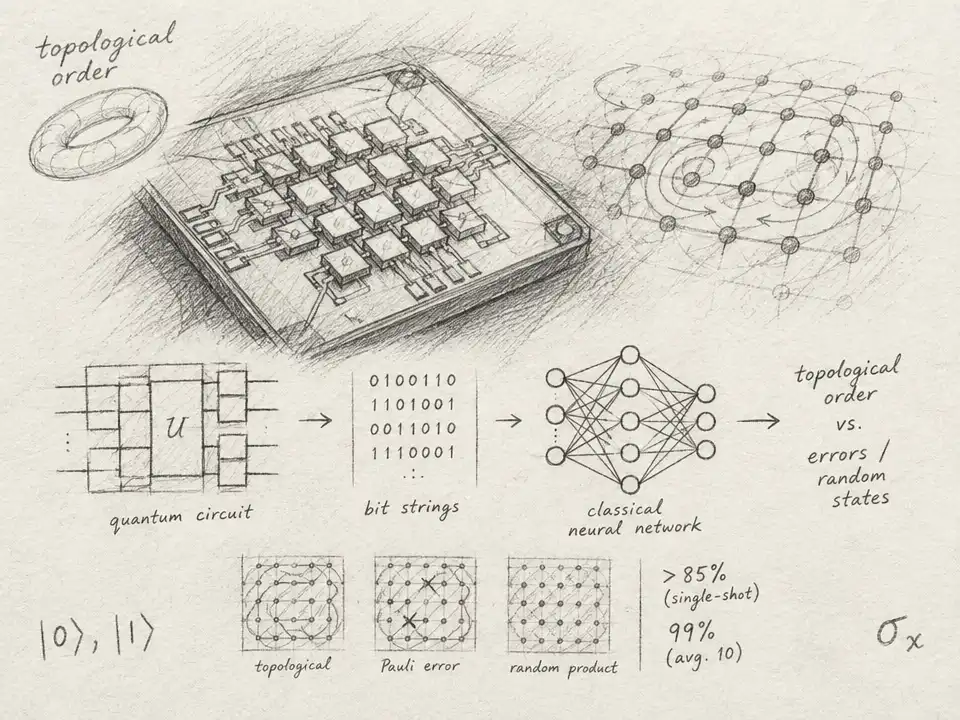
The researchers worked with the surface code, a lattice of qubits whose ground state can display topological order. The surface code is familiar from quantum error correction, but here it served as a model of an unusual quantum phase. A magnetic field gradually changes the model: at weak field, the ground state is topologically ordered; at sufficiently strong field, it becomes a simpler paramagnetic state, with the qubits tending to align with the field.
This was not a scan of a natural crystal. The team prepared model states on a superconducting processor containing 17 transmon qubits. They used 16 qubits to make a 4 × 4 surface-code lattice, and also tested a smaller, nine-qubit version. Before asking the classifier to recognize anything, they checked the prepared states using measurements of the lattice’s stabilizers and a quantity called topological entanglement entropy. Those checks supported the presence of topological order in the weak-field states, while the order faded as the field increased. On these finite lattices, the change is a crossover; a sharp phase transition belongs to the infinite-system limit.
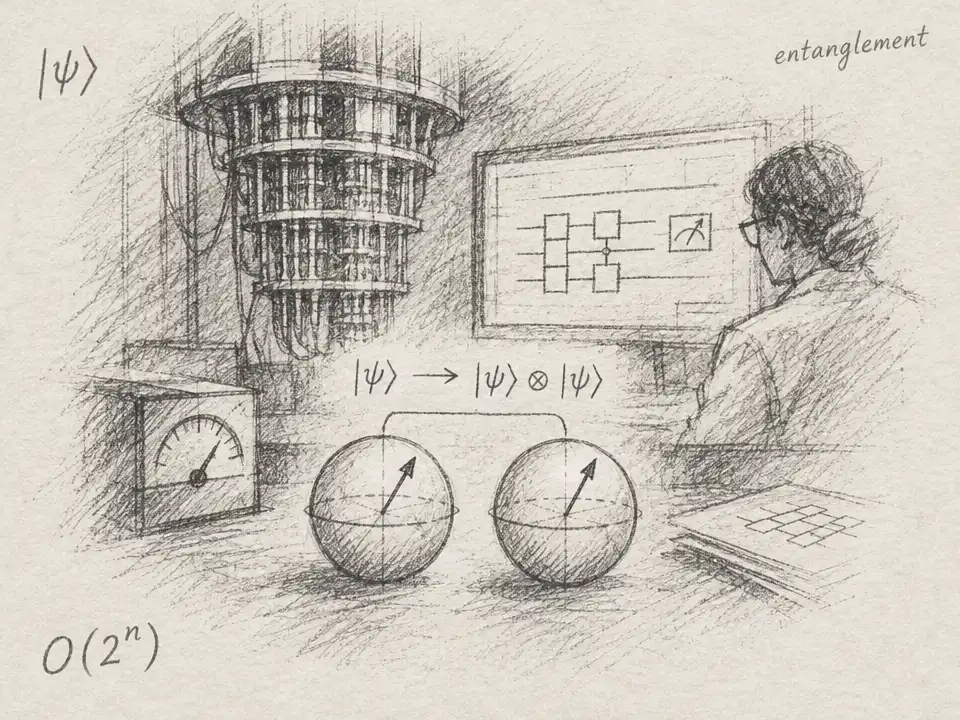
The new method has two stages. First, a tunable quantum circuit acts on the prepared state and changes the basis in which it will be measured. Then the processor records a string of qubit readouts, and a classical neural network turns that string into a score: does this look like the topological phase?
The crucial idea is that the quantum circuit can rearrange relationships among many qubits before measurement. The team designed its circuit with a useful target in mind: if it could undo the preparation of the topological state, that state would become a simple string of zeros. A featureless mixed state, by contrast, would remain spread across many possible strings. The researchers let the circuit learn a transformation that made those outcomes easier to tell apart.
Learning meant more than fitting a classical program to a table of data. The researchers put the superconducting hardware inside the training loop. They tested small variations of the quantum-gate settings on the processor, used the resulting measurements to train the classical network, and then adjusted the quantum circuit to improve the separation. Each round sampled eight nearby gate settings, with 8192 measurement repetitions for each. In this way, the quantum stage learned what information to expose, while the classical stage learned how to read it.
After training, the network’s score changed smoothly as the model’s magnetic field was varied, even for intermediate field strengths that had not been used as training examples. For the 16-qubit lattice, the score moved from about 0.9 for the topological state toward about 0.1 for the strong-field paramagnet. The circuit had learned a way of recognizing a family of states, rather than simply memorizing the examples at the two ends.
The team also tested a more demanding distinction. They applied each of the 48 possible single-qubit Pauli errors to the topological state—three error types at each of 16 qubits—and compared those states with 100 randomly chosen product states. In a single measurement, the classifier was more than 85 % accurate on this test. Averaging the outputs from ten measurements raised accuracy to 99 %. That does not mean the method corrects errors: it means the classifier could still recognize the tested topological states despite one such error.
That distinction matters. Topological order is not a local label that can be read from one qubit. A local error can alter part of the state without necessarily destroying the broader pattern. The circuit’s job is to bring that pattern into a form where the final readout can detect it. In a useful analogy, it does not inspect every tile for a symbol; it turns the whole mosaic so its hidden design becomes easier to see.
The approach is promising because it uses the quantum processor to process quantum data directly, instead of first trying to convert the entire state into a vast classical description. But the demonstration is an early step, not a general-purpose detector for unknown materials. It used small lattices and a known model, with states prepared by designed circuits. Whether the method remains trainable and reliable on much larger systems—or on quantum states that researchers do not already know how to prepare—remains open.
Still, the experiment offers a fresh way to tackle a difficult measurement problem. Rather than demanding that every hidden feature be exposed at once, it teaches a quantum circuit to reshape the evidence before the detector looks. For phases whose order is woven across many particles, that shift—from collecting more clues to making the clues readable—could be the more powerful move.