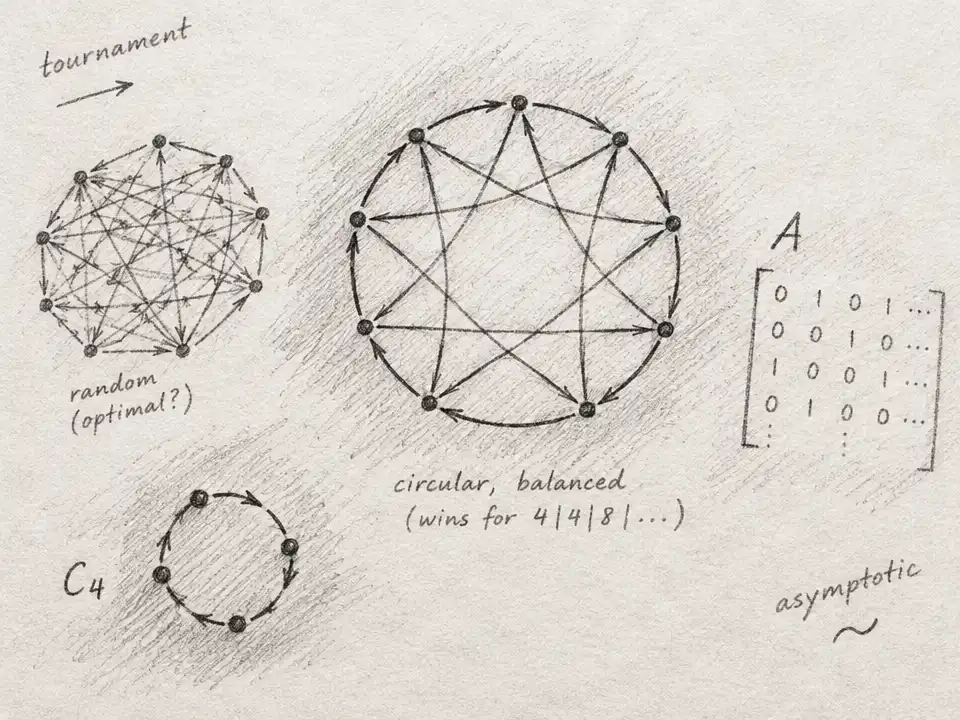
Imagine a round-robin tournament where every pair of players faces off exactly once. Draw an arrow from each winner to the loser. The result is a tournament in the mathematical sense: a complete network in which every connection points one way. Now ask a deceptively simple question: How should those arrows be arranged to create the most loops of a chosen length?
The natural guess is randomness. If every arrow is flipped independently like a coin, the resulting network has no plan, so perhaps it samples every possible cycle especially well. For many cycle lengths, that intuition holds. But a recent mathematical proof reveals a precise exception: when the cycle length is divisible by four, a balanced circular pattern asymptotically contains more cycles than a random tournament does.
The pattern is called a carousel tournament. Place an odd number of vertices around a circle. Each vertex points to the next half of the circle, moving in one direction around the rim. The arrangement is orderly, but no vertex dominates: each has the same number of outgoing and incoming arrows. Even-sized versions can be made by starting with an odd circle and removing one vertex.
That symmetry is the first clue to the surprise. In a random tournament, arrows have no coordinated arrangement. In a carousel, nearby vertices follow a local rhythm, yet the overall structure stays balanced. The arrows do not simply march from a permanent champion toward permanent losers. The circle keeps turning, and its regularity creates a different supply of loops.
The contrast depends on cycle length. Earlier work had shown that for lengths not divisible by four, a random tournament is asymptotically optimal: as the number of vertices grows, no other arrangement beats its leading cycle count. For four-cycles, however, the carousel reaches four-thirds of the random tournament’s expected count. For eight-cycles, previous work established a factor of 332/315. The new paper proves the carousel’s asymptotic advantage for every fixed cycle length divisible by four, completing the pattern that had been conjectured.
“Asymptotic” matters here. The result fixes a cycle length and asks what happens as the tournament grows larger and larger. It identifies the best leading-scale count in that limit; it does not claim the carousel wins every finite tournament. In fact, the authors leave open whether it is the exact winner for sufficiently large odd tournaments at lengths such as twelve and beyond.
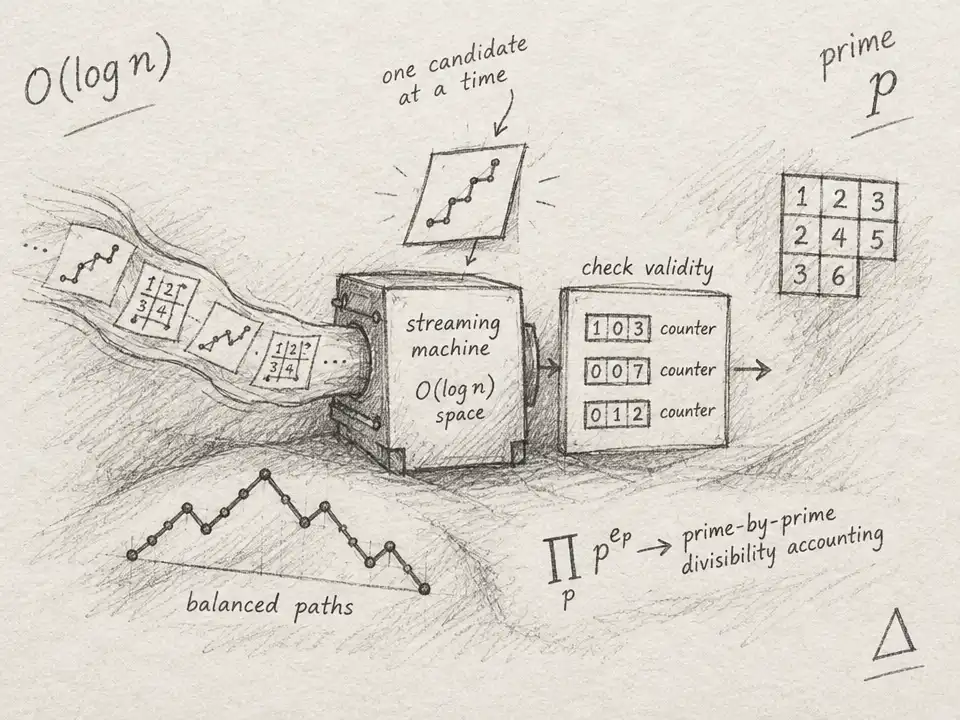
How can anyone count loops in an enormous web of arrows? The proof translates the tournament into a matrix, a square grid of numbers encoding which way each arrow points. Raise that matrix to a power matching the desired cycle length, then inspect its trace—the sum along the diagonal. In this setting, the trace counts closed directed walks: routes that follow arrows and return to where they began.
A closed walk is not always a genuine cycle. It might revisit a vertex before completing its route. But for a fixed length in a very large tournament, those repeat-visit walks make a lower-order contribution. The number of walks using fewer distinct vertices grows more slowly than the number of walks that can use a fresh vertex at each step. So, at large scale, the matrix trace becomes a reliable way to compare cycle counts.
The crucial move is to split the matrix encoding into two parts: one captures the tournament’s arrow pattern, and the other is an all-ones matrix. The authors prove bounds on high powers of these pieces. One key inequality says that adding the all-ones part cannot produce a trace larger than the separate contributions allow. Another says that among the relevant skew-symmetric sign matrices, a special transitive pattern maximizes the trace of powers whose exponents are divisible by four.
That sounds as if the transitive pattern—the one where every arrow points forward along a ranking—should be the final answer. But the matrix description allows a subtler transformation: systematically flip certain signs, then reorder the vertices. In the proof, this turns the maximizing pattern into the carousel. The circular tournament reaches the same bound, while its balanced arrows disguise the underlying order that makes the bound possible.
The authors then examine the carousel’s spectrum, the mathematical collection of its matrix eigenvalues. Those values let them calculate the limiting cycle count exactly. The resulting expression is an infinite series whose terms shrink rapidly; it gives the carousel’s precise asymptotic advantage for every length divisible by four. The paper’s main achievement is not just spotting a winning arrangement, but proving that no tournament can exceed its leading-order count in those cases.
There is a satisfying reversal here. Randomness is not a universal recipe for maximizing patterns. It wins for one family of cycle lengths, while a carefully choreographed circle takes over for another, with the boundary falling exactly at divisibility by four. The result shows how a rigid structure can beat chance without creating an obvious hierarchy: the carousel has no single winner, yet its repeating rhythm quietly produces more of the right loops.