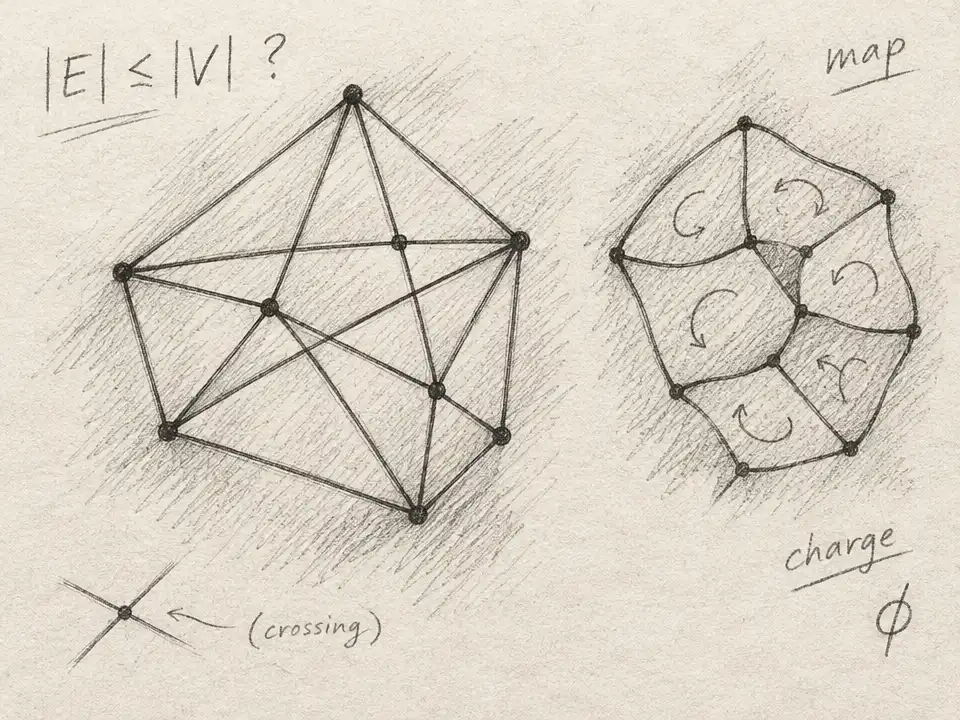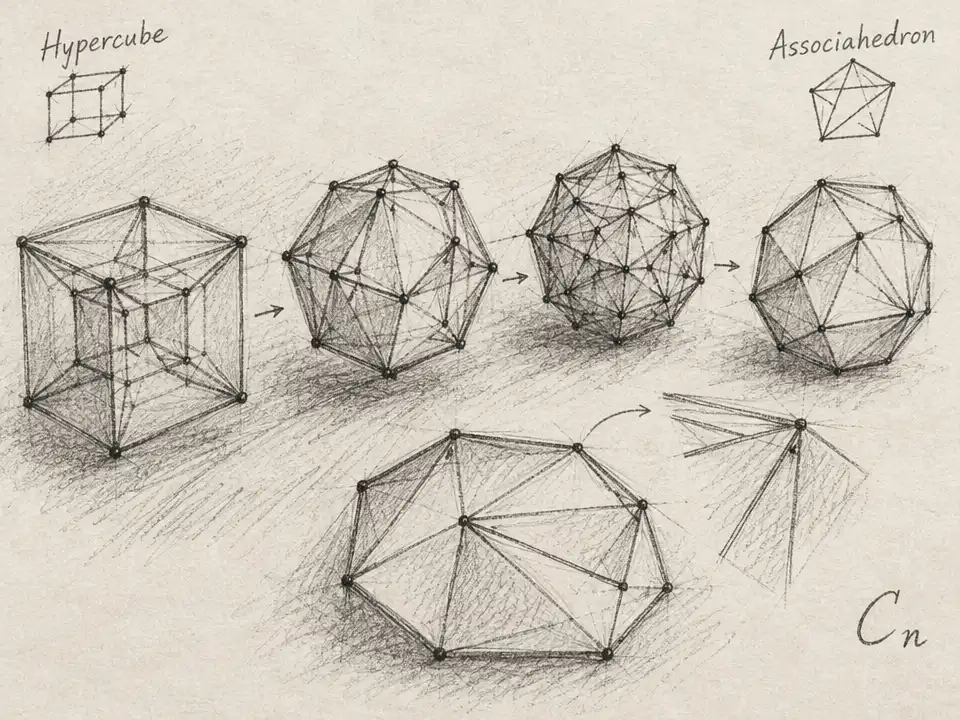
Draw a complete graph: put down a set of dots and connect every pair with a line. With enough dots, the page becomes a snarl. But the snarl raises a clean mathematical question: however cleverly you route the lines, how many crossings must remain?
For more than six decades, mathematicians believed they knew the exact answer. A familiar drawing gives a specific crossing count, and the Harary–Hill conjecture said no drawing could do better. The challenge was proving that every imaginable arrangement—however contorted—must meet that same threshold.
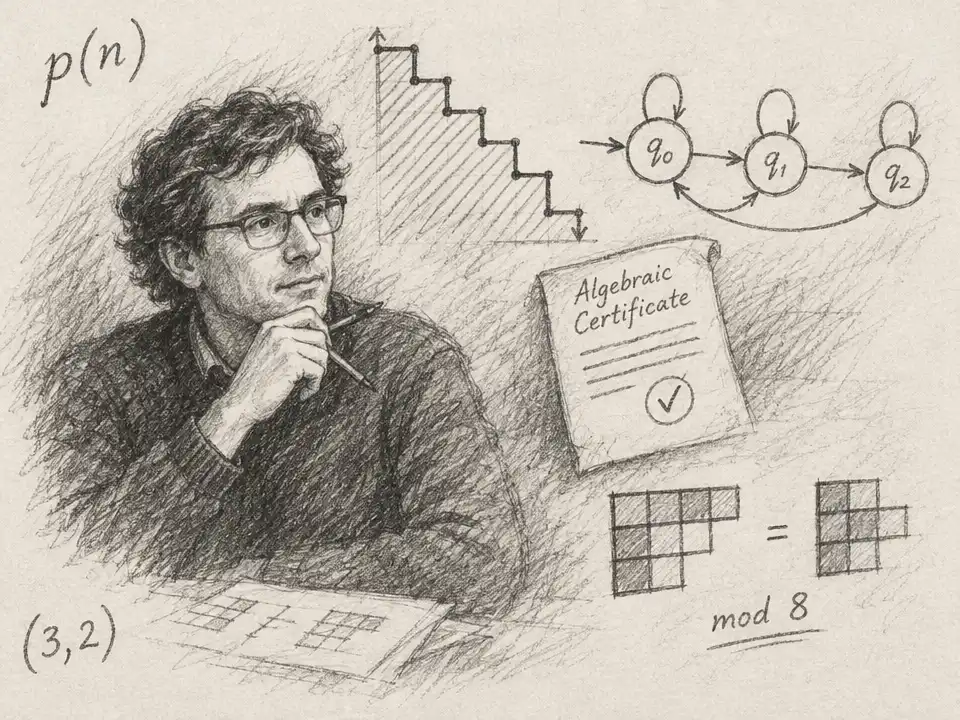
A proof posted by OpenAI in October 2026 settled the conjecture. In a paper posted to arXiv on November 2, mathematician Gelasio Salazar presents a detailed combinatorial route through the proof and extends its result. The striking move is to stop looking at the lines themselves.
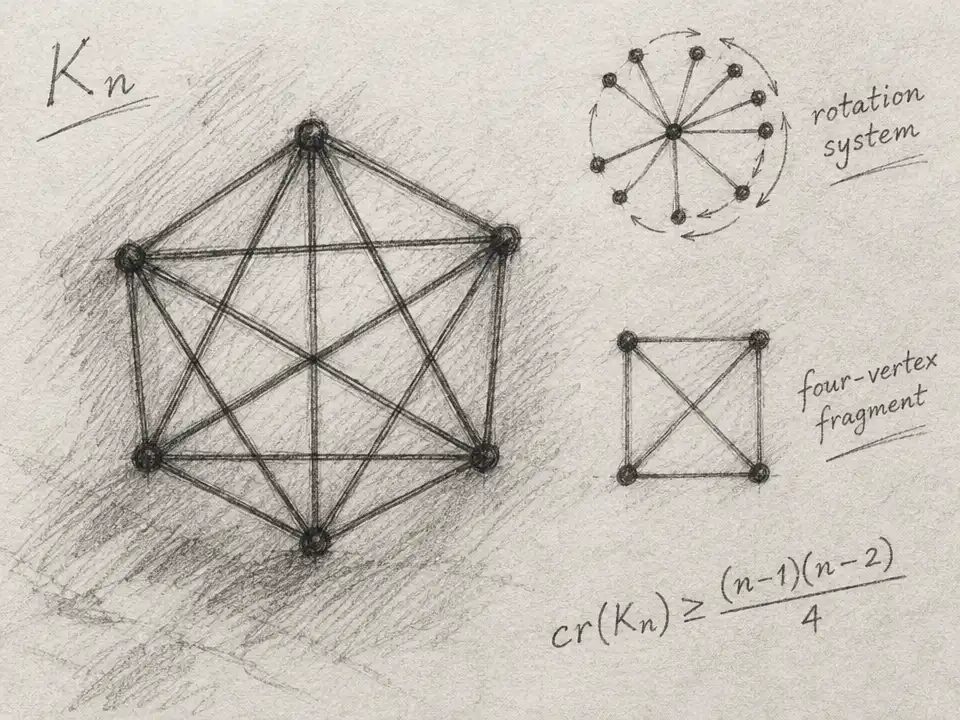
Instead, record the order in which edges leave each vertex. Imagine standing at one dot and turning around: the other dots appear in a particular clockwise sequence. That sequence is a local record of the drawing. Collect one such order for every vertex, and you have a rotation system—a description that can be studied even if no actual drawing produces it.
Now choose any four vertices. Their six connecting edges form a tiny test case, and the rotation records around those four dots can fit together in only 16 ways. Two describe a crossing-free arrangement. Six describe one crossing. The other eight are impossible to realize as a drawing at all.
That small classification is the doorway to the large theorem. In a genuine drawing, no four-vertex group can have one of the impossible patterns. And every crossing belongs to exactly one four-vertex group: the group containing the endpoints of the two crossing edges. So counting the crossing groups counts the crossings in the whole graph.
But Salazar’s extension does something more daring. It allows rotation systems that might never come from a drawing, then charges them for their impossible local patterns. The result says that the number of crossing-type groups, plus three times the number of impossible groups, must reach at least the long-predicted crossing count. For a real drawing, the impossible-group penalty is zero, leaving the desired lower bound on crossings. The theorem is stronger precisely because it survives even when the starting object is only an abstract list of local orders.
How can counting four-dot fragments constrain a graph with hundreds or thousands of vertices? The proof builds a kind of mathematical accounting system. Give each relevant group a signed score, with the score chosen by evaluating a polynomial at the labels of its vertices. The same polynomial also assigns scores to pairs of edges that meet at a vertex. A central identity guarantees that the two totals balance.
The polynomial is not decoration. Its flexibility lets the proof tune the score so that one side of the accounting vanishes, forcing useful information out of the other. The authors connect this identity to a simpler relation between signed crossings of closed walks and the cyclic orders where those walks meet. In effect, a global crossing question becomes a balance between local patterns and the way edges are ordered around vertices.
A final dimension count turns that balance into a lower bound. The available polynomials form a space with a size matching the conjectured crossing threshold. Evaluating them on the relevant local patterns cannot erase a nonzero polynomial, yet the pattern data cannot support an image larger than a limit determined by the crossing and impossible groups. Those two constraints force the required number of groups. The paper supplies the technical work behind that argument, including the proof that the evaluation process really does retain enough information.
This is not a shortcut around the geometry so much as a change of viewpoint. A drawing looks like a tangle of curves; a rotation system preserves the order information that matters and discards the rest. Then even configurations that cannot be drawn become useful: rather than spoiling the argument, their local impossibility carries a precise weight.
The payoff is a proof of a conjecture first posed in the 1960s, along with a statement that applies to a broader class of purely combinatorial objects. It also offers a lesson in mathematical problem-solving: when a global object is hard to control, erase its appearance, keep a carefully chosen record of its local structure, and see what the accounting refuses to let happen.