Four matching stones at the corners of a square: that is the whole winning condition. Yet this small game resisted a simple answer for years. Players take turns claiming cells on a square grid, trying to be the first to complete any upright square. A proof posted by Sean Reid on October 14, 2026, delivers an unexpectedly tidy result: the first player wins on every board five cells wide or larger. The clever part is that, on boards from six cells wide upward, the same compact plus-shaped tactic works again and again.
The game sounds like a cousin of tic-tac-toe, but its board can be much larger and its target can be any size: four corners of a tiny square or a broad one. A player can win by placing the fourth corner. More often, the important move is the one that threatens to do so. If three corners are already claimed, the empty fourth corner must be blocked on the opponent’s next turn.
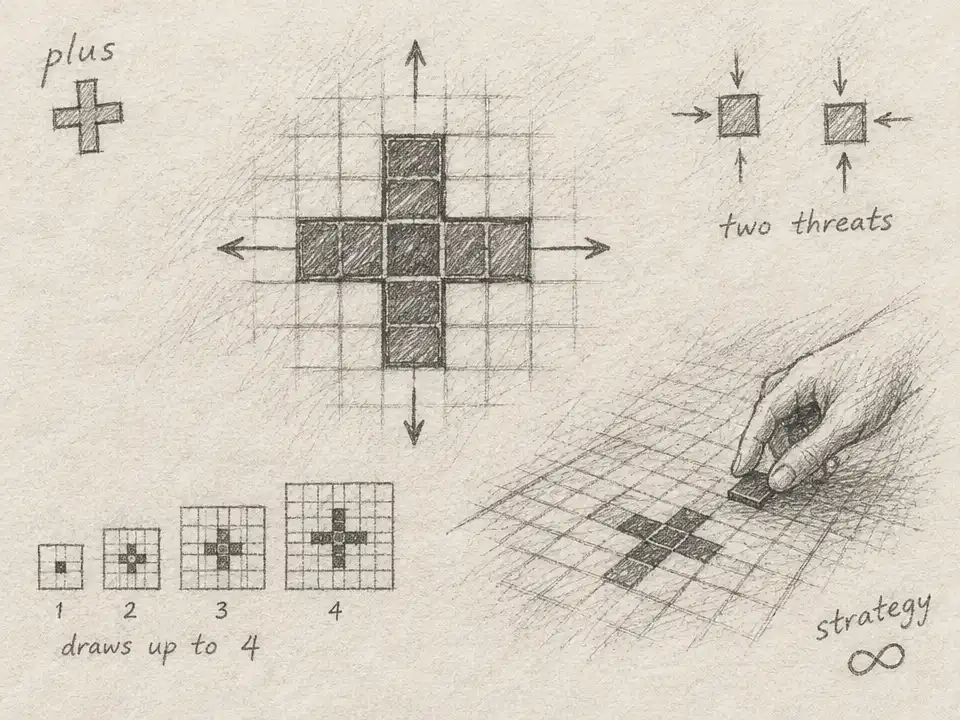
That creates a familiar squeeze. Make one threat and the opponent blocks it. Make two at once and one survives. The challenge is building toward that double threat when the opponent gets to place stones across the board, sometimes in exactly the awkward spots that spoil a neat plan.
Earlier work had settled some sizes but left an odd gap. Searches had found a first-player win on the five-by-five board, while a result about two-colorings guaranteed a win on boards at least fifteen wide. For boards six through fourteen, neither a general winning method nor a drawing method had been published. It was possible that each size required its own sprawling strategy. Reid’s result instead finds a reusable rule for all boards from six upward, and proves the five-by-five case separately.
The rule is built around a plus: a center stone with four arms, one above, below, left, and right. Imagine the center and one arm already claimed. Playing a perpendicular arm completes three corners of a small square, so the fourth corner becomes an immediate threat. The opponent has to block. When the first player later places the opposite arm, the move can threaten two different squares at once. The opponent can plug only one; the other gives the first player a win on the next turn.
There is the engine of the strategy. The plus does not win just by looking like a cross. Its arms turn moves into questions the other player must answer. But the second player’s stones can occupy an arm or a square’s missing corner before the pattern is ready. So the rule sometimes takes a detour, making a move that forces a block and builds up another stone before returning to the plus.
The paper makes that plan precise. After the first two replies, the rule searches for a sequence of forcing moves followed by the arms of a plus. It prefers sequences that need fewer detours, then fewer remaining arms. If the opponent blocks a threat, the planned line continues; if the opponent does not, the first player completes the threatened square. In the longest recorded line, the first player wins by the seventeenth move. That move count comes from the checked lines, rather than from the theorem’s formal statement.
A strategy for a small board is not automatically a strategy for a huge one. Faraway stones might combine with nearby moves to create unexpected threats. Reid handles that with a compact way of recording what matters: the rule plays inside a six-by-six corner region and reads the opponent’s stones inside a seventeen-by-seventeen region. For certain distant replies, the proof tracks a “hidden corner”—the nearby cell that would complete a square involving those remote stones. The rule is designed not to force the opponent to block at that cell.
That lets the proof replace faraway replies with carefully chosen stand-ins on a twenty-three-by-twenty-three board. Reid checks the rule on boards from six through seventeen, then uses those representative positions to extend the result to every larger size. The extensive-looking grid is reduced to a manageable set of local patterns: remote cells matter only through a limited summary, and the strategy responds to that summary in the same way.
The five-by-five board is the exception to the simple plus rule. There, the winning strategy comes from a table checked across the complete game tree. The solver examined 1.79 × 10⁸ positions. In 104 reply-pair cases, the table uses a “quiet” move that makes no immediate threat before continuing its plan. On boards up to four wide, exhaustive checks show that the first player cannot force a win; because the game is finite, both players can secure at least a draw.
Reid formalized the results in Lean 4, a proof assistant that checks mathematical arguments. The formal development includes the game rules, the finite searches, the plus strategy, and the proof that the larger-board cases follow from representative checks. The paper reports no unproved declarations in that development. Computation helps explore and verify the many positions, but the mathematical argument explains why the checks establish a win rather than merely reporting what a program found.
The surprise is not simply that the first player wins. It is that one small shape can organize the strategy across boards of every size from six upward. A plus gives the player a repeatable way to turn a forced reply into another step toward a double threat; careful bookkeeping makes the same rule survive even when the board grows without bound. A puzzle that once seemed to demand a separate answer for every grid size has a compact pattern at its center.