Imagine building a shape from overlapping pieces, but with one rule: you are not allowed to let one piece’s contribution cancel another’s. The familiar inclusion–exclusion principle gets the job done by adding and subtracting intersections, sometimes correcting a large overcount with a large subtraction. A newer mathematical conjecture asked whether unions of sets could instead be assembled from the intersections that genuinely contribute, using operations that avoid this kind of cancellation.
A recent paper delivers an unexpected setback—not to the whole conjecture, but to a tempting simplification of it. The authors prove that a particularly orderly way of building those unions cannot always work. Their proof does not exhibit a small, concrete counterexample. Instead, it turns the question into a game played across a geometric landscape, then uses randomness to show that some game boards cannot be solved.
The simplification concerns the shape of the construction. Think of an expression as a tree: pieces branch into smaller pieces as the construction unfolds. In a left-linear tree, each new step attaches just one leaf to the work already done. It is an assembly-line version of the conjecture—one accumulated result, one new ingredient at a time. The paper shows that this tidy, restricted strategy fails for at least one finite lattice, a mathematical structure that organizes elements by how they relate.
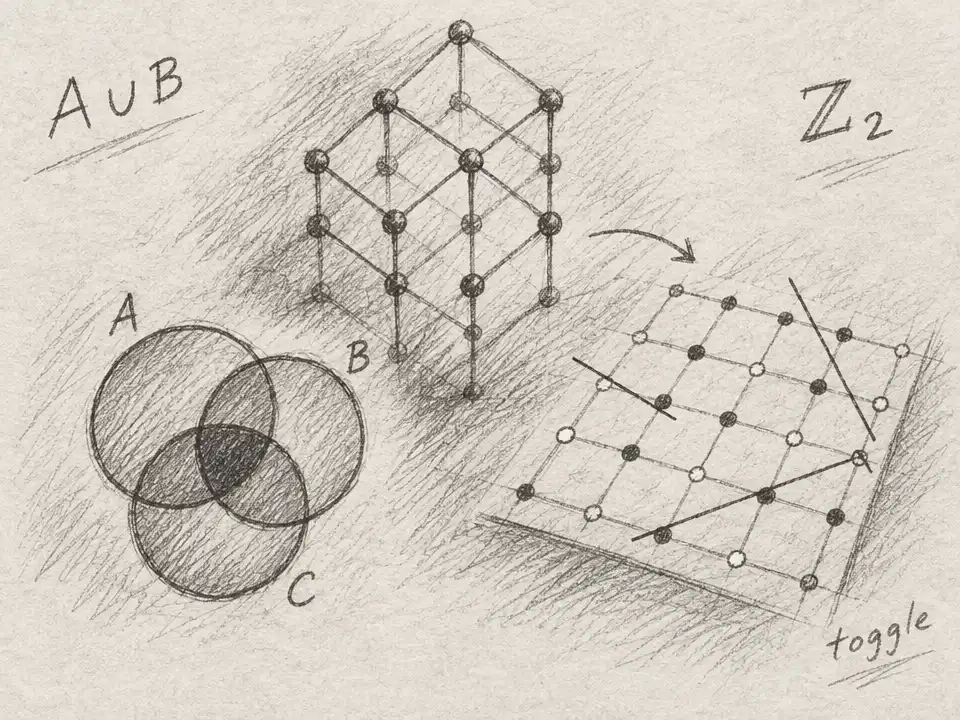
To get there, the authors translate the construction problem into a toggle game. Picture a lattice as a network of connected pieces, each either black or red. At the start, everything is black. A move selects one piece and flips it, along with all the pieces beneath it in the hierarchy. But the move is allowed only when that whole group is the same color, and only for pieces with a nonzero value determined by the lattice’s overlap structure. The goal is to turn every piece red except the top one. The paper shows how being able to win this game corresponds to being able to make the restricted construction.
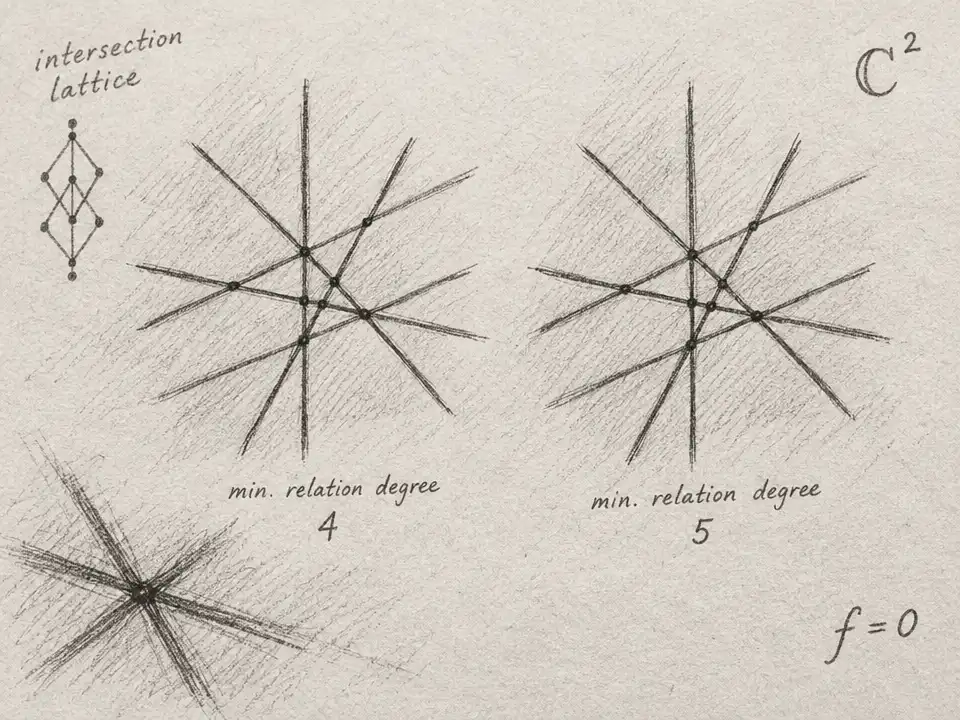
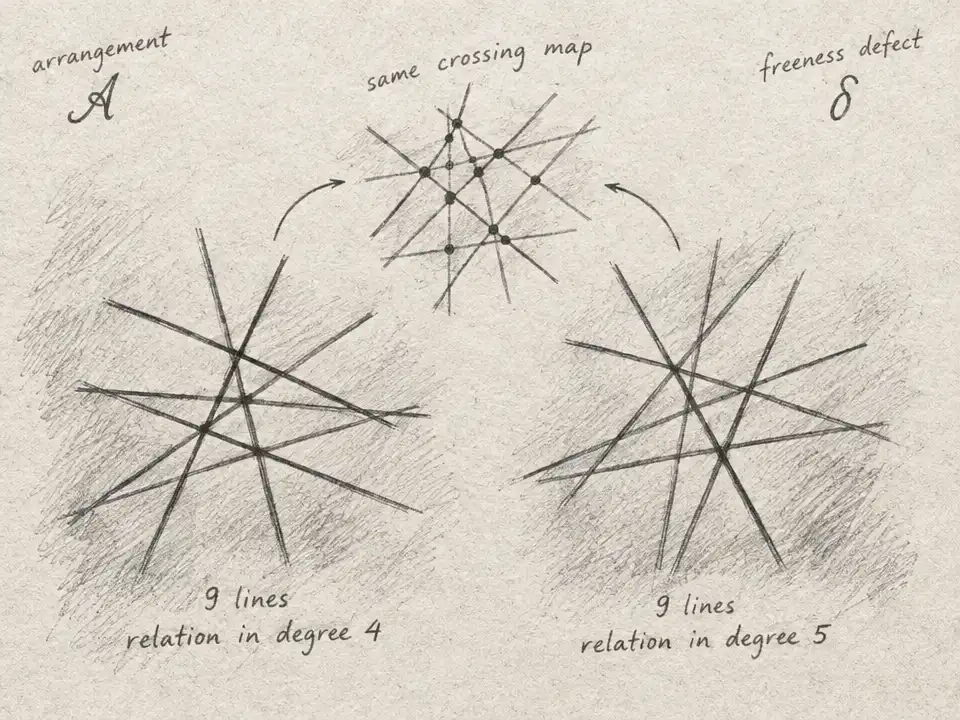
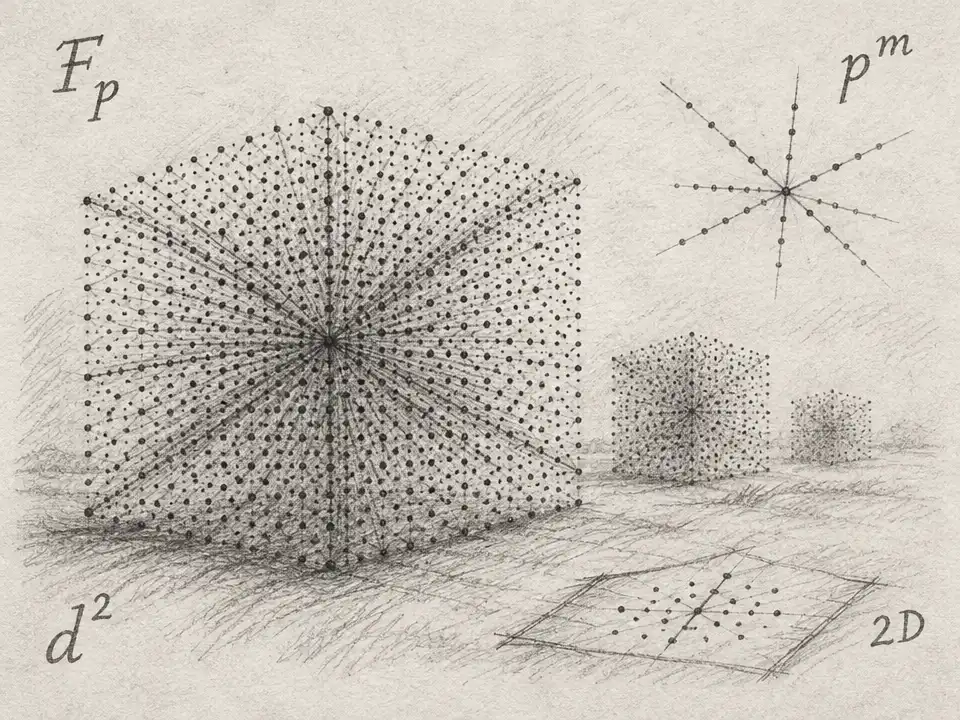
Rather than search through lattices directly, the researchers build a geometric version of the game on a finite plane. Take a plane with coordinates drawn from a field containing a prime number of values. Its points can be toggled on or off, one at a time. Each line has a set of marked points. A state is permitted only if, whenever two or more switched-on points lie on a line, at least one of them is marked for that line.
Now comes the surprising turn: the marks can be chosen so that no sequence of moves reaches the all-on state while obeying every line’s rule. To prove this, the paper first studies point collections that are spread around the plane rather than crowded onto one line. A result in combinatorial geometry says that such a collection determines many distinct lines. Among them are many “short traces”: lines that meet the collection in at least two points, but not in a large group. Every one of those traces would need to contain a marked point for the collection to be permitted.
The researchers randomly choose the marked points, giving each line the same number of marks: the ceiling of the square root of twice the prime number, plus one. For a large enough prime, any particular point has only a small chance of being marked for a particular line. The more short traces a collection creates, the more unlikely it is that all of them happen to contain the required marks. A counting argument then shows that some choice of markings leaves no permitted spread-out collection of a certain size at all.
That does not yet rule out a winning game. A player might try to gather almost all the switched-on points along one line, where the geometry produces fewer different traces. The proof handles this escape route too. Any winning sequence must pass through a state with a chosen number of points on. If that state has almost all its points on one line, then as the game continues, the number of points off its dominant line must eventually reach a particular threshold. The authors show how to trim that later state down to a spread-out collection that still obeys the marking rules. But the random construction was chosen precisely to make such a collection impossible. The supposed winning sequence cannot exist.
It is a proof by collision: a player trying to move smoothly from an empty plane to a full one must pass through configurations, and the random constraints block every possible route. The argument proves that there is a finite lattice on which the toggle game cannot be won. That, in turn, refutes the left-linear version of the set-union conjecture.
There is an important limit to the result. The paper does not disprove the unrestricted conjecture. More complicated construction trees, where new branches can be attached in less orderly ways, may still succeed. And the proof establishes that a counterexample exists without displaying a specific one. Its upper bound on the size of the lattice is less than a tower of three nested powers of ten, with 2,215 at the top exponent. The authors stress that this is an extremely crude upper bound, not a claim that any counterexample must be that large; finding an explicit example or the smallest one remains open.
The result’s appeal lies partly in its unlikely bridge. A question about assembling sets becomes a game about flipping descendants, then a problem about marked points and lines. The orderly strategy seemed like a plausible way to keep cancellation under control. The proof reveals that geometry can impose constraints too tangled for any such step-by-step plan to navigate—while leaving open whether a more flexible construction can still find a way through.