Give a computer a large number and ask it to find a number that takes a long time to cycle back to one when repeatedly multiplied by itself, with every step reduced modulo the original number. With randomness, this can be relatively easy: pick a number and, with high probability, its cycle will be long enough. The puzzle is how to guarantee the same result without rolling the dice.
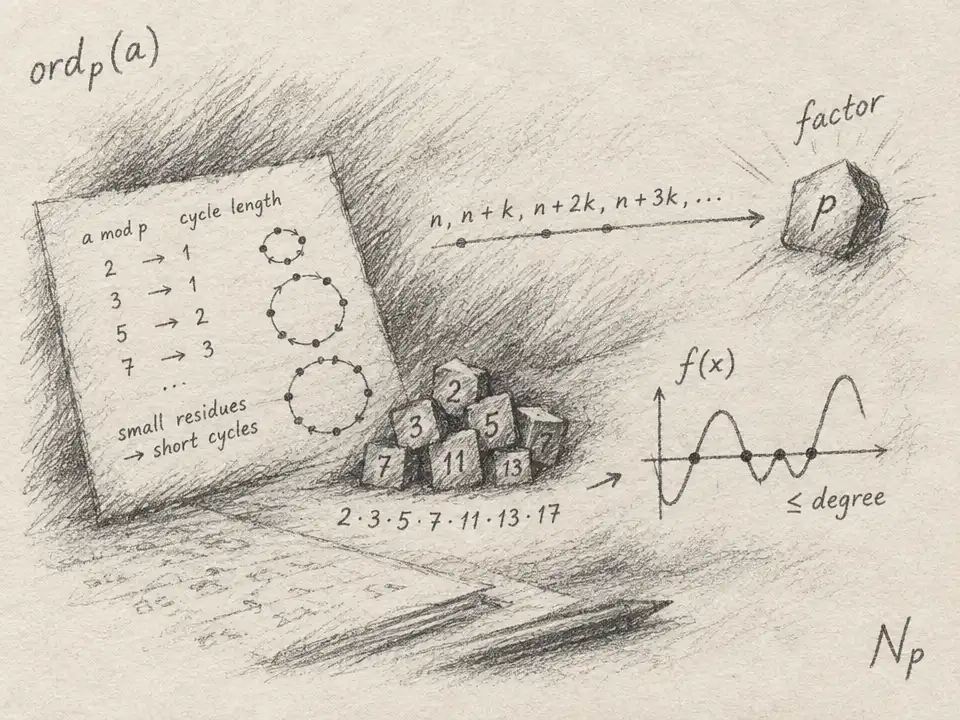
That cycle length is called a number’s multiplicative order. It measures how many repeated multiplications it takes before a residue returns to one. Finding a residue with an order above a chosen threshold matters because algorithms for factoring large numbers use such long cycles as a tool. But a deterministic search faces an awkward possibility: perhaps none of the numbers it checks has a long enough cycle.
Itamar Nir’s paper turns that apparent dead end into a clue. Under a specific condition on the cycle-length threshold, a deterministic algorithm either finds a long cycle, finds a nontrivial factor of the original number, or correctly reports that the number is prime. The unexpected part is how it handles the final search: after gathering information about cycle lengths, it scans a simple sequence of candidate numbers. The paper’s analysis shows that this plain search is fast enough.
Here is the trap the algorithm sets. It begins with small numbers and computes their multiplicative orders. If one exceeds the target threshold, the search is over. If an order is short, the algorithm checks whether that information exposes a factor directly. When it does not, the order must match the corresponding cycle length modulo every prime factor of the original number. In turn, each such prime factor must be one more than a multiple of that order.
The algorithm gathers these short orders into a single number, their least common multiple. Call it M. The key deduction is that every prime factor of the original number is one more than a multiple of M. So instead of searching everywhere for a factor, the algorithm checks the much narrower sequence of numbers one more than M, two times M, three times M, and so on. If the original number is composite, this progression reaches its smallest prime factor before it reaches the square root of the original number. If it reaches that boundary without finding a factor, the algorithm can report that the number is prime.
Why should this progression be short enough to make the method efficient? The answer comes from a surprisingly crowded family of numbers: those built entirely from small prime factors. Mathematicians call them smooth numbers. A number like 72 is smooth relative to a cutoff of 5 because its prime factors are only 2 and 3. Such numbers turn out to multiply the force of the algorithm’s earlier observations.
Suppose the search has not yet found a long cycle or a factor. The small numbers it checked all return to one after M multiplications, even when considered modulo the smallest prime factor of the original number. So do products of those small numbers. That means a great many smooth numbers are roots of one polynomial. But a polynomial’s degree limits how many roots it can have modulo a prime. Smooth numbers crowd the available root slots, forcing M to be large. A large M means the progression of factor candidates has relatively few steps.
The paper uses an established lower bound on the number of smooth numbers to make that intuition quantitative. Its fast guarantee applies when the target D is below the original number N but exceeds the exponential of the square root of twice the natural logarithm of N multiplied by the natural logarithm of that logarithm. Under this condition, the progression can be searched in roughly the square root of D steps, up to a subpolynomial factor. In plain language: the fast routine’s search is governed by the target cycle length, not by an exhaustive march through all possible factors.
This improves on an earlier deterministic result that required the target to exceed the one-sixth power of N. The threshold in Nir’s paper grows more slowly than any fixed positive power of N, so for sufficiently large inputs it reaches a wider range. The paper also gives a simpler, slower method that works for any target below N. It notes that independent concurrent work reaches the same square-root running time for every such target, using a different approach. Nir’s distinctive contribution is a simpler algorithm and analysis in its stated range—not a claim to cover every case with that fast bound.
There is a deeper change in perspective here. At first, failure to find a long cycle looks like a lack of useful information. Instead, the collection of short cycles acts like a measuring device: their shared structure constrains the prime factors, and the smooth numbers make that constraint strong enough to exploit. What looked like a barren search has quietly narrowed the map.
This is a theoretical result about an algorithm, not a report of new experimental factorization records or a demonstration that deployed encryption can be broken. Its interest is more precise: it shows how deterministic number theory can turn a negative result—no long cycle found yet—into a useful guarantee. The search does not need a lucky guess. It can make the numbers it has already examined point toward the factor it has not.