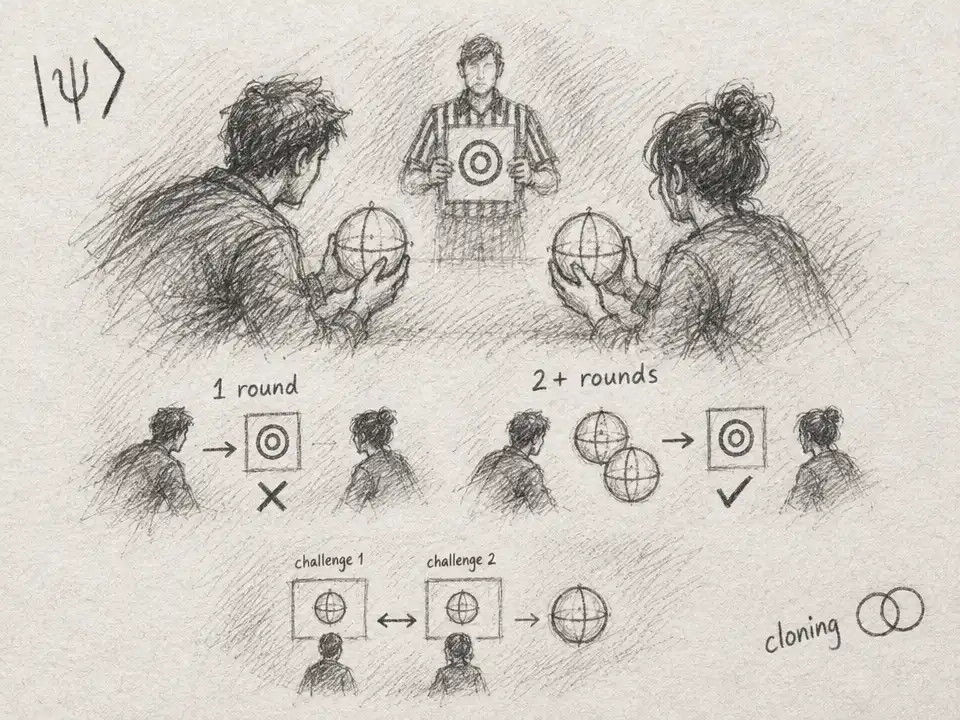
Imagine a referee handing two players a quantum state and asking them to return a different, precisely specified state. They may work on their own halves, but cannot communicate with each other. In one round, no allowed strategy can pass the referee’s test with certainty. Then the referee repeats the test in parallel—and, in a carefully built example, the players can now win every time. The extra rounds were supposed to make success harder. Instead, they supplied something the players could use.
That reversal runs against a familiar mathematical expectation. In classical games, if players cannot guarantee a win in one round, requiring them to win every round usually drives their chance of success down rapidly as the game is repeated. This principle, called parallel repetition, has made repeated tests useful in the study of proofs and computation. But quantum games can include more than new demands: the referee’s quantum questions may also provide fresh resources. The copies are not necessarily independent opportunities to fail; players may be able to process them together.
A paper posted September 25, 2026, makes this distinction vivid. The players in its one-round example do not begin with a private store of shared entanglement. Instead, the referee supplies them with a shared quantum input. Their task is to transform it, using local operations, into a target state that the referee can check. The crucial word is “exactly”: the referee’s test accepts only the specified target. The authors prove that one copy of the input cannot be converted perfectly, but two or more copies can.
The mechanism is a puzzle of matching patterns. A quantum state has a set of weights that describes how its two halves are linked. For one copy, the incoming pattern cannot be arranged into the required target pattern, even with an extra leftover state. The authors show that when the input is repeated, its combined pattern changes. With two copies—and also with three—the weights can be grouped so that the target appears cleanly, with a remainder that does not interfere. Once that exact match exists, the players have a strategy that passes the idealized test with certainty.
The proof turns on a surprising piece of bookkeeping. The researchers encode the counts of different weights in an auxiliary polynomial. One version of that polynomial contains a negative coefficient, which would make no sense as a probability. But this is not a list of probabilities; it is a counting device. When squared or cubed, the polynomial’s coefficients become nonnegative, revealing the groupings needed for exact conversion. A pattern that refuses to fit in one round can become workable when its copies combine.
Two and three copies are enough to unlock every larger number of repetitions in the construction: any whole number of copies from two onward can be assembled from pairs and triples. So the result is not merely that one lucky pair of tests can be passed. For this particular game, the best success probability is below certainty in one instance and reaches certainty in every repeated instance with at least two copies. The paper also builds related two-round interactive protocols with a similar effect, connecting the game to a surprising phenomenon in quantum information theory: some channels can carry information jointly even when their separate uses cannot.
A second paper, posted August 1, 2026, finds a milder—but instructive—break from the same intuition in a quantum cloning game. A referee gives two players a challenge, then checks whether the player selected by that challenge shares the required special quantum link with the referee. The best one-round success probability is 75%. If two rounds behaved like independent copies of the one-round game, winning both would amount to 56.25%. Yet the authors give a two-round strategy that succeeds at least about 57% of the time. They also prove an upper bound below about 59.6%; the exact two-round value remains unknown.
That small edge has a clear source: the players’ responses depend on the full two-part challenge. The authors prove that if the players must use responses that ignore the challenge, their success probability is exactly the simple product expected from repeating the one-round strategy. The advantage appears only when they adapt their actions to the combined challenge. This is a different setup from the September paper: the cloning-game analysis allows an unrestricted shared initial state, while the perfect-win example concerns local strategies using the state supplied by the referee. The papers illustrate related surprises, not one identical protocol.
Neither result means that repeating quantum tests generally helps the players, or that ordinary security systems are suddenly easy to defeat. These are mathematical constructions under carefully stated rules, not reports of laboratory demonstrations. The September paper also identifies boundaries: it proves that this kind of perfect-success jump cannot occur for the entanglement-assisted value of one-round quantum games, and rules it out for certain interactive protocols with up to three messages. Which resources the players already share, what the referee sends, and how the interaction unfolds all matter.
The deeper lesson is that repetition can change the game, not just repeat it. In the classical picture, another round mainly adds another hurdle. In these quantum examples, another copy also enlarges the inventory of states the players can coordinate across. A test that defeats every one-copy strategy may still have a hidden route to success when its ingredients are combined. The route is narrow and mathematically engineered—but finding it exposes a weakness in the comforting assumption that more tests must always mean less chance of passing.