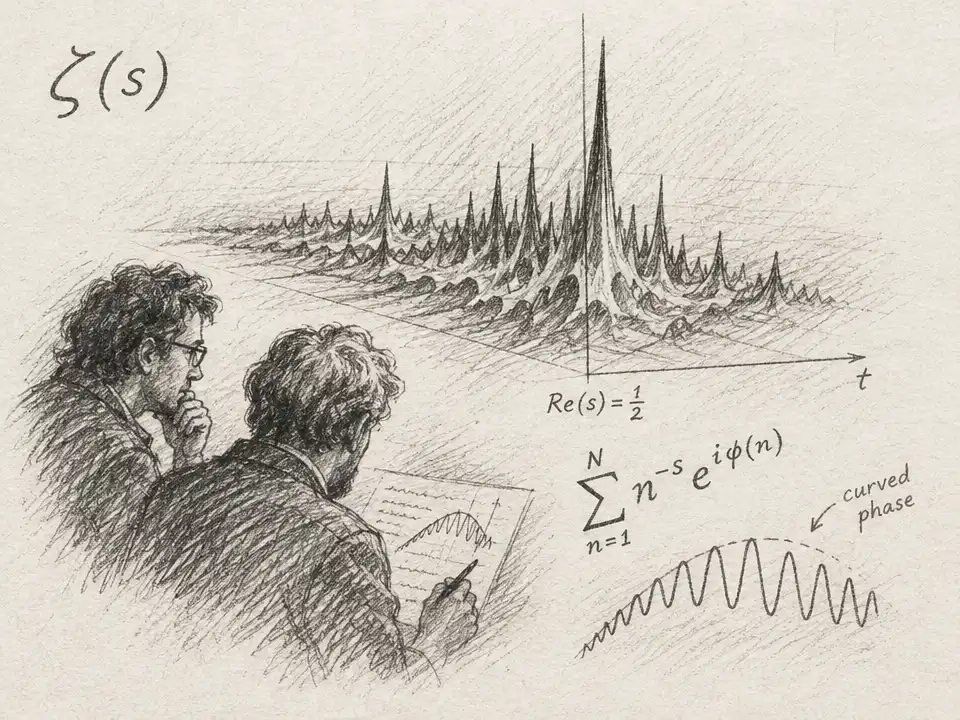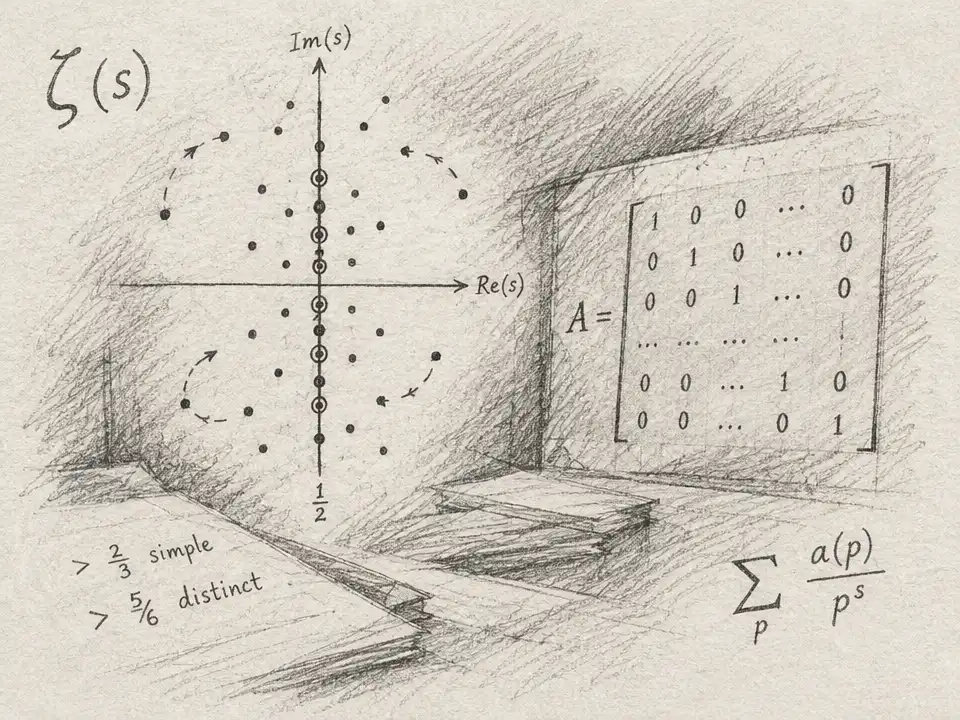
Imagine the nontrivial zeros of the Riemann zeta function scattered high above the number line. For more than a century, mathematicians have wondered whether every one of them sits exactly on a single vertical track: the critical line. The Riemann hypothesis says yes. A new result takes a strikingly different step. Without assuming the hypothesis, it proves that at least two-thirds of these zeros are both simple and on that line.
That is not a proof of the Riemann hypothesis. A substantial minority could still lie elsewhere. But the result turns a question that sounds all-or-nothing into a quantitative one: even without knowing where every zero falls, mathematicians can now account for a large share that must be precisely where the hypothesis predicts.
The zeros matter because they help describe the irregular rhythm of prime numbers. The zeta function packages information about primes into a landscape of complex numbers, and its zeros act like markers in that landscape. Their positions affect how precisely mathematicians can describe prime-counting patterns. The hypothesis says that every nontrivial zero has the same real coordinate, one-half. The new theorem says that at least two-thirds lie there, and each of those is simple: the function crosses zero there in the least complicated way.
The percentage is an asymptotic guarantee, not a claim about a small list of zeros. Look higher and higher in the complex plane, counting zeros in a band from height T to twice that height. As T grows, at least two-thirds of the zeros in those bands are simple and on the critical line, up to a vanishing error. The result also guarantees that at least five-sixths are distinct, whether or not each distinct zero is simple or on the line.
Here is the unexpected turn: a familiar route to that two-thirds figure seemed to need the Riemann hypothesis itself. Earlier work linked the count to a statistical pattern called pair correlation, which captures how zeros tend to be spaced relative to one another. Under the hypothesis, a second-moment calculation leads to the two-thirds bound. Without it, zeros off the critical line complicate the calculation: their contributions are not all positive, so they cannot simply be counted one by one and added.
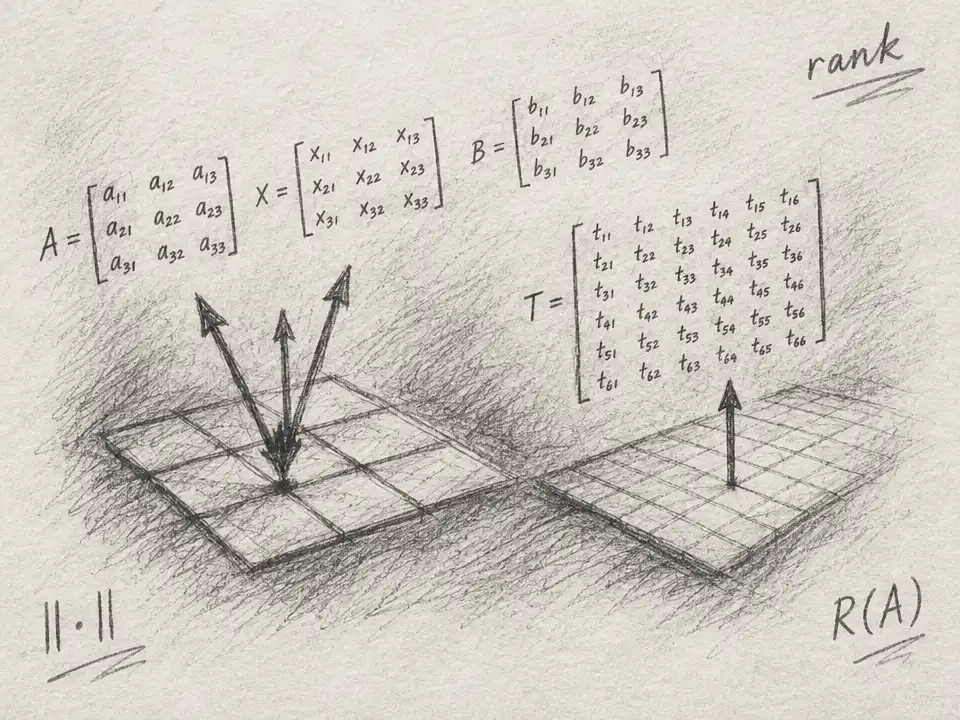
Rather than assume those troublesome zeros away, the researchers built a finite matrix to keep track of them. Start with many carefully chosen test functions, each tuned to a slightly different height. Think of them as overlapping listening windows sweeping through the band of zeros. The explicit formula—a mathematical bridge between prime numbers and zeta zeros—turns the interactions among those windows into entries of a matrix.
That matrix can be inspected from two sides. On the prime side, established estimates let the researchers control its overall weight and its squared size. On the zero side, each zero leaves a fingerprint in the matrix. A simple zero on the critical line contributes a clean, positive direction. Zeros off the line arrive in reflected pairs, because of the zeta function’s symmetries. Each pair contributes a block with one positive and one negative direction.
The negative directions are the complication—but they also have structure. Linear algebra can count how many positive directions remain in a matrix even when some contributions are negative. The researchers combine that count with the matrix’s total weight and squared size. In effect, they show that the off-line pairs cannot cancel enough of the positive signal to erase the contribution from simple zeros on the line. The remaining rank—the number of independent directions the matrix still occupies—forces a lower bound on how many such zeros there must be.
This is the conceptual reversal: they do not prove every zero behaves nicely before counting the well-behaved ones. Instead, they let the entire mixture contribute, including zeros off the line, and use the mixture’s overall signature to show that enough simple, on-line zeros must be present. A tool that first appears to be an obstacle becomes something that can be measured and bounded.
The proof also offers a modest improvement when the researchers replace their basic window with a smoother one. The lower bound rises from two-thirds to 0.67250 for simple zeros on the critical line; the corresponding bound for distinct zeros rises from five-sixths to 0.83625. The paper establishes the same main result for the zeros of any fixed primitive Dirichlet L-function, a broader family that includes zeta-like functions tied to arithmetic patterns. Its main theorems are also formalized in Lean 4, a system for checking mathematical proofs.
For all its reach, the result leaves the central mystery intact. It neither proves that every zero lies on the critical line nor identifies particular zeros that might lie elsewhere. It does not settle the Riemann hypothesis. What it does is remove a barrier that had made a strong proportion bound appear dependent on that hypothesis. The zeros need not all be in formation for mathematicians to count the majority: the matrix can track the disorder, and still reveal how much of the pattern must hold.