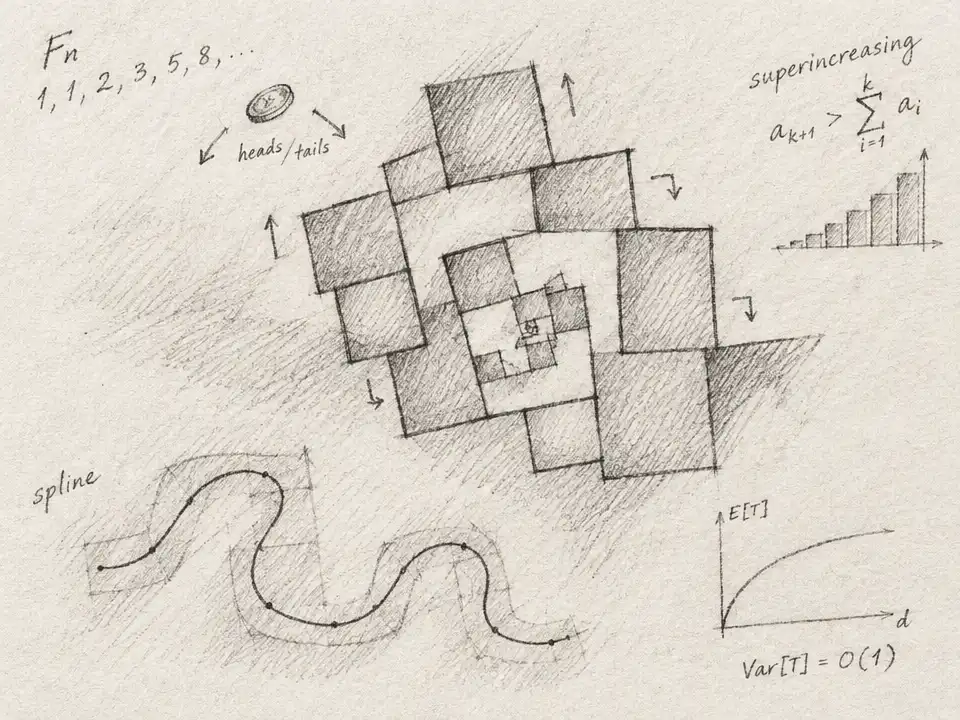
Start with a square. Add another square whose side length is the next Fibonacci number, then another, and another. In the familiar version, each new tile turns in a set direction, and the squares curl into a spiral. Now let a fair coin choose which side gets the next square, while the direction of attachment alternates between horizontal and vertical. The tiling wanders, but its growth still follows Fibonacci numbers. A natural question follows: when will this unpredictable patchwork first reach a particular point on the grid?
That question sounds like a tour through every possible sequence of coin flips. But the researchers found a way to ignore most of the growing outline. Instead, they follow one coordinate direction at a time: how far has the expanding edge traveled toward the target? Each time that axis is updated, it advances by a Fibonacci-sized step. The sizes of those steps are not an arbitrary jumble. They form a superincreasing sequence: each new step is larger than the sum of all the earlier steps along that same axis.
That property turns a geometric chase into a kind of number-reading problem. Imagine two histories of coin flips that differ at several moments. Find the latest, largest step where they disagree. If one history points toward the target at that moment and the other points away, the new step outweighs every earlier difference combined. The two histories therefore end up at different distances, in an order determined by that single decisive flip. It works much like comparing binary numbers from their leftmost digit: the first important difference settles which number is larger.
With the histories neatly ordered, the team can identify the first number of updates at which a coordinate could possibly reach the target. They call this the earliest feasible stage. At that stage, some coin-flip patterns succeed and some still fall short. The striking part is what happens afterward: every new step is already big enough to cross the remaining distance on its own. To keep missing the target, every later flip must point away from it. With independent fair coins, each extra update cuts the chance of continued failure in half.
So the lingering uncertainty has a simple shape: a geometric tail, dropping by a factor of two with every additional update along that coordinate. This is not merely a useful estimate. The paper derives an exact covering-time law for a single coordinate, including the probability of each possible delay. The key move is the change in viewpoint: rather than simulate the whole growing tiling, order the possible boundary positions by the Fibonacci steps that created them.
The idea extends beyond the plane. In three or more dimensions, the construction cycles through the coordinate axes, attaching a new slab to one face at each move. The sizes follow a generalized Fibonacci recurrence: each term adds the previous term to the term from a full cycle earlier. The shape's side lengths are fixed by that recurrence, while coin flips determine where the shape sits. Each axis uses its own set of independent flips, so the time to reach a target in one coordinate is independent of the times for the others. The point is covered when the slowest coordinate finally catches up.
That separation lets the researchers combine the coordinate-by-coordinate laws into exact probabilities and formulas for the mean and variance of the full covering time. For any fixed dimension, the expected number of moves grows logarithmically with the target's greatest distance from the starting block. In the plane, the underlying growth rate is the golden ratio. In practical terms, moving a target much farther away increases the expected wait, but not in direct proportion to the distance. Meanwhile, for each fixed dimension, the variance stays bounded as the target recedes, and the chance of a long delay beyond the earliest feasible time falls exponentially.
There is a second payoff: the random tiles can still carry a spiral. In the orderly, familiar tiling, quarter-circle arcs connect the route through one square to the next. Random turns change which corners the curve must join. In some squares, an ordinary arc no longer fits the needed entry and exit. The authors handle those cases by using a specially chosen fifth-degree polynomial curve, joined to a circular arc. The construction needs one-step lookahead—the next square's placement determines how the current tile's segment should finish—but the resulting curve stays inside its square and avoids self-intersection. The whole path is continuously differentiable, and the polynomial and arc meet smoothly within each repaired segment.
The broader lesson is that randomness does not always make a system impossible to analyze. Here, the outline's position is random, but its scale is controlled, and its coordinate movements have a rigid numerical order. By tracking those movements separately, the researchers turn a sprawling family of random pictures into a countable set of threshold questions. The same Fibonacci rule that makes the tiles grow also gives the mathematicians a way to sort the uncertainty.
The results do have boundaries. The probabilities assume independent, fair choices; biased or dependent turns raise questions the paper leaves open. And although the authors build the spiral curve in two dimensions, they do not yet have a corresponding curve or surface for the higher-dimensional tilings. For now, the adventure ends with a precise answer to a deceptively visual question: even when a Fibonacci landscape takes a random route, its arrival times can be read from the hidden order of its steps.