Picture a staircase made of two kinds of steps: up and down. You start at ground level, never dip below it, and finish exactly where you began. How many such paths are there after a long walk? The answer is a Catalan number, a familiar guest in problems about balanced parentheses, tree shapes, and ways to group objects. The surprising question in a new mathematics paper is not just how to calculate that number. It is how little memory a machine needs to certify it.
The straightforward strategy seems to demand a ledger: generate every possible path, decide which ones obey the rules, and keep a running total. But Álvaro Gutiérrez, Christian Ikenmeyer, and Greta Panova build a different kind of account. Their paper, Counting in logarithmic space, asks whether a counting problem can be described as a stream of candidate answers, each checked by a machine that remembers only a few small counters.
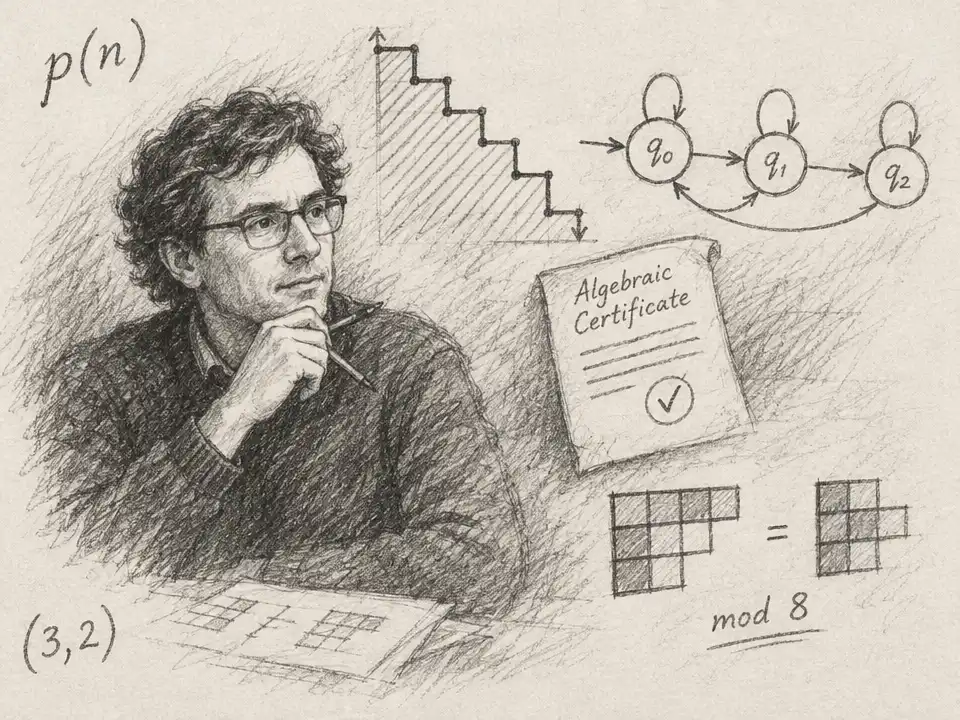
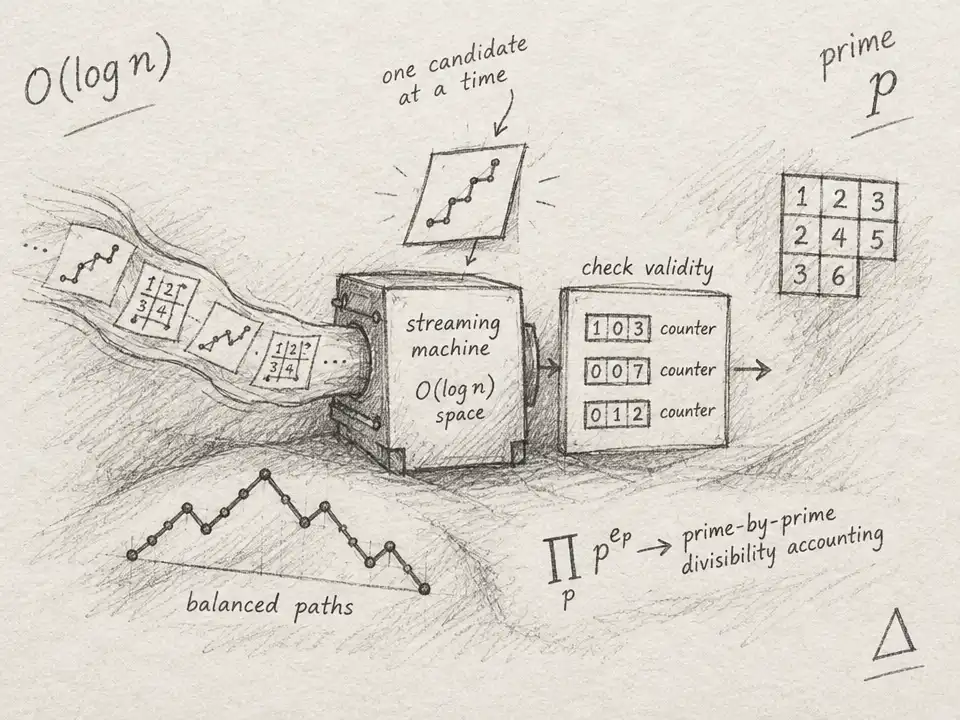
Here is the basic trick. The machine makes a sequence of yes-or-no choices, one at a time, to form a possible path. It reads that candidate from left to right. A counter tracks how many steps remain; another tracks the path’s height. The machine rejects a path that falls below ground, ends at the wrong height, or has the wrong length. It never needs to keep the whole path on its work tape. Every candidate that passes gives one accepting computational route; every candidate that fails gives none. Count the accepting routes, and you have counted the valid paths.
In computer science, this way of classifying counting problems is called #L, pronounced “sharp L.” The “L” refers to logarithmic working space: as the input grows, the amount of scratch memory grows very slowly. The hash marks that the quantity of interest is a count—the number of accepting routes through the machine. The machine is not wandering randomly, and it is not storing a giant tally as it checks candidates. Its branching choices define the possibilities; the number of successful branches is the answer.
That distinction matters. A problem can be easy to describe as “count all the objects that satisfy these rules” and still be difficult to give a satisfying mathematical interpretation. A generic encoding might count arbitrary certificates that happen to pass a test, without revealing why the answer has anything to do with the objects mathematicians care about. The researchers’ aim is more exacting: construct compact, one-pass checks that correspond to meaningful combinatorial objects.
For the staircase, the certificate is simply the sequence of steps. The same style of reasoning applies to choosing a subset, where a stream of bits marks which items are selected and counters check the size; to counting permutations, where a sequence can be checked against ordering rules; and to counting standard Young tableaux. A tableau is a diagram of boxes filled with consecutive numbers so that entries increase across each row and down each column. The paper places a broad collection of such counts in #L, including Catalan and Stirling numbers, certain tree orderings, and many quantities from number theory and geometry.
One of the paper’s more ingenious moves tackles a case where the simple “guess an object and check it” story is not enough. For any ordinary Young diagram, the number of standard tableaux is given by the hook-length formula: a factorial divided by a product of numbers attached to the boxes. A quotient is awkward for a counting machine. Multiplication has a natural interpretation in this framework—combine independent choices—but division does not obviously correspond to choosing a positive set of objects.
The authors turn the fraction sideways. For each prime, ask how many times it divides the numerator and how many times it divides the denominator. This difference is the prime’s exponent in the final integer. Then the answer can be rebuilt from its prime factors. The machine can work through the primes one by one, using small counters to calculate the needed divisibility information, rather than storing the entire tableau or a huge intermediate product. In the paper’s framework, the formula’s arithmetic structure becomes a route to a counting proof.
This is a proof technique, not a claim that a laptop can now instantly enumerate every tableau—or that the new method beats every existing algorithm in practice. It shows that a problem belongs to a particularly constrained class of counting problems. That classification has consequences: the authors note that #L functions can be computed in polynomial time, and their results put many exact counting questions into that territory. The input encoding matters, too. Some numbers are supplied in unary, as a string whose length grows with the number itself, so “logarithmic memory” is measured against the actual encoded input, not against an arbitrarily compact representation of a giant integer.
The paper also reaches beyond familiar counting puzzles into representation theory, where coefficients describe how complicated symmetries break into simpler pieces. For a particular family of coefficients, with one parameter held bounded, the authors give a verifier using logarithmic-squared rather than logarithmic space. That result is a separate step forward, not a claim that every mysterious coefficient now has a simple combinatorial interpretation. Several questions remain open, including whether some broader families fit into the tighter #L framework.
The underlying change in viewpoint is the real adventure. Instead of asking how to hold an immense collection of objects in memory, ask what a single valid object looks like as it streams past—and what tiny state is enough to tell whether it qualifies. Sometimes the answer is a height counter. Sometimes it is prime-by-prime bookkeeping. Across both cases, a difficult counting problem becomes a sequence of local checks. The objects may be numerous, intricate, or hidden inside an algebraic formula. The certificate, it turns out, can still be small.