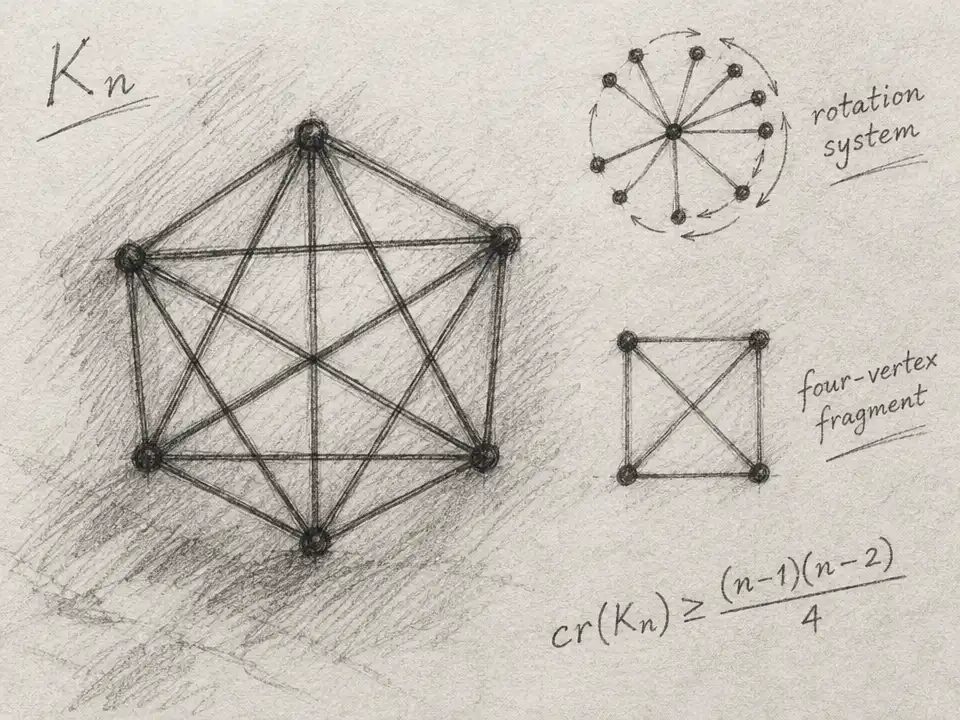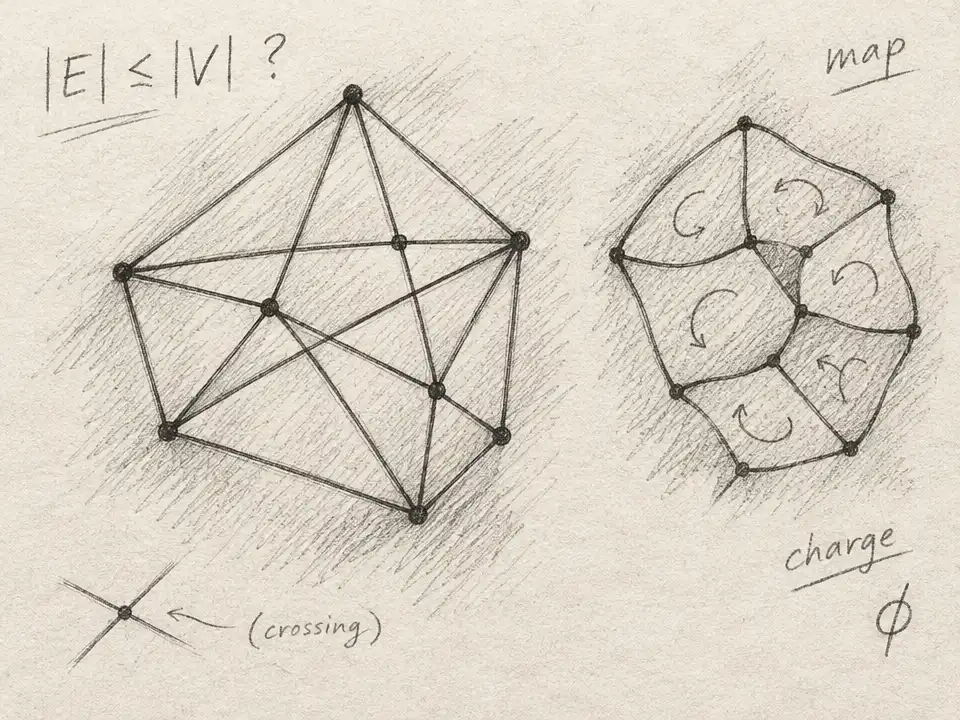
Imagine drawing a handful of dots and connecting them with lines. Now impose a strange rule: every pair of lines must meet exactly once. Two lines may cross, or they may meet at a shared endpoint—but no pair gets to miss each other, and no pair gets to meet twice. How many lines can the drawing hold before the rule becomes impossible?
This is the thrackle puzzle, and it has resisted a clean answer for decades. In 2026, mathematician Dániel Gábor Simon proved a sharper limit than any previous one: for a thrackle with at least four vertices, the number of edges cannot exceed the greatest integer at or below four times one less than the number of vertices, divided by three. In plain language, the ceiling is now a little less than four edges for every three dots.
That is progress, but not the finish. The conjecture, associated with John Conway, predicts a much stricter rule: a thrackle should never have more edges than vertices. The new result narrows the gap without closing it. The puzzle is not just to find a limit, but to understand why a seemingly simple crossing rule should impose one at all.
At first, the challenge sounds like a drawing contest. Add a line, rearrange a crossing, try to squeeze in another edge. But the conjecture concerns the underlying graph: the dots are vertices and the lines are edges, and the question is whether any valid drawing of that graph exists. A graph might look tangled in one sketch yet admit a different drawing—or fail the rule in every possible arrangement.
That shift gives the first clue. Earlier work showed that thrackles have a tightly constrained structure. For instance, they cannot contain a four-edge cycle, and distinct six-edge cycles cannot share vertices. A computer-assisted result by Christian Pammer adds a useful local limit: among thrackles with at most twelve vertices, none has more edges than vertices. Simon’s proof uses that small-scale result not as an answer for all graphs, but as a set of rules for what can happen inside larger ones.
The next clue is topological. Although a thrackle begins as a drawing in the plane, its abstract graph can be represented in a particularly controlled way: bipartite cases can be embedded on the ordinary plane, while non-bipartite cases can be handled on a projective plane. These are not interchangeable surfaces; the projective plane has a twist that changes how paths can loop around. But in both settings, the drawing breaks the surface into regions called faces.
Faces turn the global puzzle into a bookkeeping problem. Simon shows that, in the cases his central argument handles, every face has an even boundary with at least six sides. A face with six sides is a hexagon; one with eight is an octagon; one with ten is a decagon. The small faces are the awkward ones. Hexagons have too little boundary to meet the average needed for the final count, so the proof has to find a way to make their neighbors help.
Here comes the discharging trick. Give each face an initial charge equal to the number of sides around it. Then let neighboring faces pass a small amount of charge across their shared edges. Each hexagon receives one-third of a unit along each of its six sides, bringing its total charge up to eight. The transfer is designed so the other faces do not fall below eight: an octagon has no hexagonal neighbor to subsidize, a decagon can share at most six edges with hexagons, and larger faces can afford to give away part of their charge and still keep enough.
Why should moving imaginary charge count real edges? Because the total charge does not change when it is transferred. Count every face boundary once around its region, and each edge contributes twice—once from each side. If every face ends with at least eight units, then the combined total of face boundaries must be large enough relative to the number of faces. Euler’s formula, which links a surface’s vertices, edges, and faces, turns that relationship into the new limit on edges.
The argument still has loose ends to tie. The clean face-counting stage assumes no triangles and no dangling vertices, and the paper explains how to handle those cases: remove leaves, use a doubling construction to transform a triangle-containing graph into a bipartite one, then account for disconnected pieces. The proof is not simply “draw it and count.” It is a chain of translations—from crossings to graph structure, from graph structure to surfaces, and from surfaces to a ledger of face sizes.
There is also a reason the final bound remains above Conway’s prediction. Simon notes that this style of argument, based on forcing faces to have some finite average size, cannot by itself drive the edge-to-vertex ratio all the way down to one. A stronger answer will likely need a deeper structural reason—something that explains why dense thrackles cannot exist, rather than merely charging them a higher price for each face.
So the drawing puzzle is still open. No one has shown that every thrackle must have at most as many edges as vertices, and the new theorem does not claim that. What it does is expose a surprising bridge: a rule about how pairs of lines meet can be converted into restrictions on tiny cycles, then into the topology of a surface, and finally into arithmetic on faces. The next breakthrough may come from finding the pattern that this accounting has not yet captured.