Imagine two maps of the same city. One groups neighborhoods by the shape of their streets; the other, by the colors of their buildings. They look nothing alike, yet both can get you to the same address. A recent experiment with a vision system suggests that neural networks may have this kind of hidden flexibility: an AI can rearrange how it internally represents images while continuing to classify them much as before.
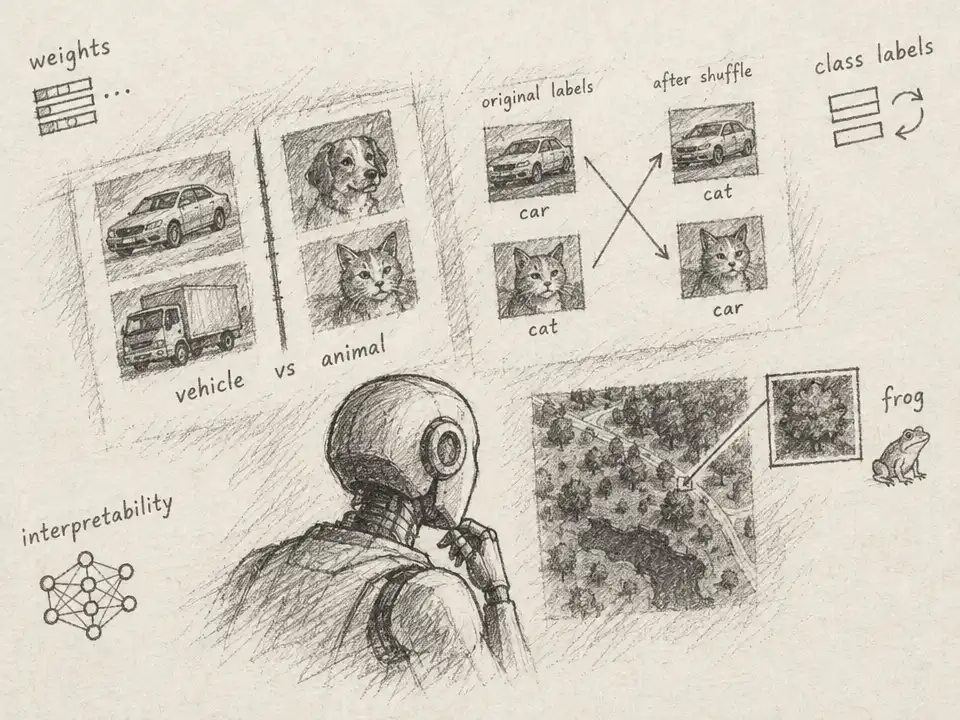
The visible answer from an image classifier is a label—perhaps a type of animal or a kind of vehicle. But inside the model, each image is transformed through layers of numerical activity. Those internal representations form a kind of feature map: images judged similar by the network tend to sit near one another in that hidden space. It is tempting to think that a task determines the map. If a system recognizes the same pictures, surely it must have learned roughly the same inner organization. The researchers behind a new method called Hessian Null Space Continuation, or HNC, tested that assumption by exploring the terrain around a trained model.
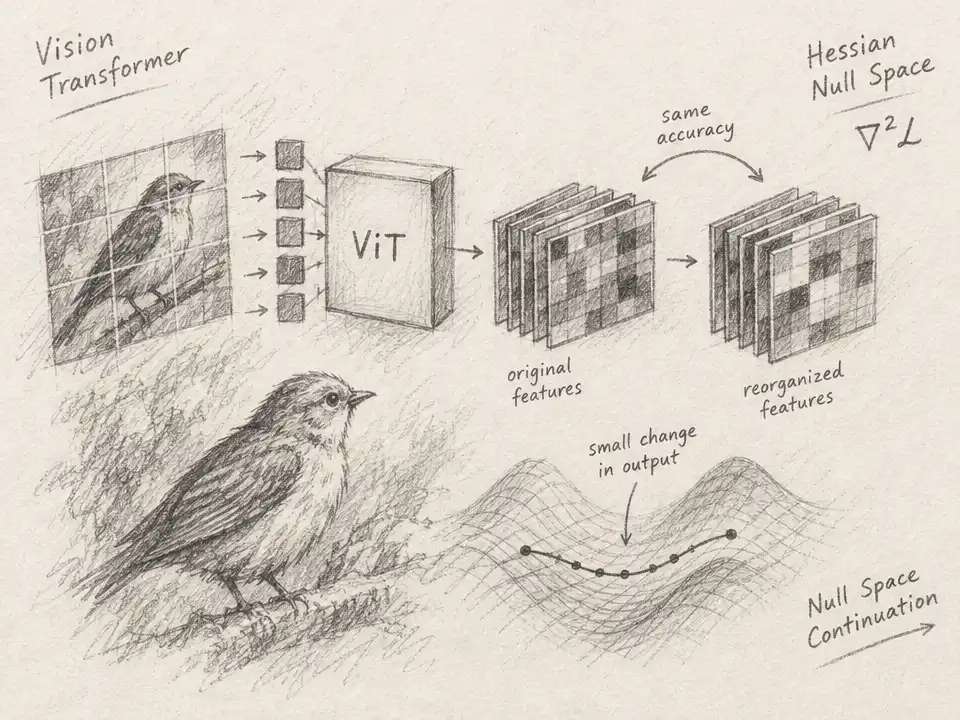
Their starting point was a Vision Transformer with 22 million parameters, pretrained for ImageNet classification. They treated this network as an anchor: a reference whose outputs an alternative should preserve. To check those outputs, they used 512 images from the Places-365 validation set. Meanwhile, they measured the model’s internal representations across its layers and set HNC a different goal: change those representations as much as possible without straying far from the anchor’s outputs.
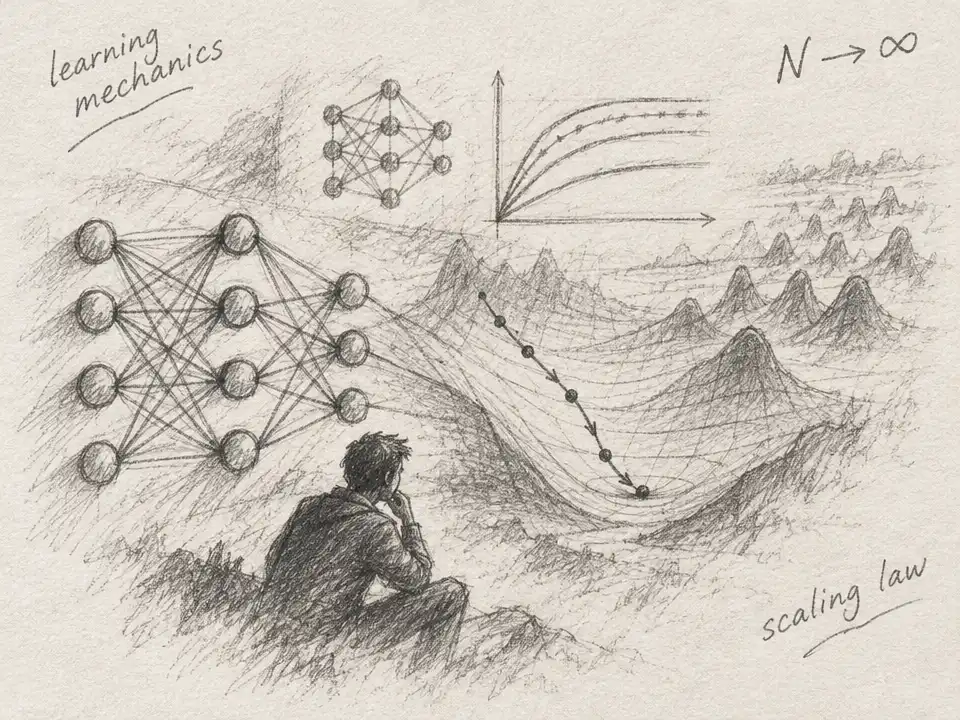
That sounds like trying to alter a machine without changing what it does. The key is that a trained network’s weight landscape is not equally steep in every direction. Some small parameter changes sharply disrupt its outputs; others barely affect them. HNC uses curvature information from the network’s loss landscape to find these flatter directions. It takes a step along one, checks whether the outputs have drifted, and makes a correction to bring them back. Repeating this process creates a careful walk through nearby versions of the model—versions selected for their different internal maps.
The walk led somewhere surprising. The network’s weights changed by only 1.3% in norm, yet its internal representations became less similar to the original than those of every trained vision model in the researchers’ comparison. The new map was even less similar to the original than the representation of a randomly initialized Vision Transformer, according to the study’s measures. Still, on the probe images, the alternative kept the anchor’s top-one predictions. On ImageNet images that had not been used to constrain the walk, top-one accuracy fell by less than 1%, while top-five accuracy stayed nearly unchanged.
What had changed was not simply the answer key. The researchers compared how the networks arranged images in hidden space. The alternative reorganized which images appeared close to one another, including relationships within and across classes. Yet there were patterns it did not erase: among the image pairs it considered most similar, semantic content and color remained meaningful clues. Similarity in spatial layout, by contrast, weakened toward the level of random pairs. In effect, the system could keep much of its image-classification performance while changing what kinds of visual resemblance its internal map emphasized.
This is a shift in scale: from the label at the output to the geometry of the activity that produces it. A classifier’s success does not reveal a unique internal route to that success. The network trained by ordinary optimization may occupy just one among many nearby solutions—a map that works, but is not the only map that could work. HNC makes that possibility experimentally visible, rather than relying on comparisons between models trained separately from scratch.
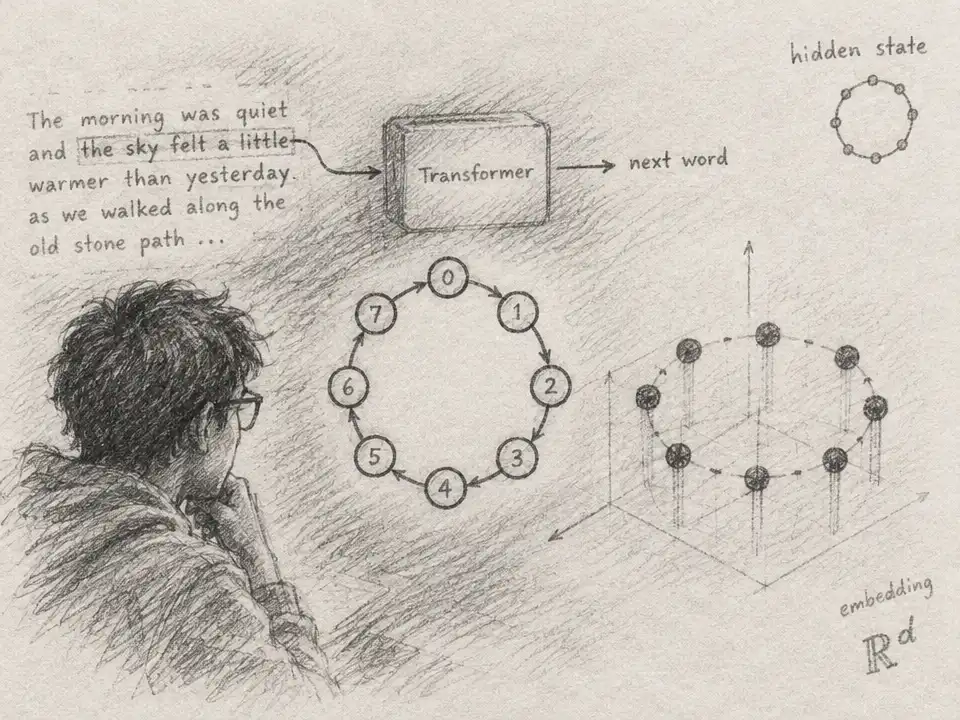
The paper found a related kind of flexibility in a very different system: a recurrent network trained to remember three binary inputs, one for each of three channels. Its usual solution stored the eight possible memory states as stable resting points in the network’s hidden activity. After an HNC walk, one alternative kept the correct output while its hidden state continued to move during periods with no input. The memory was no longer held at eight fixed resting points; it occupied distinct regions of a changing internal landscape. The outside behavior could remain recognizable even as the machinery beneath it took a different form.
But “same behavior” needs a boundary. In these experiments, HNC preserved outputs approximately, and its checks relied on a finite set of probe inputs. Passing those checks cannot guarantee identical responses to every image the model might encounter. The researchers also found that alternative memory networks could differ in robustness to disturbances or in how well they held a memory over prolonged periods. And in a simulated odor-tracking task, an agent could reach the same source by a different route—sliding along the plume’s edge rather than charging straight toward it. A similar score or answer does not mean every hidden process, or every response to unfamiliar conditions, is interchangeable.
That caveat is part of the discovery, not a footnote to it. HNC is a local exploration method, not a proof that every possible solution has been found. Its alternatives depend on which inputs are used as probes and how much output drift is allowed. The ImageNet tests provide evidence that the altered vision model retained much of its performance beyond the probe set, but they do not establish universal equivalence.
Still, the experiment opens a useful window onto a neural network’s hidden world. Researchers can ask which structures are truly needed for a task and which may reflect the habits of the training process that produced one particular model. That could help make internal representations easier to study, compare, or edit. For now, the more basic lesson is striking: when two systems give much the same answers, their inner maps may tell very different stories about how they got there.