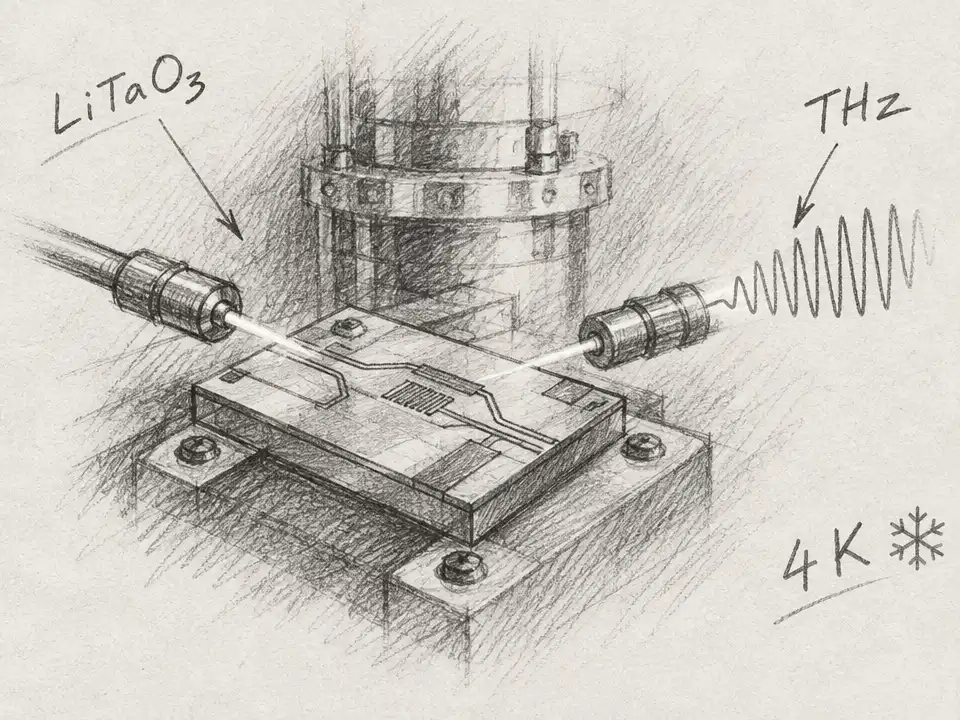
Inside a dilution refrigerator, every wire has a cost. Cables carrying very high-frequency signals can leak energy, crowd a cramped instrument, and bring unwanted heat toward equipment that must stay near absolute zero. Yet those same signals could help researchers probe delicate quantum devices and explore a hard-to-reach region of the electromagnetic spectrum. A new chip offers a striking alternative: send light through fibers, and let a tiny chip turn it into a signal, steer it, and read it back.
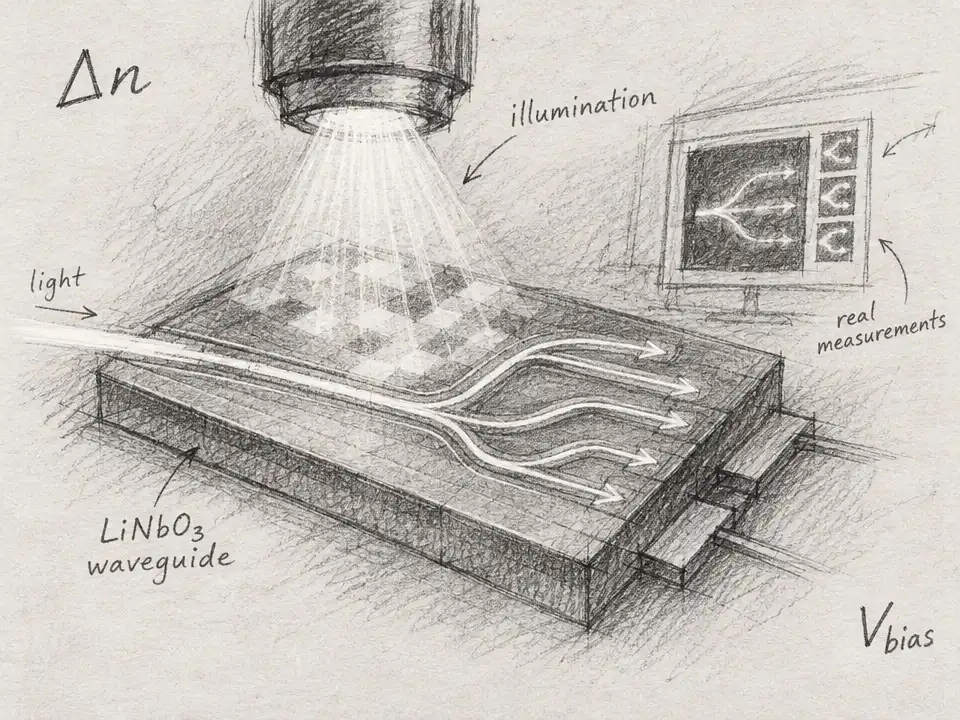
The device, made from thin-film lithium tantalate, is a complete signal chain on a single chip—not just a source or detector. Its optical interfaces are fibers, while a small on-chip metal structure carries the millimeter-wave or terahertz field between the chip’s generator and detector. That distinction matters: “all-photonic” describes how light drives and reads the system, not a signal that travels as light every inch of the way.
To make the signal, two laser tones enter a ring-shaped optical resonator. Their frequency difference becomes a much lower-frequency electromagnetic wave, created in a gold coplanar stripline beside the resonator. The wave travels across the chip to a second resonator, where it imprints itself on a probe beam. The detector reads that imprint as new optical sidebands—small shifts in the light that can be measured outside the refrigerator.
In principle, this converts a demanding electrical relay race into a compact chain linked to the outside world by fiber. In the experiment, the chip operated at selected frequencies from 100 gigahertz to 2.56 terahertz at room temperature. Those weren’t all the frequencies in between: the device worked at discrete resonances, like a set of rungs on a ladder. Still, reaching this far into the terahertz range with generation, on-chip routing, and detection in one system is the central achievement.
The researchers tested the chain at 360 gigahertz, where they inferred a signal power of about 120 nanowatts inside the chip. They also showed that the signal could be shaped rather than simply switched on and left alone. By changing one of the incoming laser beams, they controlled the high-frequency signal’s amplitude and phase. At 360 gigahertz, the measured rise time was 10.3 nanoseconds and the fall time was 9.2 nanoseconds. The controls themselves were off-chip; the important step was that their changes passed through the chip’s signal chain.
Then came the colder test. Mounted in a dilution refrigerator, the device ran at about 4 kelvin, using fiber links to send in light and carry the optical readout back out. At that temperature, the team detected the chain’s response at selected frequencies from 178 to 576 gigahertz. A combined 2.6 milliwatts of pump power entered the generator’s bus waveguide, producing about 77 milliwatts of circulating optical power inside its resonator.
That demonstration points toward a possible use in quantum experiments, where dense electrical wiring can be a practical headache. A light-fed chip might deliver and recover signals near cold hardware without running a separate high-frequency electrical cable all the way to the device. The authors estimate that their measured signal flux could be compatible with weak readout tones in representative superconducting resonators. But they did not connect the chip to a qubit or demonstrate a quantum readout. The experiment establishes a working link, not a finished quantum instrument.
The price of pushing higher is visible in the chip itself. The optical-to-electrical interaction becomes stronger as frequency rises, but the metal stripline also loses more of the signal. At the highest frequencies, radiation and conductor losses increasingly sap the energy traveling between the two modules. The team’s measurements show this tug-of-war directly: a favorable conversion process cannot compensate indefinitely for a lossy route across the chip.
There is another constraint: tuning. The optical resonators have mode spacings of about 36 gigahertz, which help determine which signal frequencies can line up across the generator and detector. The result is a series of usable frequency points rather than a freely adjustable sweep. The authors suggest that reconfigurable resonators could eventually tune between points, while improved metal layouts and substrates could cut losses. Those are design paths to test, not capabilities already demonstrated by this chip.
Even the refrigerator test makes clear that packaging is part of the science. One fiber connection was permanently bonded to the chip, while the detector’s fiber sat on a cryogenic positioner. Cooling preserved the optical spacing needed for operation, but the researchers noted a possible effect from epoxy on one resonator and had to realign the movable fiber during the run. A device meant to simplify a complicated instrument still has to survive the mechanics, materials, and careful alignment of a real cryogenic setup.
The larger possibility is not simply a faster communication line. A source and coherent detector placed close to a device under test could help researchers inspect high-frequency behavior without carrying a fragile signal through long external links. That could matter for spectroscopy, sensing, and future quantum hardware. For now, the chip’s clearest lesson is architectural: light can bring control into a cold, crowded instrument, while a carefully engineered on-chip pathway handles the high-frequency signal itself.
Whether that approach scales will depend on improving the route, not just the conversion at either end. The frequencies remain selective, losses grow toward the terahertz, and the cryogenic demonstration reached only partway up the room-temperature range. But the experiment turns a daunting collection of separate components into a single integrated chain. The frontier it opens is real—and so is the engineering bill still attached to it.