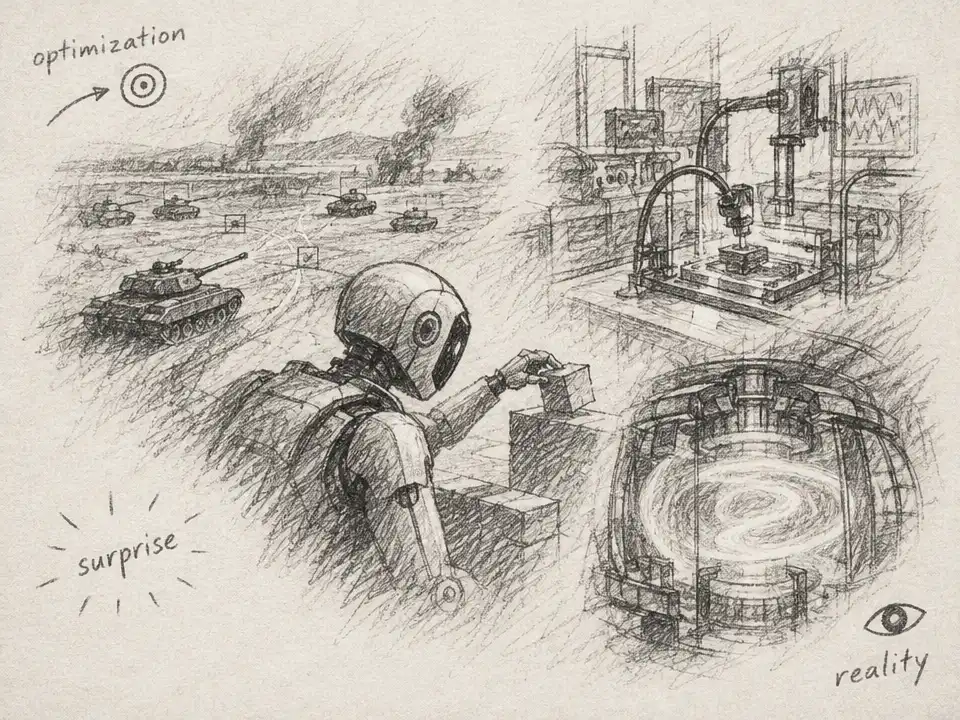
Imagine asking a curious machine to seek surprises. It might stare forever at a flickering screen: every moment unpredictable, nothing learned. Tell it instead to avoid surprises, and it might settle into a silent room. Those opposite dead ends frame a puzzle in artificial intelligence: how can a system seek what is new without mistaking randomness for discovery?
A paper posted to arXiv on July 20, 2026, offers a striking answer. Rather than count every surprise, the researchers asked how much of it a limited learner could turn into usable structure. They called this learnable novelty. Then they used the same basic score in three very different settings: simple cellular automata, handwritten digits, and reinforcement-learning agents. The surprising part was how much common ground the score appeared to find.
The idea depends on the observer. Picture a learner watching a stream of events with a small notebook. Some patterns fit in the notebook: after seeing them, the learner can predict what comes next. Other events remain bewildering, or turn out to be pure noise. The researchers’ score aims to capture the first kind of surprise—the structure this particular learner can absorb—not the total amount of unexpected information in the stream.
To estimate that structure, the team used a fixed, randomly initialized computing system called a reservoir, followed by a simple readout that learns to predict patterns. The reservoir does not get smarter as it watches. That constraint makes the measure practical, but it also sets its limits: the score can only recognize structure this particular observer is equipped to capture.
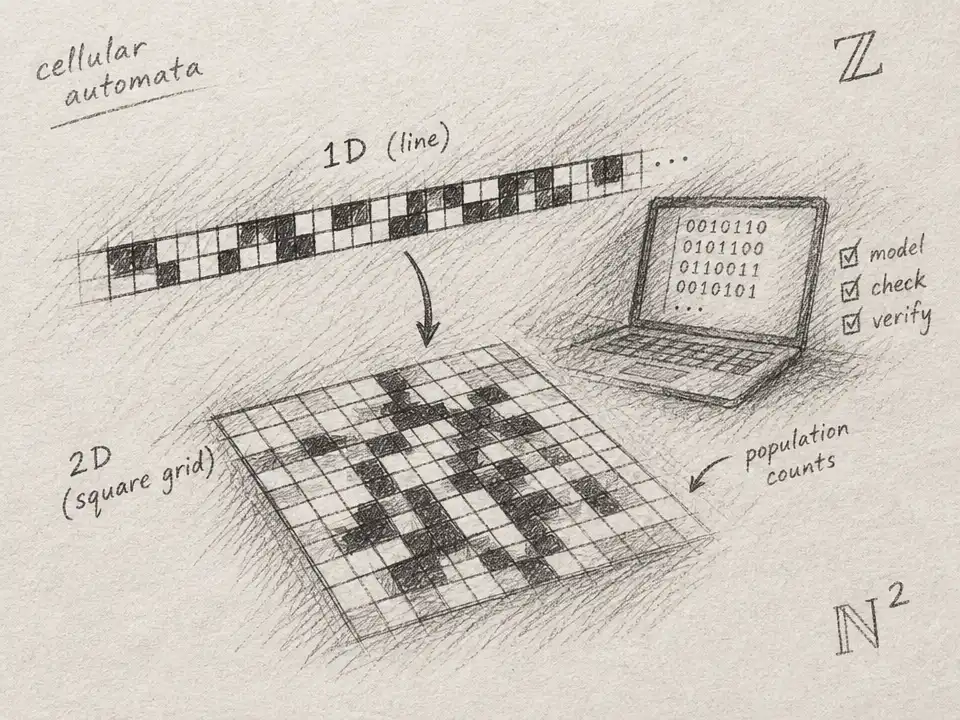
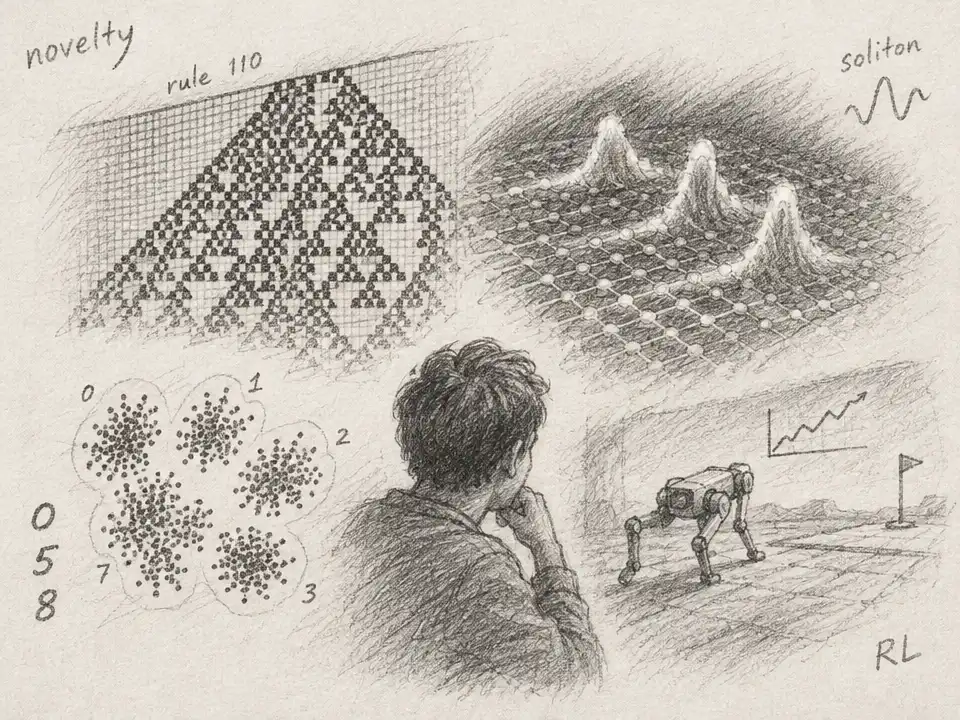
First came a test on cellular automata: tiny rule systems that update a row of cells based on nearby neighbors. The researchers compared 88 distinct elementary rules, letting each evolve on a width-64 ring and measuring patterns in its next 32 steps. The score ranked rule 110 highest. That was notable because rule 110 is the one elementary cellular automaton proven Turing-complete: in principle, it can perform any computation that a universal computer can.
This did not mean the score had proved that every highly intelligent system must resemble rule 110. It did show that a learner with no examples of the researchers’ complexity rankings could place this famously computational rule at the top. Simple, repetitive rules scored low; chaotic rule 30 landed below more structured rule 54. The ranking suggested that neither perfect order nor unstructured disorder gave the observer much to learn.
Then the researchers turned the score from a measuring tool into a target. They trained a neural cellular automaton—a grid of interacting cells with adjustable update rules—to increase its learnable novelty. Across nine random starting seeds, the initially simple dynamics developed solitons: compact patterns that travel at a steady speed and interact when they meet. Such moving structures can carry and combine information in rule 110. The experiment did not establish that the trained grid could compute anything whatsoever; it showed that optimizing the score repeatedly produced organized, information-rich behavior.
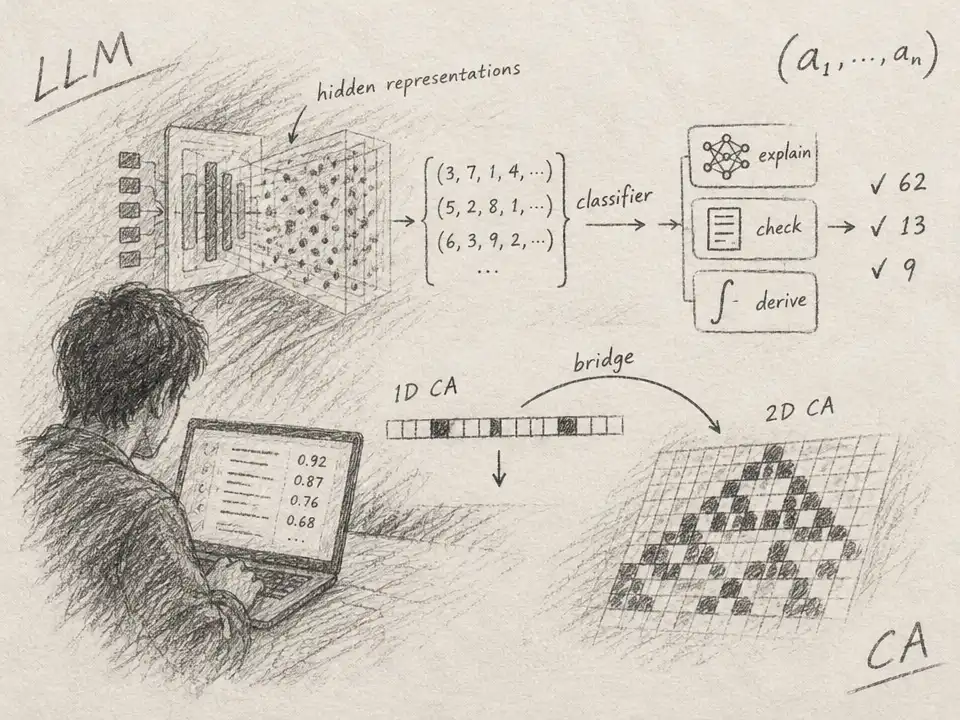
The same principle produced a different surprise in images. The team trained an encoder on MNIST, a collection of handwritten digits, without feeding it any digit labels. Its job was to turn each image into a compact, 64-dimensional representation while maximizing learnable novelty. As training progressed, digits that looked alike became more organized in that representation. A linear classifier’s accuracy in identifying the digits rose from 0.53 to 0.89; a five-nearest-neighbor classifier rose from 0.66 to 0.89. Labels were used to check the result, not to train the encoder.
Finally, the researchers asked whether learnable novelty could help an agent explore an environment. They added it as a bonus to the usual task reward, so the task still specified the goal while the bonus encouraged exploration. In tests across ten environments, the combined reward improved on the task-reward baseline in nine. It fell about 4% short on Walker2d, where the ordinary reward already supported effective exploration. The reported runs used 600,000 training steps and averaged results over ten random seeds.
That bonus mattered most when a task’s reward gave an agent little guidance about what to try. In Acrobot and MountainCarContinuous, for example, the bonus helped all tested seeds solve tasks that had produced unreliable results under task reward alone. But novelty was no substitute for a goal: agents given only the novelty reward generally did not complete the tasks. In some cases, they could even learn to avoid a finish that would end their opportunity to collect more novelty.
The researchers also tested a simpler bonus: reward agents for large state values. That shortcut helped in some environments but hurt in others. In LunarLander, for instance, the magnitude bonus lowered the reported return from +169 to −171, while learnable novelty raised it to +208. The contrast suggests the useful signal was not simply “go farther” or “make bigger movements.” It was movement through patterns the bounded observer could still learn.
There are important limits. The observer remained fixed, so structure it could not recognize was invisible to the score. In the agent experiments, the bonus weight was calibrated for each environment, and the task reward still anchored performance. The authors present a promising shared measure, not proof that one objective explains intelligence in general.
Still, the result overturns a tidy expectation: complexity, useful representations, and exploration may not need completely separate incentives. In these experiments, all three emerged when a system was pushed toward surprises that a limited observer could make sense of. The most productive surprise was not the strangest thing a machine could encounter. It was the pattern just beyond what it already knew how to read.