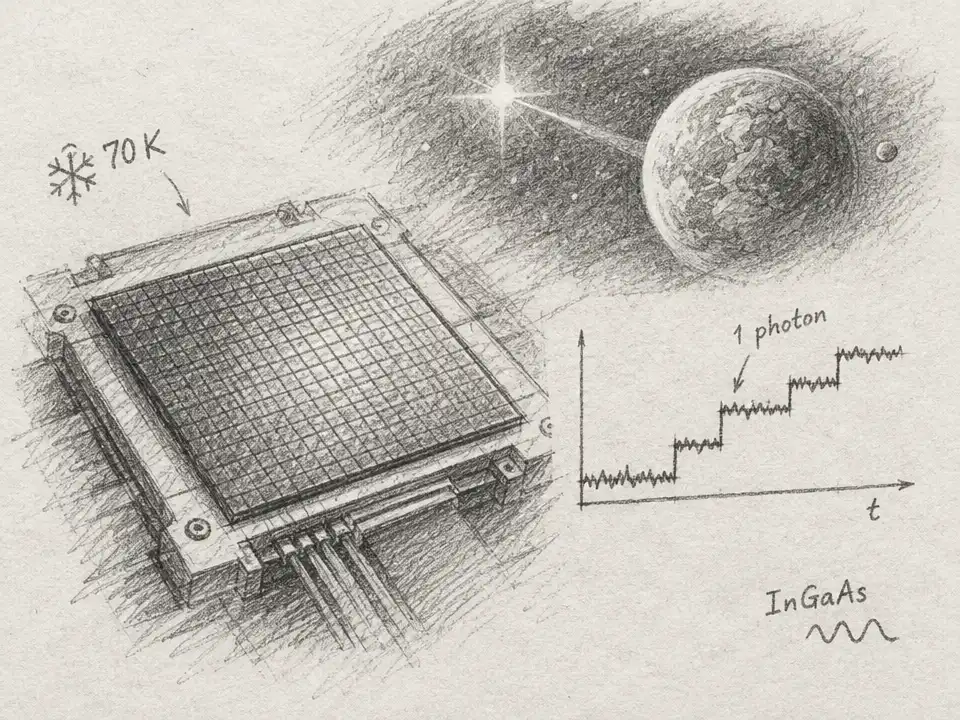
A microwave photon arrives. The detector catches it—and then has to check whether it did. That pause is a problem: while a conventional detector measures and resets, another photon could slip by unseen. For years, resolving individual microwave photons seemed to demand a choice between watching continuously and detecting efficiently. A new experiment suggests that choice may not be unavoidable.
The challenge starts with the photons themselves. Microwave photons carry far less energy than visible-light photons, so catching one requires a carefully engineered device. Some microwave detectors can run continuously but do not reliably resolve single arrivals; superconducting-qubit detectors can register individual events, but typically take turns listening, measuring and resetting. The detector is effectively blinking during the very moments when an unpredictable photon might arrive.
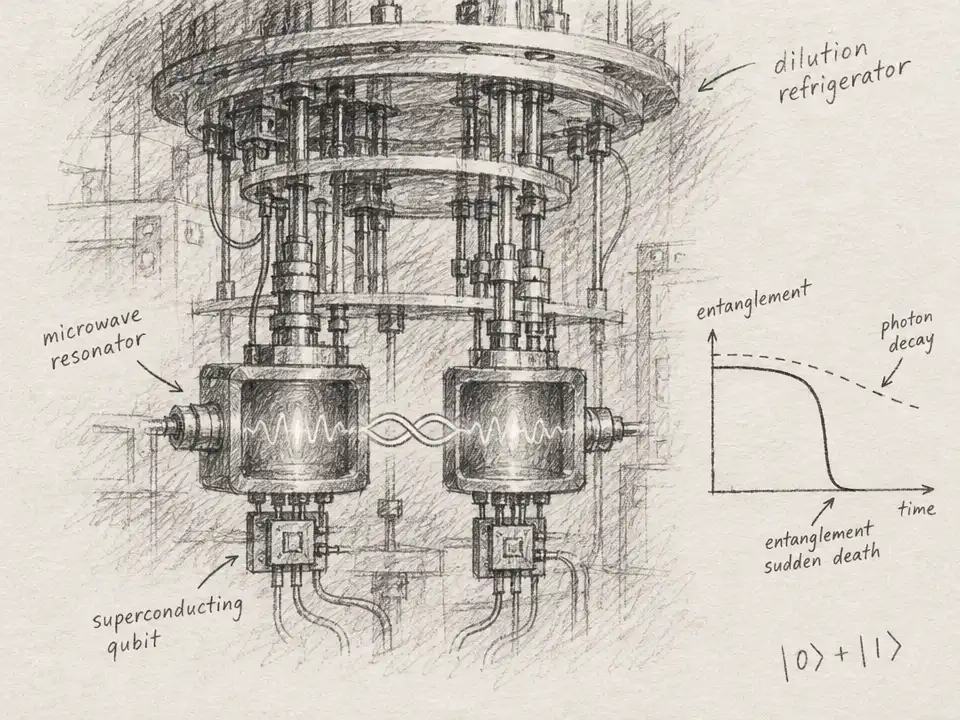
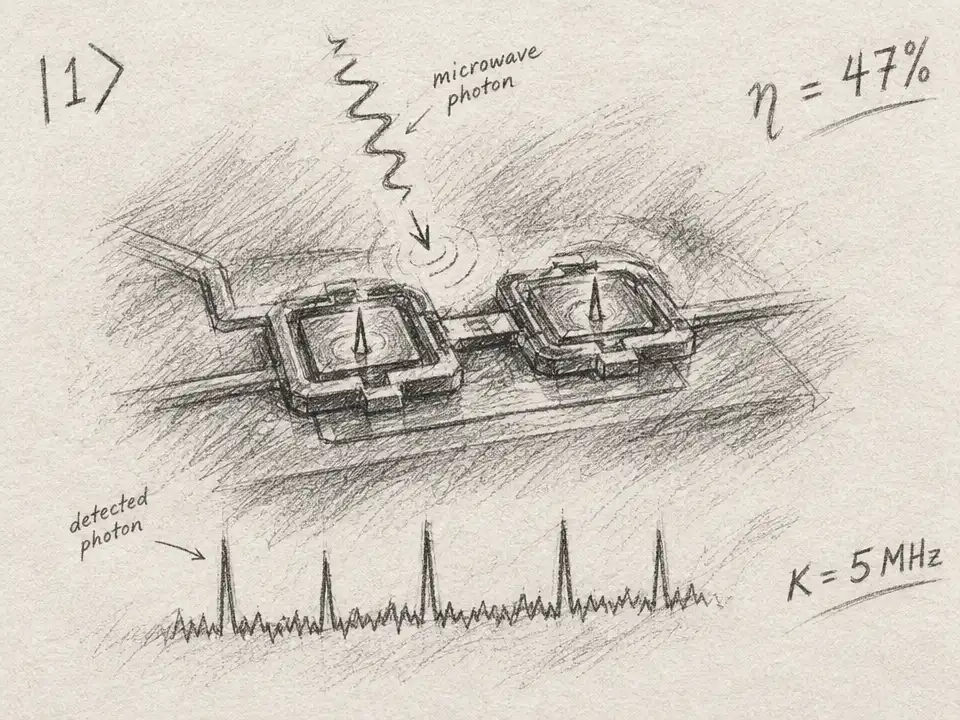
Researchers at Chalmers University of Technology built a different kind of circuit: two coupled superconducting qubits that behave like an artificial molecule. At 8 mK, the pair’s quantum states can be arranged by symmetry. One state interacts strongly with incoming microwaves, making it bright to the input channel. Another interacts much more weakly, making it dark and longer-lived. The names describe how readily the states couple to the outside world—not whether they emit visible light.
The detector uses that contrast as a handoff. An incoming photon excites the bright state. A continuously applied pump then helps move the excitation through a higher-energy state; the system relaxes into the dark state. Meanwhile, a separate readout monitors that dark state. When the molecule switches from its ground state into the stored state, the readout registers a quantum jump: the detector’s version of a click.
The dark state is not an everlasting memory. It eventually relaxes, freeing the device to detect again. But it lasts long enough to separate two jobs that are awkward to combine: absorbing a weak photon and reading out evidence that absorption happened. The pump and readout can stay on while the device waits for the next arrival, rather than forcing it to stop and reset after every measurement.
The team first tested the circuit in the more familiar cyclic mode. A pump pulse opened a detection window, a photon pulse was sent in, and the state was measured at the window’s end. For weak pulses, the measured cyclic detection efficiency was 0.73. That was a useful benchmark—but it did not solve the blinking problem. Photons arriving outside the acquisition window could still be missed.
Then the researchers left the pump and readout running continuously. They sent a calibrated, weak microwave signal toward the device and tracked its readout in 1 μs bins. A filtered trace showed discrete jumps rather than just a smooth change in the signal. As the incoming photon flux increased, the jump rate rose linearly. From that relationship, the team measured a continuous detection efficiency of 0.47, over a 5 MHz instantaneous bandwidth.
That is the unexpected result: continuous monitoring did not erase the detector’s ability to register individual events. The experiment reports a detector that resolves single microwave photons while remaining on, with 1 μs temporal resolution. The reported dead time is 15 μs, set by how long the dark state takes to relax. So “always on” does not mean it can register a second photon immediately after every click; it means the device can watch for arrivals without scheduling separate listening and readout windows.
The continuous version also reveals why the design is a balancing act. If the readout is too weak, the signal from a jump can be hard to distinguish from noise. Turn it up too far, though, and measurement back-action disturbs the bright state that needs to absorb the next photon. In this device, monitoring the dark state also dephases other molecular states, reducing the efficiency of photon capture. The best result comes between those extremes, not at maximum readout power.
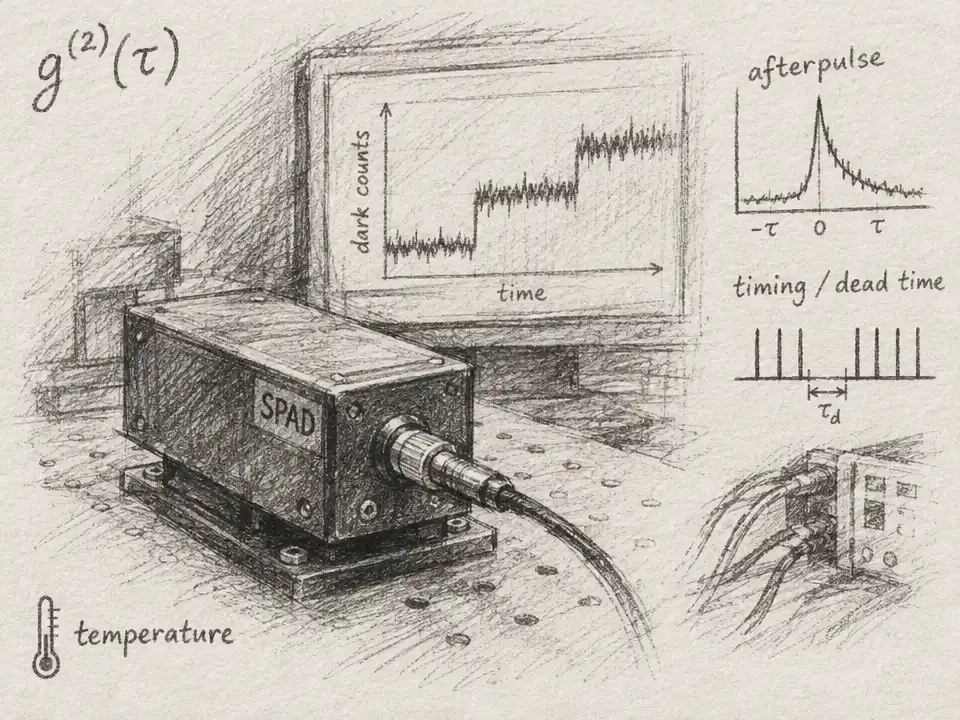
False clicks remain another limit. The measured continuous dark-count rate was 1.3 kHz, and the authors identify residual thermal photons in the input line as an important source of background. The continuous efficiency, too, was lower than the cyclic value of 0.73. Those numbers matter: this is a laboratory demonstration of a new operating method, not a finished detector that never misses a photon. Its value is showing that continuous operation and single-event readout can coexist in the same microwave circuit.
The underlying idea is less like listening harder than like building a relay. A photon enters through a state designed to catch it; the circuit transfers its trace into a different state that can be watched without immediately losing the evidence. The researchers’ model reproduces the measured efficiency trade-off using independently calibrated parameters, and they suggest that more selective readout could reduce the unwanted disturbance. That improvement remains a proposal, not a demonstrated performance gain.
For experiments that wait on unpredictable emissions, a detector that need not blink could open new ways to track microwave signals, including fluorescence from a single spin. The advance is not that the circuit catches every photon. It is that the qubits’ symmetry gives a faint, fleeting arrival somewhere to go—and gives the detector time to notice it.