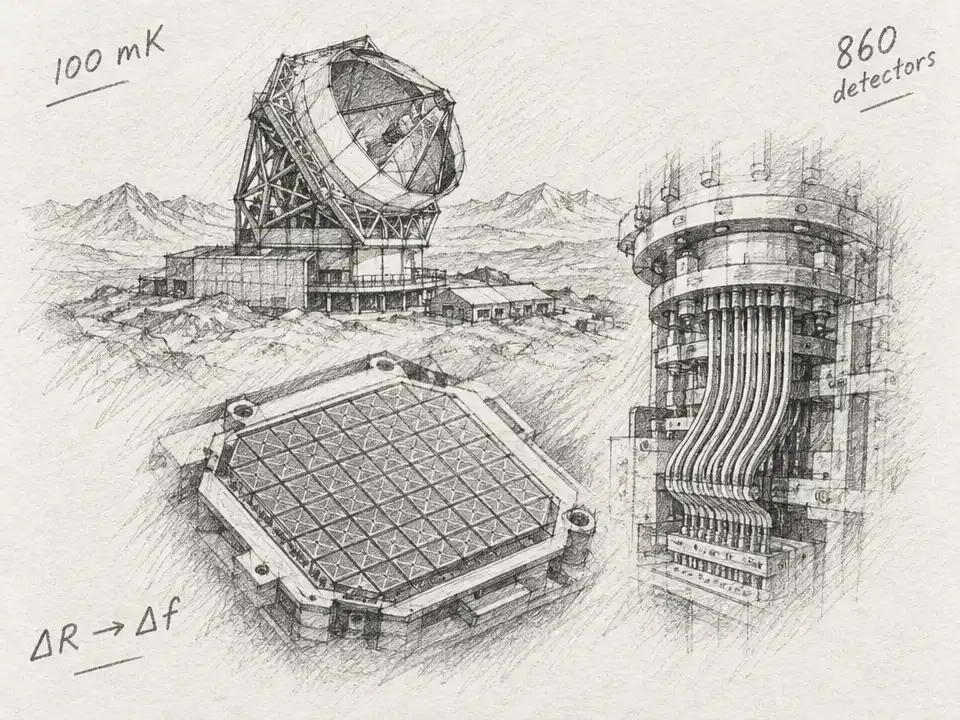
At 5,200 meters above sea level, on Chile’s Cerro Toco, the Simons Observatory is built to map the faint microwave glow left over from the early universe. Its 6-meter Large-Aperture Telescope gathers that light and funnels it toward an instrument whose most astonishing work happens out of sight: inside a receiver chilled to 100 millikelvin, where 63,000 detectors must be heard without giving every one its own microwave cable.
The puzzle is one of scale. A telescope can collect light across a huge mirror, but a map is only as good as the measurements made at its focal plane. The observatory’s detectors are superconducting transition-edge sensors, or TESs. They are made to operate near a delicate boundary: cold enough to be superconducting, but poised to become slightly resistive when they absorb incoming energy. The detectors have a target critical temperature of 160 millikelvin and operate around 100 millikelvin.
That narrow operating range makes them sensitive to faint changes in microwave power. When radiation deposits energy in a detector, its resistance shifts; the current through its circuit shifts with it. The signal is tiny, but the instrument gives it a longer route through which to become legible. Each detector circuit is inductively linked to a superconducting quantum interference device, or SQUID, which responds to changes in magnetic flux. The SQUID, in turn, is coupled to a microwave resonator.
Here the story changes scale again: from a minute resistance change to a tone traveling along a shared line. Each resonator has its own frequency, chosen within a band from 4 to 6 gigahertz. The readout electronics send a collection of microwave tones into the cold receiver and measure what comes back. A detector’s changing signal nudges its resonator’s response, shifting the phase of its tone. Because the resonators occupy distinct frequencies, their signals can share a transmission line and still be separated at the other end—rather like many instruments playing different notes into one carefully tuned listening system.
The arrangement is called microwave frequency multiplexing. In the telescope’s mid- and ultra-high-frequency modules, a single transmission line reads out 860 optically coupled detectors. The low-frequency modules use a different arrangement, with 236 optically coupled detectors per line. Across the Large-Aperture Telescope, the paper describes 63,000 detectors; across the observatory’s four telescopes, nearly 100,000 superconducting detectors have been deployed.
This sharing is not a trick that removes the need for a complex instrument. Each module has cryogenic detector and readout circuits, while warm electronics generate and track the microwave tones. The signals travel between them through a ladder of temperature stages. The focal plane sits at 100 millikelvin; radiation shields step through 1 kelvin, 4 kelvin, 40 kelvin, 80 kelvin, and 300 kelvin. Five pulse-tube coolers and a dilution refrigerator help maintain those conditions. The electronics that decode the returning signals operate outside the coldest part of the system.
The temperature ladder is more than an engineering backdrop. At these scales, warmth is a source of unwanted energy, and the detector is designed to react to very small energy changes. The observatory must keep the sensors cold while letting useful signals enter, then amplify and carry those signals without adding too much noise of its own. Even the everyday hardware has to survive the mountain: the team reports dealing with cold-sensitive commercial components, precipitation protection, disconnected cables, and failed cryogenic amplifiers during deployment and commissioning.
Before the telescope can use the sensors for observations, the readout system has to find each resonator, learn how it responds, and keep its probe tone near the resonant frequency as the detector signal changes. Software first sweeps tones across the microwave bands and identifies resonances as dips in the returning signal. Then the system continuously tracks them. The SQUIDs’ response is periodic, so a repeating flux ramp helps make that response easier to interpret. In the paper’s description, the readout electronics generate a 4-kilohertz flux ramp for detectors with millisecond time constants.
When the team tested the integrated system, it identified 93.1% of microwave resonators and 86.3% of SQUIDs. In measurements of detector current-voltage curves, 81.4% of the TES detectors showed a measured superconducting transition—above the project’s 80% goal criterion. These figures describe commissioning checks, not a claim that every detector was simultaneously operating during an observation. The analysis also excluded one focal-plane module because of a readout-chain issue, which the team planned to address during a later warm-up.
The readout’s own noise matters, too. The team measured a median readout noise of 68.1 picoamperes per square root hertz, compared with a target of 65. They estimate that this readout contribution is at the percent level relative to the overall on-sky noise of operating detectors. That is a useful distinction: the electronics need not be noiseless, but their contribution must stay small enough that the telescope can still make sensitive measurements of the sky.
The paper is an account of an early operating phase, not a report of a new cosmic discovery. Its achievement is infrastructural: a detailed demonstration that a large, cryogenic detector array can be read out and that the integrated system meets key performance benchmarks. The telescope’s science goals include studying the growth of large-scale structure and constraining cosmological models; reaching them depends on collecting clean, reliable signals from a vast focal plane.
From the summit, the telescope appears to be an eye trained on the universe. At its focal plane, the view is stranger and more intricate: thousands of sensors held near a superconducting threshold, each translated into a faint change in a microwave resonance, many of them sharing a single line. The sky’s ancient light is the reason to build the observatory. But before that light can become a map, its whisper must pass through this hidden network—and emerge with its meaning intact.