A computer proposes a crystal with a useful property. The obvious next question is whether anyone can make it. But before asking that, a team of researchers tried a different one: where does the proposed structure sit on the map of crystals people have already made?
The answer overturned one expectation. Computer-generated candidates did tend to stray beyond familiar structural territory. But they were not uniquely adventurous: high-throughput calculations that were not generative AI strayed about as far. The sharper divide was between materials realized in experiments and materials proposed by computation.
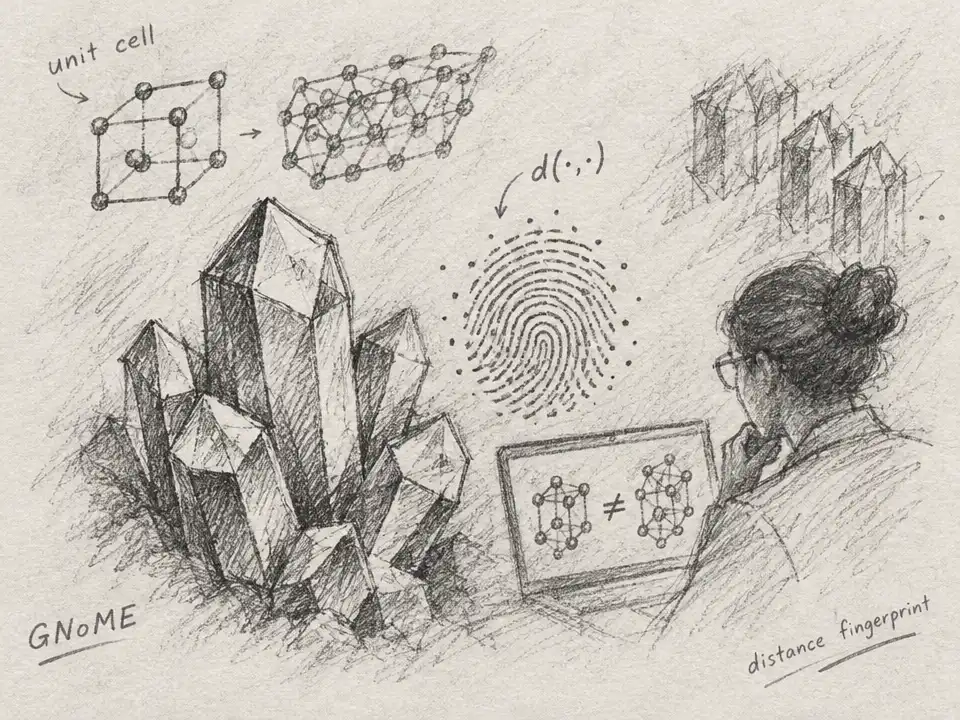
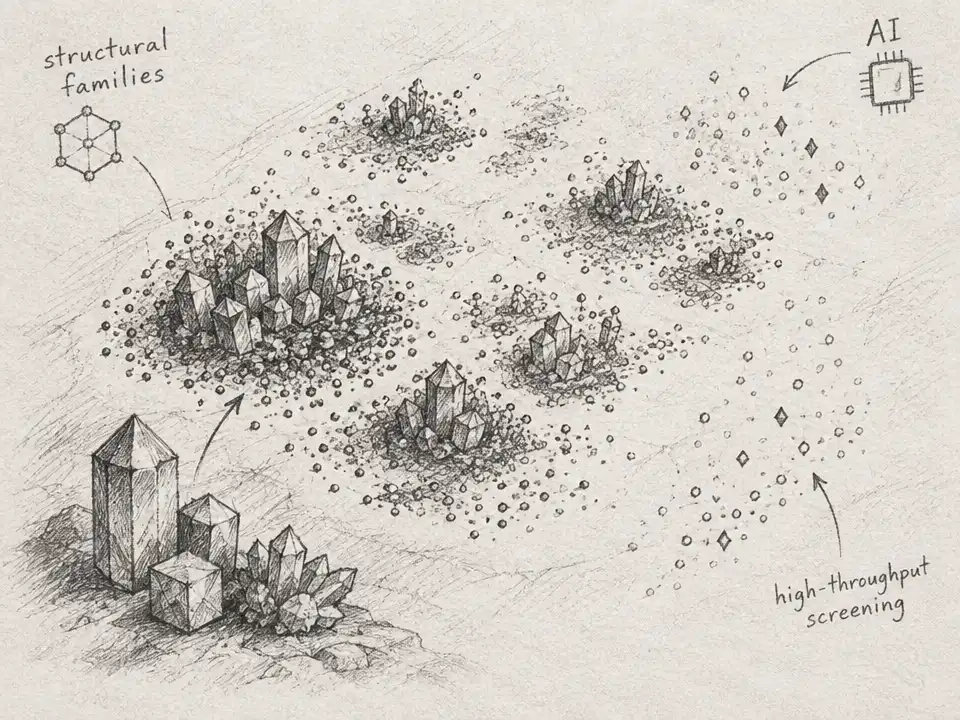
In a June 29, 2026 arXiv preprint, Dan Nguyen and colleagues built their map from 167,500 entries in the Inorganic Crystal Structure Database. A crystal is not just a list of ingredients; its atoms repeat in an organized arrangement. The team encoded both the elements and their local surroundings, then placed structures with similar features near one another in a shared, 32-dimensional space.
Think of that space as a landscape of structural neighborhoods. A neighborhood does not mean every crystal inside it is identical. The largest communities could include many different crystallographic space groups: among the ten largest, the average was 44.2, with a range of 16 to 86. The map was designed to group related arrangements even when their formal labels differ.
Then the researchers added a timeline. When a newly recorded structure joined a neighborhood already represented in the database, it counted as an attachment. When it appeared in a structural community not seen before, it counted as opening new territory. Those are measures of the database’s history, not a count of every material anyone has ever discovered.
The historical pattern was striking. Among newly reported chemical formulas that the team could match to its comparison network, 82.9% entered structural communities that already existed. Across the database, the share of entries opening new communities fell from 40.2% in the 1930s to 2.6% in the 2010s. Meanwhile, same-community attachments rose from 60.9% to 88.0%.
That could have been a quirk of the map: perhaps its clustering method simply made old neighborhoods look crowded. So the team checked whether the neighborhoods tracked recognizable shifts in research. They did. A community associated with cuprate superconductors began appearing after the 1986 breakthrough and grew at a rate of 22.3 entries per year afterward. A community of colossal-magnetoresistance manganites showed a 32× increase in its member rate after a 1994 report. In other words, the map registered moments when researchers began exploring a promising structural family in earnest.
Only then did the team place computational proposals onto the same historical terrain. It compared several public samples—including proposals associated with generative systems and structures from high-throughput density-functional-theory databases—with crystals held back from the historical map. The holdout mattered: it let the researchers ask how often later experimental discoveries landed inside neighborhoods formed by earlier discoveries.
For experimental structures published after the map’s cutoff, the in-basin share was 52.0% using a map ending in 1990, 58.1% for a map ending in 2000, and 60.6% for one ending in 2010. Every computational sample landed inside the historical neighborhoods less often. By the 2010 cutoff, the gap ranged from about 13 percentage points for the MatterGen sample to about 37 for the Alexandria sample.
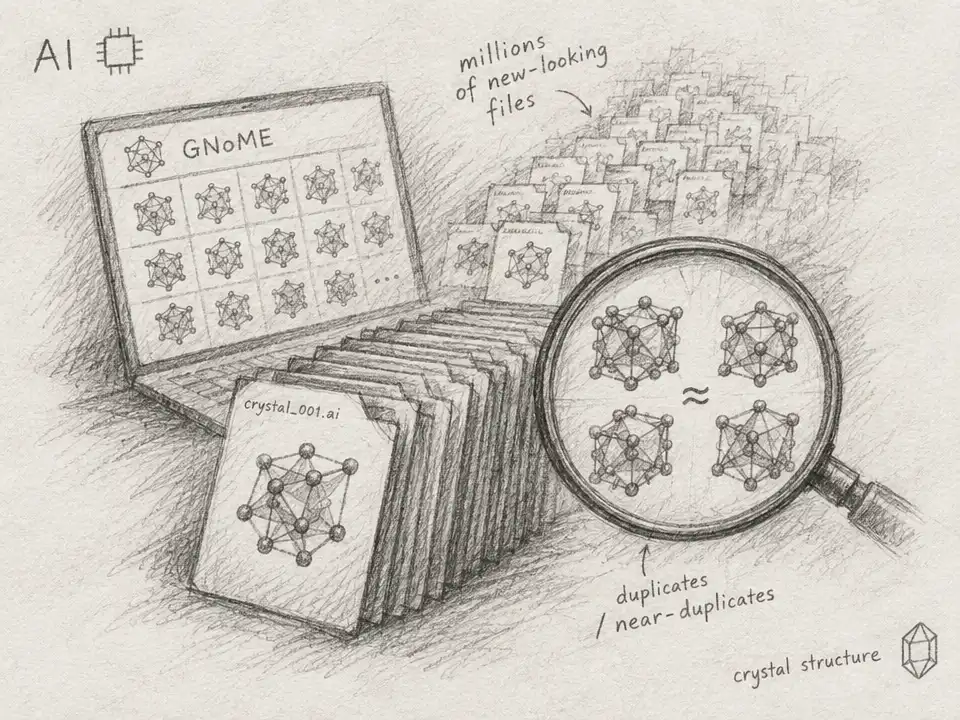
Here came the more surprising turn: the pattern did not single out AI. At the 2010 cutoff, 36.4% of the sampled GNoME structures landed in a known basin, compared with 35.8% of the sampled theoretical structures from the Materials Project. The team found those rates statistically indistinguishable across the cutoffs they tested. A generative model and a conventional high-throughput calculation were both exploring beyond the regions most densely occupied by experiment.
Why might that happen? Making a crystal is not the same task as calculating whether a proposed arrangement looks favorable. The researchers suggest that experimental work often advances through structural neighbors: a known arrangement offers a practical starting point for trying related materials. Computation, by contrast, can score a target structure without mapping the route from familiar ingredients and phases to a sample in a lab. An unfamiliar position on the map may therefore mean ambitious exploration—or a harder synthesis problem. The map alone cannot tell which.
That distinction gives the work a practical use, but also sets a firm limit. Combining a known composition with a structure inside an established neighborhood gives a proposal stronger historical precedent than one that is novel on both fronts. In the samples studied, about 7% of the Materials Project and JARVIS candidates met both conditions; 2.3% of the MatterGen sample did. The researchers describe this as a prioritization clue, not a prediction that a crystal will succeed in synthesis.
That caution matters. The study compares particular public releases and filtered database samples, not the complete output of every model. Its experimental record ends in 2015, and its structural-distance score does not measure whether a material is stable, useful, or impossible to make. A structure outside the map may be an unsynthesizable dead end—or exactly the new territory a materials search hopes to reach.
The map does not rule on whether computational discovery works. It changes the question. Instead of asking only how many new structures a search can propose, researchers can ask how far those proposals lie from chemistry already realized in the lab. Familiar ground can be a useful trailhead. But sometimes the point of drawing a new map is to see what lies beyond it.