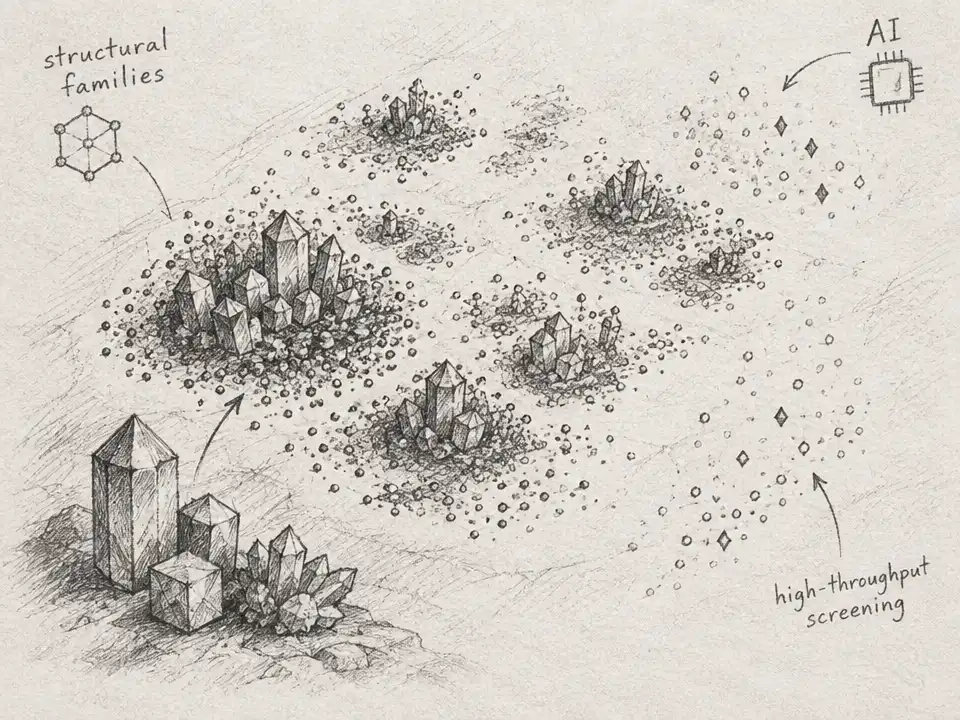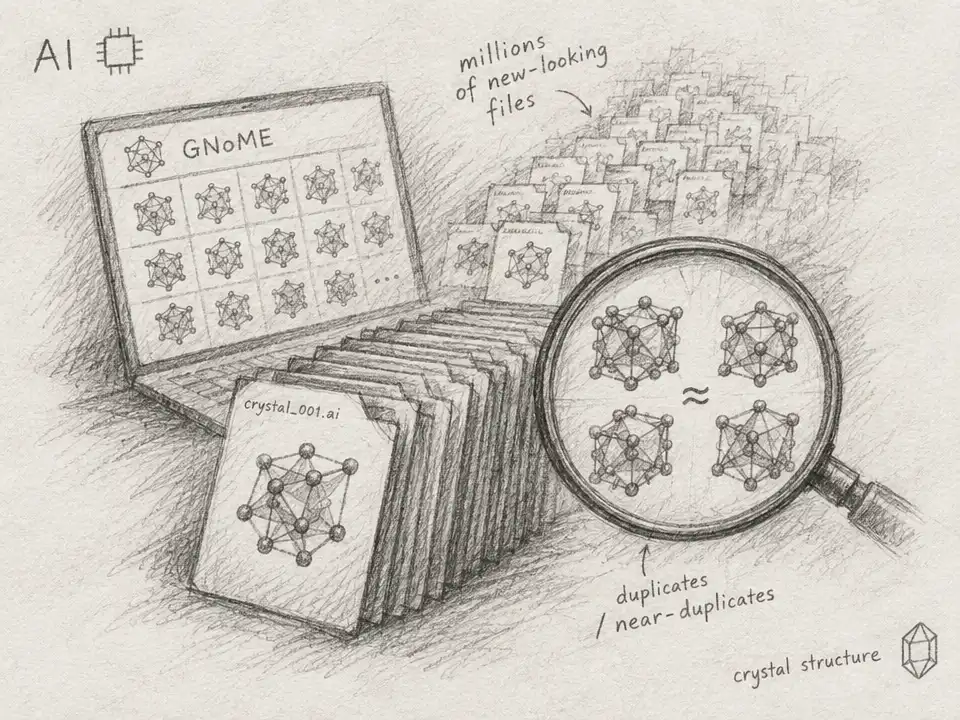
Imagine a machine-learning system handing you a catalog of hundreds of thousands of possible crystals. Each entry has a name, a chemical recipe and a file describing where its atoms sit. The list looks like a map to undiscovered matter. But there is a catch: two files can look different while describing the very same repeating arrangement of atoms.
That distinction matters because a crystal is not just a chemical formula. Carbon atoms, for example, can form diamond or graphite: same ingredient, different arrangement, different material. Yet the reverse problem is just as tricky. One crystal can be recorded in many different ways, like the same neighborhood shown on maps with different borders, scales or starting points. A new file is not automatically a new structure.
In an October 2026 arXiv paper, Daniel Widdowson and colleagues put that problem to a demanding test. They examined two public releases of Google’s GNoME crystal predictions, a high-profile effort to use AI to identify promising materials. The researchers expected that ordinary file comparisons and familiar crystal-matching tools might fail to recognize some equivalent structures. Their analysis found that the answer depends sharply on what counts as a match—and that a database can appear more novel, or more repetitive, depending on the test.
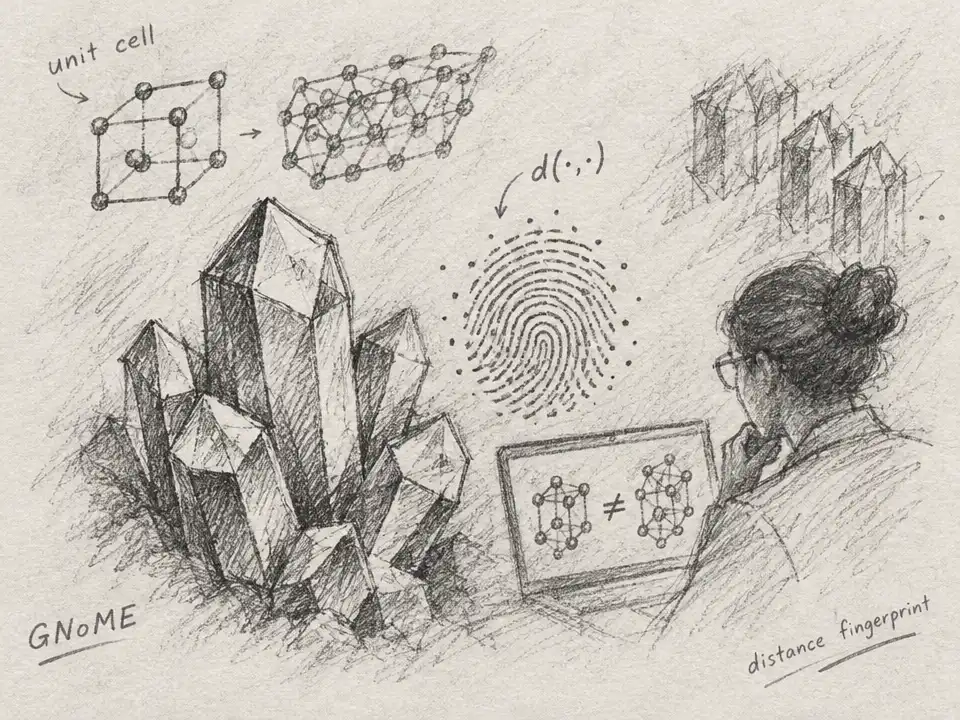
The challenge begins with the unit cell: a small block of atoms that can be repeated in three dimensions to build the entire crystal. There is no single compulsory block. You can choose a different starting point, rotate the arrangement, or use a larger block containing several copies of the smaller one. The infinite crystal remains unchanged, even though its file can look quite different. A comparison based too heavily on the chosen cell can mistake a change of description for a change of substance.
The team instead built a hierarchy of geometric fingerprints. Some compare how far each atom is from its neighbors; stronger versions retain more of the pattern and can distinguish structures that simpler summaries confuse. The useful idea is that the fingerprint describes the repeating arrangement rather than the particular cell chosen to write it down. The researchers also kept two questions separate: are two entries geometrically alike, and do they preserve the same chemical elements? That distinction is essential. Similar geometry does not prove two crystals have the same chemistry or properties.
GNoME’s first release contained 384,938 entries; its later release contained 554,054. At the strictest comparison, the first release included groups of entries with matching geometry and chemistry: 1,178 entries were excess beyond one representative per group. Broaden the geometric comparison to a tolerance of 0.01 Å, however, and the picture changes dramatically. The researchers counted 47,878 excess entries in GNoME’s first release and 84,092 in the second—12.438% and 15.178% of those databases, respectively.
Those larger figures need a crucial qualifier: they came from a geometry-only screen. The same analysis, when it required the chemical elements to match as well, found a much smaller redundancy rate in the first release, 1.156%, and no matching pairs in the second release up to that 0.01 Å tolerance. These are not interchangeable measures, and the broader screen does not mean that all flagged entries are the same useful material. It shows how quickly a count of “duplicates” grows when the definition of similarity changes.
The version history offered another clue. The researchers found that the later release had removed many of the first release’s groups of entries with matching geometry and chemistry. In their analysis, 95.3% of first-release entries with a geochemical duplicate had been dropped, compared with a background removal rate of 21.7%. That pattern suggests curation had already caught many exact or near-exact repeats. At the same time, the later database contained more geometry-only groups under the broader tolerance, a reminder that cleaning up one kind of duplication does not settle every question about novelty.
To demonstrate how easily a file-based novelty test can be fooled, the authors describe a simple program that can turn existing crystal structures into millions of new-looking files in about a day on a small laptop. It rearranges how the crystal is represented, enlarges the chosen cell and makes small changes to atom positions. The result can look unfamiliar to a cell-based matcher while remaining a near-duplicate of a known structure. This was not evidence that GNoME deliberately did such a thing, nor a discovery of millions of new substances. It was a stress test: a way to show that a benchmark can reward novelty of paperwork rather than novelty of matter.
The distinction reaches beyond headline-grabbing counts. If near-identical structures slip into both the training and test portions of a machine-learning dataset, a model may seem better at predicting unfamiliar materials than it really is. A reliable test has to ask not just whether two records differ, but whether the structures differ in a meaningful, measurable way—and whether their chemistry and physical plausibility make them worth pursuing.
The researchers do not show that AI-generated materials are all repeats. Their paper notes that experimental follow-up has produced real materials from AI-guided searches, and their analysis is not a verdict on every prediction in a large database. It is a warning about the measuring stick. A prediction can be stable in a calculation yet still be chemically impractical, physically implausible or too similar to something already known. Novelty, stability and usefulness are separate claims.
For materials science, then, the surprising result is not simply that a database contains duplicates. It is that the word new can quietly change meaning as a crystal moves from atomic geometry to a computer file, from a file to a benchmark, and from a benchmark to a discovery claim. Before asking how many materials AI can invent, researchers may first need a sturdier answer to a deceptively basic question: when are two crystal records actually the same thing?