On a water-rich world, the ocean may not rest directly against the rocky interior. A deep mantle of ice, squeezed into forms unfamiliar on Earth’s surface, can lie between liquid water and rock. That frozen layer might seem like a barrier. But a new high-pressure experiment asks a more revealing question: what if the ice itself can carry ocean salt upward—and then drop it?
The question matters because salts help determine the density and chemistry of an ocean. Many models have treated the deep ice as a kind of one-way sieve: as it freezes, dissolved salt is pushed back into liquid water. If the ice instead stores salt, then its motion could connect a planet’s rocky interior to its ocean—or interrupt that exchange before the salt gets there.
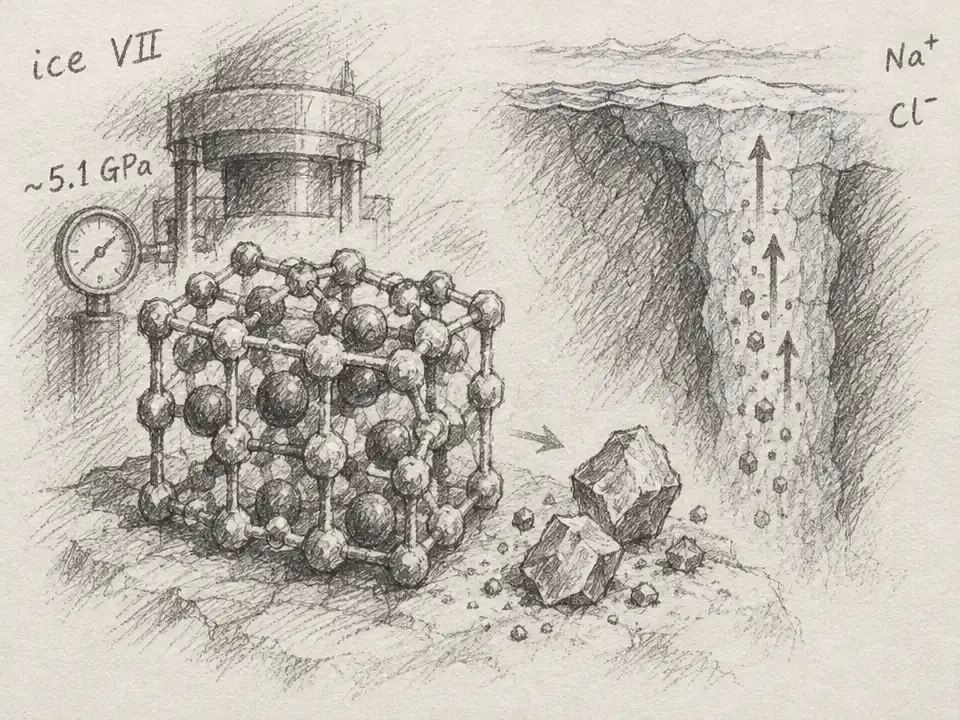
To test the assumption, researchers made a concentrated solution of sodium chloride, the salt in ordinary table salt, and water. They first compressed it to 0.3 GPa, chilled it to 77 K so it became an amorphous solid, then compressed it further while cold, to between 6 and 10 GPa. When warmed to room temperature, the sample crystallized into ice VII, a form of ice stable at high pressure.
The route through those conditions proved crucial. X-ray diffraction revealed an expanded form of ice VII alongside ordinary ice VII. The salty crystal’s unit cell—the repeating building block of its structure—was about 8.5% larger than the pure ice’s. Researchers detected no separate crystalline salt in the mapped sample. The evidence points to sodium and chloride ions being incorporated into the ice structure, taking the places of water molecules. Computer calculations showed how the surrounding water network might rearrange around those ions.
This was not a direct picture of every atom in its place. The proposed arrangement comes from combining diffraction measurements with calculations, and a separate neutron-diffraction experiment found a smaller expansion, about 3%. The researchers suggest that some salt may have separated during that sample’s preparation, leaving less salt in the ice. That unresolved difference is a reminder that, under extreme conditions, how a sample is made can shape what scientists observe.
And how it is made may be the point. When the team compressed a salt solution directly, without first quenching it into an amorphous state, the pronounced expansion did not appear. The researchers’ interpretation is that rapid chilling traps the ions in a disordered precursor; at high pressure, the ice can then crystallize around them. The result is a metastable salty ice: a structure that can persist along the right path, even if it is not the state the material would necessarily settle into at equilibrium.
Then came the twist. As the researchers slowly reduced the pressure, the salty ice remained intact down to 5.40 GPa. At 4.80 GPa, the expanded ice structure disappeared and crystalline salt appeared. The transition therefore occurred at 5.1 ± 0.3 GPa under the experiment’s conditions. When the sample was compressed again, the salt did not re-enter the ice. Once the ions had assembled into salt crystals, pressure alone could not restore the earlier structure.
That pressure threshold suggests a possible gate inside an icy world. Deep in a mantle, salty ice VII could be carried upward by slow solid-state convection. As it rose and pressure fell past the point where the salt-bearing form can persist, it could release its salt. The separated salt and ice would be denser than the salty ice had been, potentially slowing the upwelling, recycling some material downward, or allowing salt to collect near that boundary. The team calls this a possible “compositional filter”: not a solid wall, but a zone that could limit how much salt reaches the ocean above.
The idea gains force from an unexpected density result. Despite containing 26.9 wt% sodium chloride in the sample used for density measurements, the salty ice had a density close to pure ice VII. Its expanded structure largely offset the extra mass of the ions. A simple mixture of ordinary ice and separate salt crystals, by contrast, was substantially denser. In other words, the same ingredients could move differently through a planetary interior depending on whether salt was dissolved into the ice lattice or stored as its own crystals.
Interior models in the paper illustrate how this might matter on larger water-rich planets. For planets more massive than 2 Earth masses, the authors’ models suggest that most of the high-pressure ice mantle may sit in the range where salty ice VII could persist at 300 K. That is a projection built from planetary models and laboratory results—not evidence that any particular world has this salt filter. Still, it gives the experiment a destination: a pressure-sensitive process that might influence whether salts circulate between deep rock and a hidden ocean.
There is a significant price of admission before this becomes a reliable planetary story. The experimentally studied salty ice contained far more salt than a typical ocean, though the authors suggest such concentrations might occur in brine-rich zones near the ice-rock boundary. The measured threshold is a kinetic transition at 300 K, not a universal equilibrium boundary; its location under the hotter conditions inside actual planets remains unknown. Lower salt concentrations, other salts, and realistic interior temperatures all need testing. Models must also determine whether released crystals rise, settle, or become trapped.
For now, the discovery changes a useful assumption into a testable possibility. High-pressure ice may not simply reject salt and seal an ocean off from its rocky floor. Under a particular history of freezing and compression, it can take salt along—until pressure falls and the cargo is released. The next frontier is finding out whether real planetary interiors follow that route, and how much ocean chemistry depends on the answer.