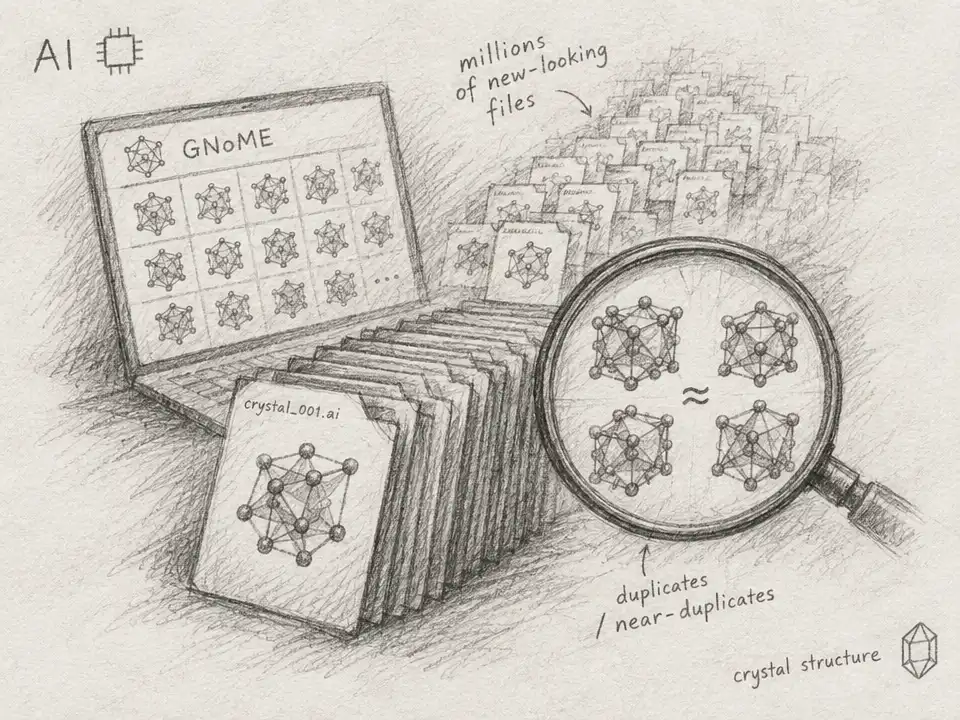
A crystal can look new on a computer screen for a surprisingly ordinary reason: someone described it differently. An AI system might output a file with a changed unit cell, shifted coordinates, or reordered atoms, even when the underlying repeating arrangement is nearly the same. For materials researchers, that creates a tricky question before they can ask whether a proposed crystal is useful: did the system find a new material, or just a new way to write one down?
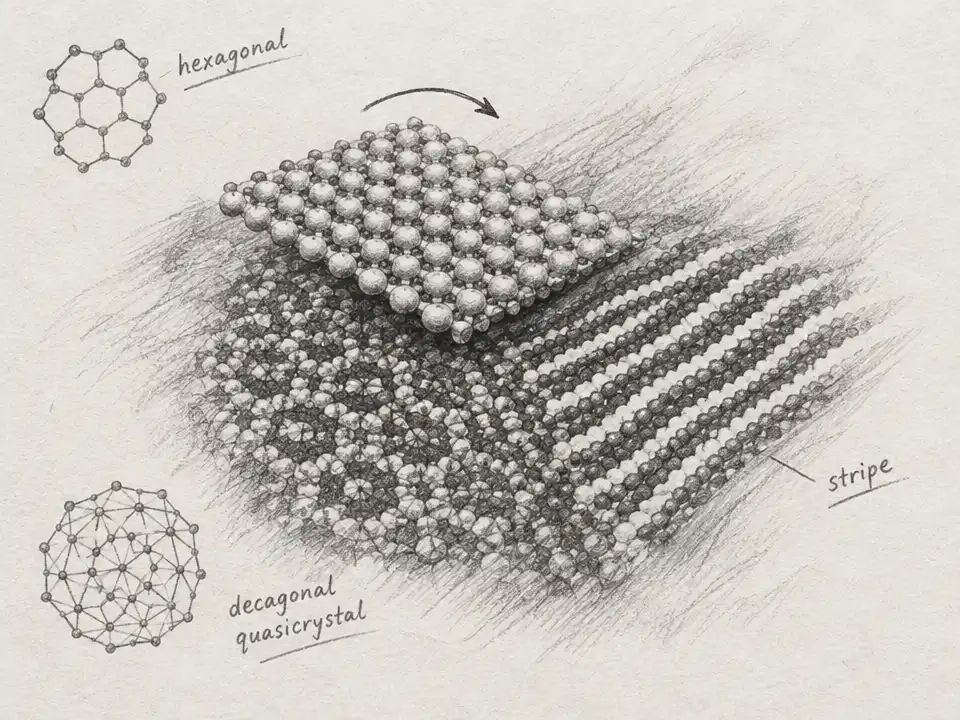
The distinction matters because crystals are repeating patterns of atoms, while the files used to store them capture only a convenient slice of that pattern. A unit cell is like a small tile that can reproduce an endless floor. But the same floor can be tiled using different-sized tiles, or viewed from a different starting point. Chemical composition alone cannot settle the matter, either: diamond and graphite are both carbon, yet their atoms are arranged differently and their properties diverge.
As AI tools generate larger collections of candidate materials, simple checks can stumble over these differences. A comparison based on a particular cell may miss two descriptions of the same structure. A yes-or-no match based on a chosen tolerance has its own problem: change the tolerance and the answer can change. The challenge is not simply sorting files. It is finding a stable way to compare the repeating structures they represent.
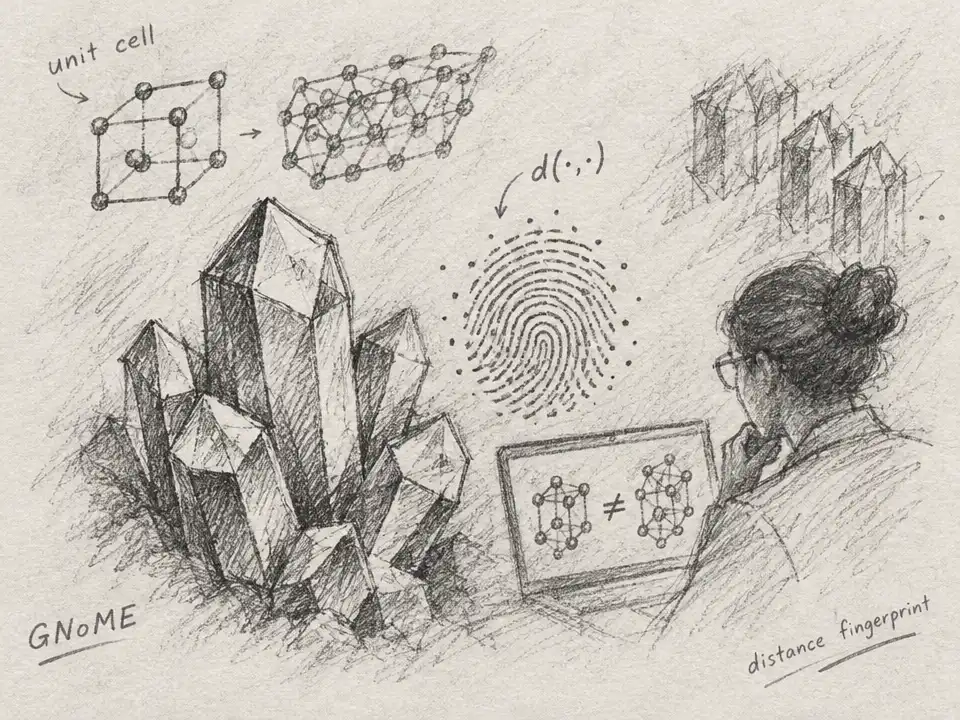
In a recent arXiv study, Daniel Widdowson, Tatiana Kurlina, Olga Anosova, and Vitaliy Kurlin bring ideas from geometric data science to that challenge. Their central move is to describe a crystal through invariants: features that stay the same when the structure is shifted or rotated, rather than changing with the coordinates chosen to represent it. The researchers build up a hierarchy of these geometric fingerprints, using increasingly detailed comparisons to narrow down which structures are alike.
One starting point is the distance from an atom to its neighbors—not just the closest one, but a sequence of neighbors farther out. The authors average these distances for a quick first comparison, then use richer fingerprints that retain how different atoms’ distance patterns are distributed through a crystal. The fingerprints are designed to change smoothly when atoms move slightly, rather than jumping abruptly because a coordinate crosses an arbitrary boundary.
To compare two such fingerprints, the researchers also use a tool called Earth Mover’s Distance, borrowed from transportation theory. Imagine two piles of sand arranged across a map. The measure asks how much work it would take to move one pile until it matches the other. Here, the “piles” are distributions of atomic distance patterns. A small distance means the patterns can be brought into close agreement with little adjustment; later stages of the hierarchy can test more subtle differences.
The team used this approach to audit two public releases of GNoME, an AI-driven crystal-prediction project. The first contained 384,938 entries; the second contained 554,054. The audit was not a lab test of whether those candidates can be made. It was a closer look at how distinct the structures in the databases were from one another, and from crystals recorded in existing reference collections.
At a geometric matching threshold of 0.01 angstroms, the researchers found 24,194 groups of near-duplicate structures in the larger release. Across those groups, 84,092 entries were excess copies if each group were represented by just one entry—a redundancy rate of 15.178%. But “same geometry” does not automatically mean “same material.” When the comparison also required the chemical elements to match, the researchers found no qualifying duplicate pairs in that release at the same threshold.
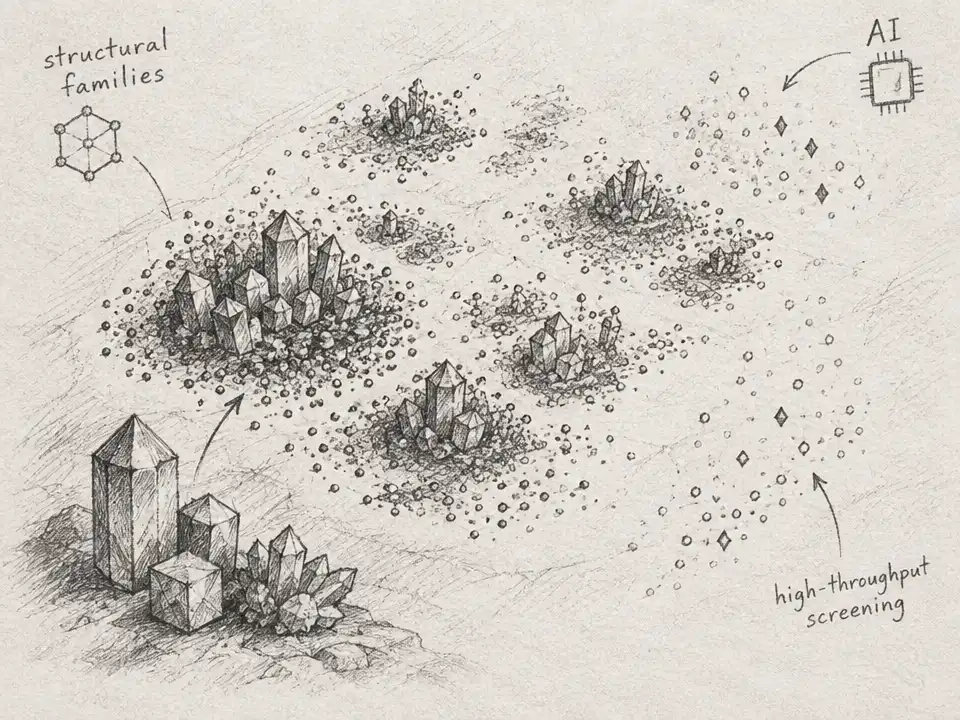
That distinction becomes even clearer when the AI-generated structures are compared with older reference databases. By geometry alone, 73.1% of entries in the second GNoME release were within 0.05 angstroms of a structure in the Inorganic Crystal Structure Database, and 78.4% were that close to one in the Materials Project. But when both geometry and chemistry had to match within that distance, the counts fell to 824 and one, respectively. A familiar-looking arrangement can still hold a different chemical recipe; resemblance is a clue to investigate, not a verdict on novelty.
The scale of the audit is part of the story. The researchers’ comparisons involved more than 134 million screened pairs and took 16 hours, 11 minutes, and 54 seconds of wall-clock time using eight worker processes. They report running the experiments on a six-core desktop computer with 32GB of memory. The point is not that every materials search will be easy to audit, but that a carefully designed geometric screen can make an enormous comparison tractable.
There are limits to what a fingerprint can establish. A structure that appears distinct in a database is not necessarily stable, possible to synthesize, safe, or useful. Nor does a close geometric match prove that two materials have the same properties: changing the elements can change how atoms interact. The authors argue that a serious AI-discovery benchmark should check whether its inputs are credible, evaluate chemical utility with expert judgment, quantify structural novelty continuously, and screen for implausible atomic arrangements. Experimental evidence still has to do work that a database comparison cannot.
That is the crossover at the heart of the study: a mathematical idea about what stays unchanged under transformations becomes a practical tool for evaluating AI’s claims about matter. The payoff is more than catching duplicates. It is a clearer definition of what a discovery claim needs to show. In the search for new materials, the number of files is easy to count. The harder question—and the one worth answering—is how much of the physical world each file actually adds.