Start with a magnet that seems to be doing nothing. Inside, neighboring atomic magnets point in opposite directions, canceling each other out. From the outside, the material has no net magnetization—the familiar calling card of an antiferromagnet. Yet electrons moving through some such crystals can behave as if the material has a powerful magnetic character after all: their energies depend on their spin, and that dependence changes with the direction they travel.
This apparent contradiction is the doorway to altermagnetism, a third family of magnetic order alongside ferromagnetism and antiferromagnetism. In an altermagnet, opposite magnetic moments still balance, but the crystal’s arrangement lets the electrons’ spin-up and spin-down energy bands split in a direction-dependent pattern. The pattern is set not simply by the atoms’ magnetic moments, but by how the crystal’s symmetries connect them.
A review posted to arXiv on April 17, 2026, follows a striking meeting of two fields: machine learning and quantum materials physics. The connection matters because the search for altermagnets is a search for fine-grained patterns in a vast catalog of crystals. Researchers need physics to say what pattern counts—and computational learning to help find it among far too many candidates for a slow, one-at-a-time investigation.
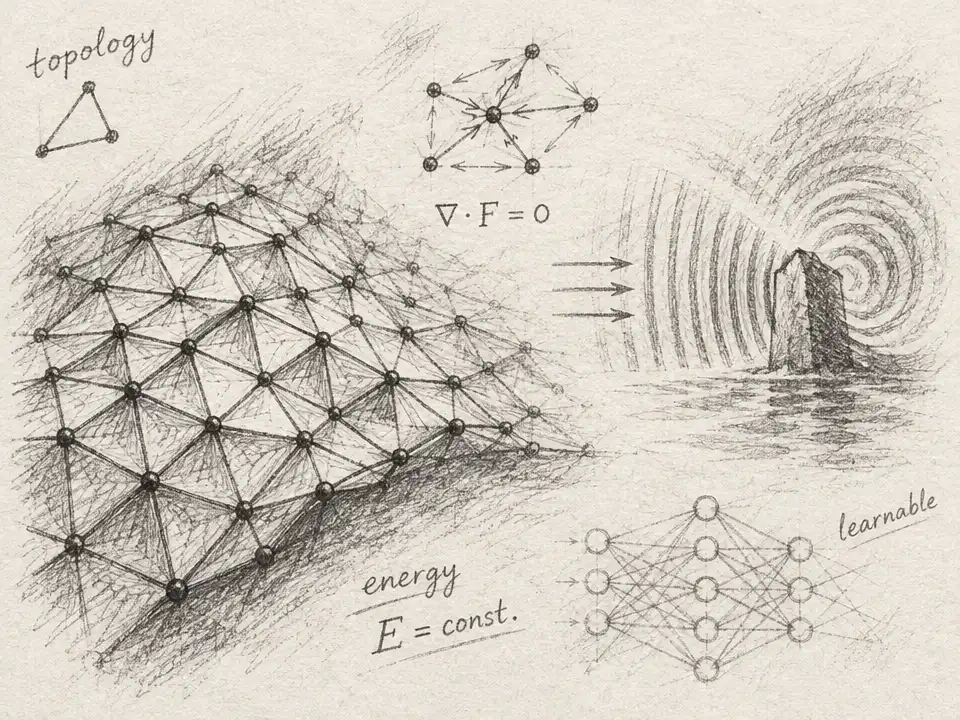
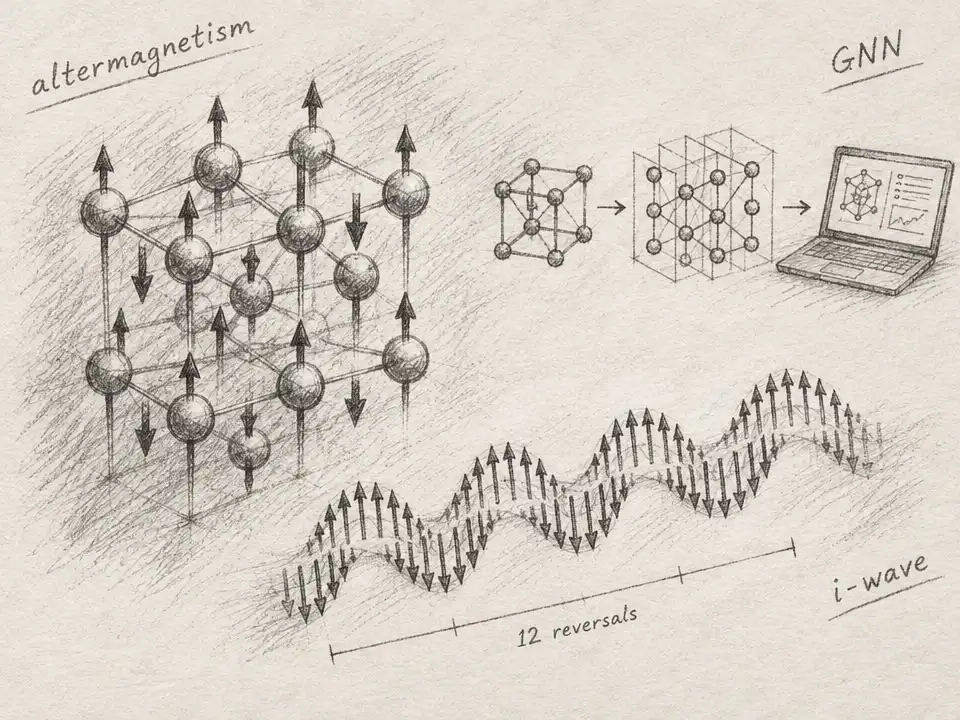
Think of a crystal as a network. Its atoms become points, and the bonds or neighboring relationships between them become links. A graph-based learning model can use that network to recognize recurring structural arrangements. But ordinary pattern recognition is not enough: a crystal remains the same material if it is rotated or if its identical atoms are listed in a different order. The useful model must learn to respect those symmetries rather than mistake a new viewpoint for a new substance.
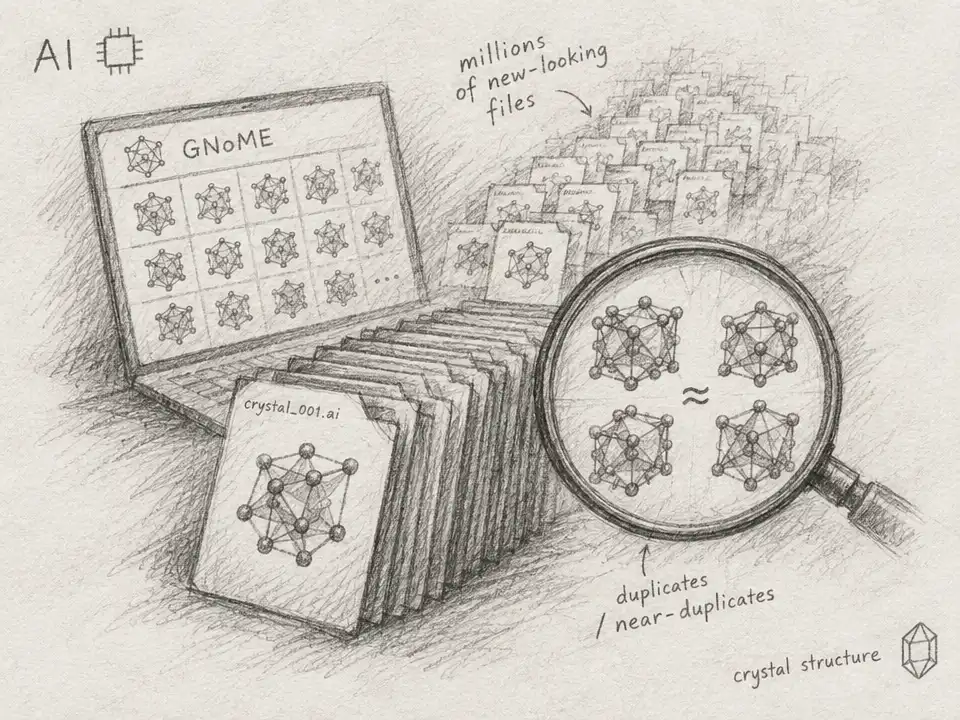
The reviewed search borrowed a strategy familiar from modern machine learning: teach a model broad patterns first, then refine it for a narrower task. According to the review, the graph model was pretrained on about 150,000 crystal structures without being given altermagnet labels. It learned structural regularities, then was fine-tuned using a much smaller set: 148 known altermagnets and 25,591 non-altermagnets. Physics supplied another guardrail. A symmetry check filtered out structures whose combined symmetries would prevent the kind of spin splitting being sought.
That blend is the crossover’s central idea. Machine learning contributes a way to sift through structure at scale; physics narrows the search and tells researchers what the answer must obey. The resulting system screened 42,377 materials. The campaign described in the review reported 50 previously unreported altermagnetic candidates, with follow-up first-principles calculations used to check the most promising predictions. The model did not replace physical calculations. It helped decide where those calculations might be most revealing.
Among the striking possibilities was a pattern called i-wave altermagnetism. Picture tracing a loop through the crystal’s momentum-space map, a way of charting the possible motion of its electrons. In the reported pattern, the favored spin flips sign 12 times around the loop. That intricate alternation is not a magnetic texture painted through ordinary space; it describes how electronic states change across directions in momentum space. The crystal’s symmetry makes the pattern possible, while the model helps spot structures that may support it.
One candidate highlighted by the review is chromium fluoride. Calculations predict that it could host an i-wave pattern and spin splitting greater than 0.5 eV. The result is intriguing because altermagnetic spin splitting can arise from crystal geometry and exchange interactions, rather than requiring the strong relativistic effects associated with heavy atoms. But a promising calculation is not a confirmed material property. The candidate still needs experimental scrutiny to establish whether the predicted magnetic order appears in a real sample.
The review also makes clear why a machine’s confident ranking cannot close the case. A material may have the right symmetry on paper without actually settling into the predicted magnetic state. The review points to ruthenium dioxide as a caution: its structure was once treated as a strong altermagnet candidate, but sensitive experiments on high-quality bulk crystals found no evidence of long-range magnetic order. A structure can have the capacity for a phenomenon without nature choosing that state under the conditions tested.
That distinction gives the story its tension. The algorithm can expose a pattern that a conventional search might overlook, but it cannot by itself establish which candidate can be made, which magnetic state is stable, or what an experiment will observe. Those questions return the investigation to calculations, materials synthesis, and measurement. In the best version of this partnership, each stage corrects the others: symmetry guides the model, the model focuses the search, and experiments test the predictions.
Altermagnets are a reminder that a zero reading on a magnetometer does not mean electrons have no hidden structure to reveal. And machine learning’s contribution is not simply speed. By carrying ideas from data-driven pattern recognition into the geometry of crystals, it helps physicists ask sharper questions of an enormous materials landscape. The next decisive step is not another prediction alone, but finding out which of these unexpected patterns survive contact with the laboratory.