Turn two crystal sheets a fraction of a degree against each other and their atoms make a much larger pattern: a moiré, like the shifting stripes that appear when two fine meshes overlap. In some materials, that gentle mismatch can reshape how the material behaves. But making the trick work with complex oxides is difficult. Their atoms are joined in a sturdy three-dimensional network, not held together at the surface as loosely as in the materials most familiar from twistronics. Getting two oxide sheets to meet cleanly—and keeping their chosen angle—has been the hard part.
The trouble begins before the layers touch. Once freed from the substrate they were grown on, thin oxide membranes are vulnerable to contamination. Water or other molecules can cling to their exposed surfaces; polymer supports used in transfer can leave residue. Meanwhile, liquid involved in wet transfer can let a membrane drift or rotate as it is stacked. A tiny change in angle changes the pattern the researchers are trying to build. The challenge is not simply to stack two sheets, but to preserve a precise orientation and then make their surfaces bond as one crystal interface.
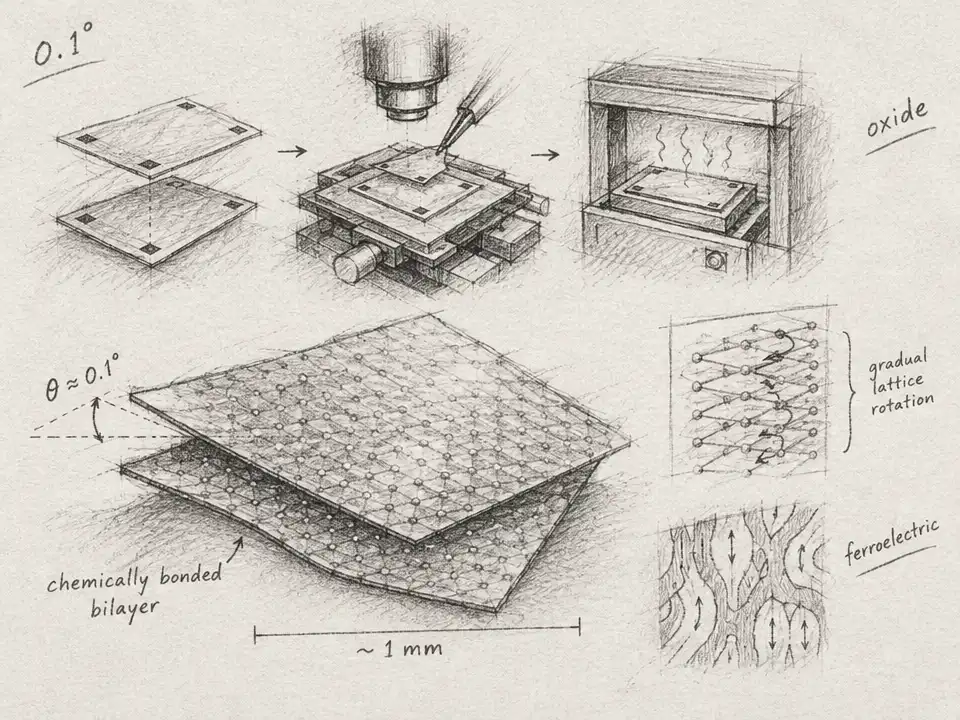
A team led by researchers at North Carolina State University developed a step-by-step way to do both. They first grew thin oxide films on a temporary, sacrificial layer. Before releasing the films, they added small chromium alignment marks. Those marks gave the researchers visible reference points—like crosshairs on two transparent maps—so they could line up the crystal directions and deliberately rotate one membrane relative to the other.
After dissolving the sacrificial layer, the team transferred one membrane onto a silicon-based support. A second membrane, carried on a flexible polymer stack, was mounted on a motorized transfer stage. The stage could move in three directions and rotate; its angular resolution reached 0.001°. Researchers aligned the markers, set the intended twist, and brought the upper sheet down onto the lower one. This did not remove liquid from the process altogether. Instead, alignment marks and controlled motion helped keep the angle from being left to the unpredictable movement of a floating sheet.
Then came a crucial step: heat. In the as-stacked samples, images showed an amorphous layer about 2 nm thick at the interface, associated with leftover carbon-containing material from transfer. For sodium niobate, heating the bilayer in flowing oxygen at 660 °C for two hours cleaned up the surface and restored an atomically coherent interface. The measured surface roughness fell from 996 pm before annealing to 158 pm afterward. At the boundary, the layers formed a chemically bonded perovskite network. The best annealing temperature depended on the material: the team used 700 °C for strontium titanate and 600 °C for sodium tantalate, each for two hours.
That combination—visible alignment, controlled transfer, and a material-specific heat treatment—produced oxide bilayers with continuous regions approaching the millimeter scale. The researchers tested several oxides and examined sodium niobate most closely. In that material, they assembled layers with intended twists of 0.1°, 7°, and 15°. Atomic-resolution images confirmed the relative rotations, with measured angles within about 0.2–0.3° of the intended values. The resulting moiré patterns changed dramatically with the twist: their measured periodicities were approximately 80, 3, and 1.5 nm, respectively.
The method is a fabrication advance, but the assembled crystals also revealed something unexpected about what happens inside them. Before stacking, sodium niobate membranes showed evidence of two coexisting structural phases. In the twisted bilayers, synchrotron X-ray measurements instead indicated a single-phase state. The twist was not just a geometric decoration at the boundary; the layers’ interaction was associated with a change in the crystal’s structure.
The X-rays also offered a clue to how the strongly bonded layers accommodate their mismatch. Rather than showing only two distinct orientations—one for each sheet—the measurements showed a continuous spread of lattice directions. The researchers interpret this as evidence consistent with a gradual rotation of the crystal lattice through the bilayer’s thickness, helping to relieve the shear strain created where the sheets meet. That interpretation is not yet a direct, atom-by-atom view of the rotation: the authors say depth-resolved microscopy will be needed to test it. Still, it points to a different response from the mostly in-plane rearrangements often discussed for weakly bonded, van der Waals layers.
There was a functional sign of the twist, too. Sodium niobate is ferroelectric, meaning its internal electric polarization can form differently oriented regions, or domains. In the 0.1° twisted samples, piezoresponse force microscopy showed periodic variations in electromechanical response with a characteristic scale of about 40 nm. These features were associated with the moiré pattern. At 1°, the expected pattern was smaller than the microscope’s roughly 20 nm lateral resolution, so the researchers saw clustered contrast rather than a clearly resolved repeating pattern. The images suggest that twisting affects local polarization, but they do not establish that more intricate structures, such as polarization vortices, were present.
The broader promise is practical as much as scientific. When a carefully designed interface can be made across a large, continuous area, researchers have more room to measure its properties and eventually explore uses in devices. The team points to possible future measurements in capacitors and transport structures, as well as optical components and integration with semiconductor technologies. Those are prospects, not devices demonstrated in this work. The achievement is a reliable route to building the material platform they would require.
In the end, the key tool is not a dramatic new ingredient but a carefully choreographed sequence: mark the crystal, lift it free, rotate it on a controlled stage, join it to its partner, and anneal away the residue. That sequence turns a nearly invisible adjustment at a buried interface into a way to tune structure and polarization across a much larger piece of material. In these oxides, a slight twist may not stay at the seam. It may be taken up by the crystal itself.