On a computer map, four small robots face a choice: explore a patch that might reveal something useful, or steer clear of it because the patch may be dangerous. The twist is that the robots are not all treated as equally valuable. A new planning method asks whether one machine should take more risk so another can stay safer—a question its designers approached with an idea from evolutionary biology.
The biological idea is associated with evolutionary theorist W. D. Hamilton: an individual may accept a cost when the benefit to others is large enough, depending on how closely connected they are. In a robot team, “connection” does not mean family or shared genes. It becomes a design choice: how much should one robot’s decisions account for the welfare of its teammates?
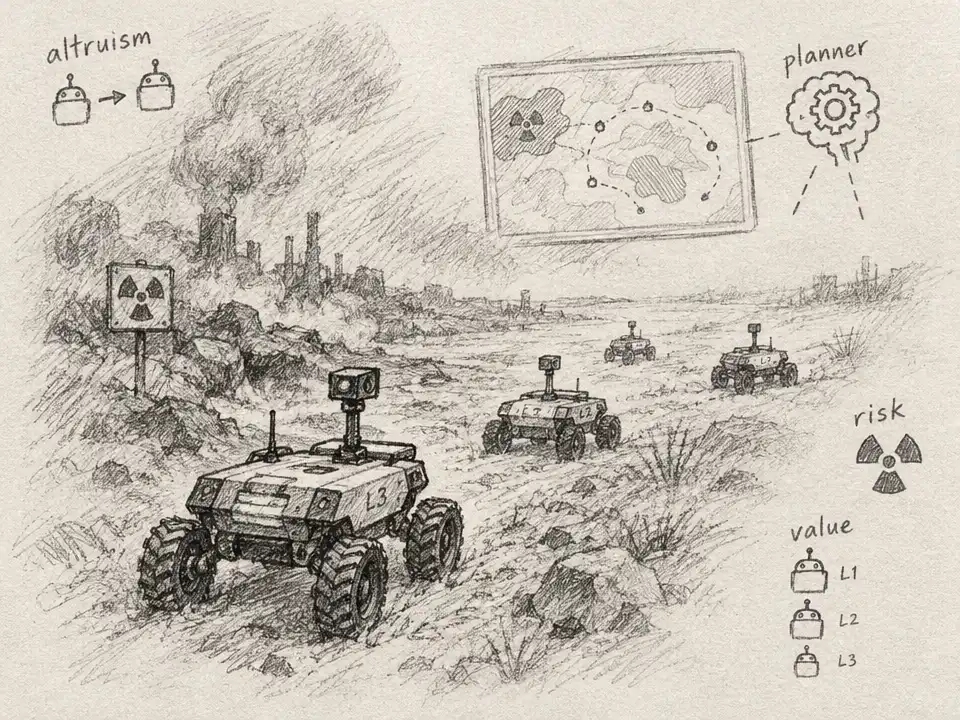
That translation is the heart of the work by Brooks A. Butler, Jair Certório, João P. Hespanha, and Magnus Egerstedt. They built a game-theoretic planner for teams exploring uncertain spaces. Each robot weighs three competing aims: gather information, avoid duplicating what teammates have already mapped, and limit its own expected exposure to hazards. The biology-inspired rule adds a fourth consideration: a robot can factor in how its route affects the others.
Why is that useful? Imagine a team sent to inspect a damaged building or another place where people should not go first. If every robot acts only to protect itself, they may crowd into the same safer areas, leaving risky but important territory unexplored. Or they may each avoid a hazard without considering whether one route could give the group valuable information while keeping more critical teammates out of danger. Coordination requires more than a shared map; it requires a way to decide whose risk matters most.
The researchers represent each robot’s importance or risk sensitivity with a value chosen for the mission. Their relatedness weights make lower-valued robots pay more attention to the outcomes of higher-valued teammates, while higher-valued robots are less inclined to sacrifice themselves for lower-valued ones. In plain terms, the planner can steer a less mission-critical machine toward a hazardous region if doing so helps protect a more important teammate and improves the team’s overall performance.
That is not a rule that says “send the cheapest robot into danger.” The value is an input to the system, not a fact discovered by the robot. A mission designer decides what the values mean. They might reflect a machine’s task-critical capabilities, vulnerability, or the consequences of losing it. The research therefore turns a technical planning question into a consequential human one: who sets the ranking, and on what grounds?
To test the idea, the team first simulated four robots moving through a bounded map containing two modeled hazard zones. The robots had to reduce uncertainty about the environment while avoiding overlap and accounting for risk. The researchers compared a selfish planner, in which each robot optimized its own objectives, with the biology-inspired version, which also weighted teammates’ outcomes.
Across 50 trials for each of five configurations of robot values and risk tolerances, the altruistic planner generally sent robots along more separated routes. It maintained uncertainty reduction comparable to the selfish baseline, while increasing the minimum distance between robots—a sign of less redundant or conflicting exploration. In mixed-value cases, it also lowered the team’s value-weighted risk: more of the modeled danger fell on lower-valued robots, shielding those assigned higher values.
There is an important distinction between a simulated risk decision and a robot actually facing a dangerous building. In the simulations, hazards were represented by a modeled field, and uncertainty itself contributed to the risk estimate. The planner’s results show how the chosen objectives distribute modeled risk; they do not establish that a robot can reliably recognize every real-world hazard or that the strategy is safe in a disaster zone.
The researchers also ran the planner on physical wheeled robots at the UCI Robotarium, a test platform. The machines followed waypoints from the high-level planner while standard control and safety tools helped them respect boundaries and avoid collisions. That demonstration showed the plan could be executed on hardware. It was not a test of sending one robot into a real hazardous area.
The bridge between evolutionary biology and robotics is useful because both fields confront a version of the same problem: when individual interests collide with group outcomes, what makes cooperation possible? In this system, the answer is not affection, instinct, or kinship. It is a carefully designed incentive that lets each robot account for the consequences of its choices for the rest of the team.
The approach remains a starting point. Its authors identify richer robot dynamics, incomplete knowledge of hazards, communication limits, and changing mission priorities as challenges for future work. A robot’s value might need to shift as its battery drains, its condition changes, or its role becomes essential. For now, the study offers a small but revealing lesson: a machine team’s cooperation can depend not just on where its members go, but on whose safety the plan is built to protect.