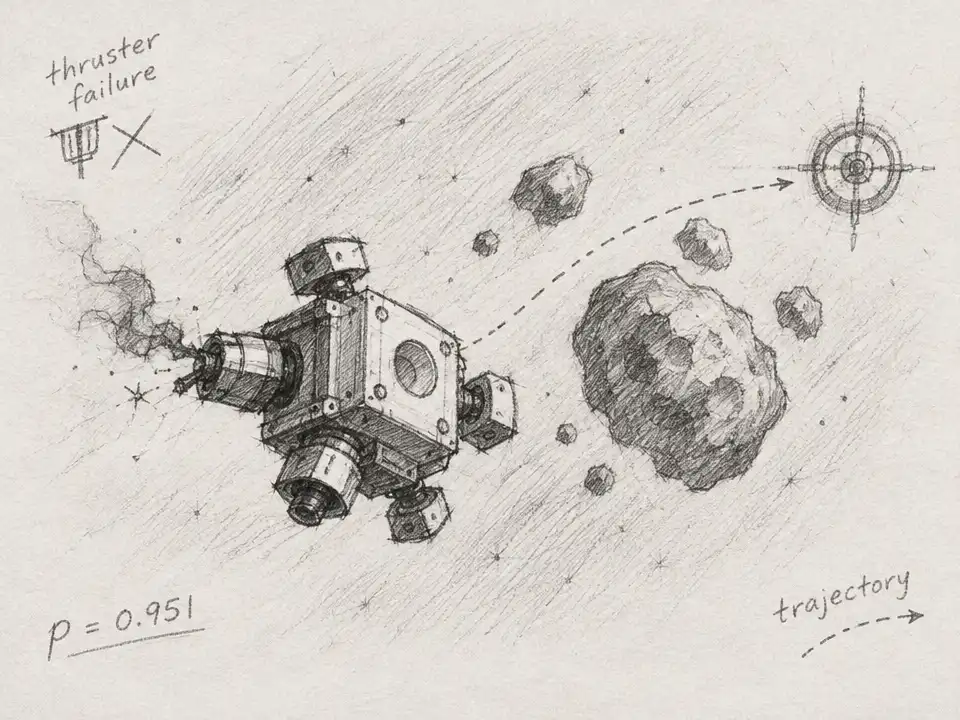
A space robot loses its thrusters. The obvious outcome seems settled: without a way to steer, it cannot reach its destination. But in weightlessness, a drifting spacecraft does not simply stop. It keeps moving. Could a robot plan its route so that losing every actuator does not necessarily end the mission?
That question is the puzzle behind a motion-planning study by Nicolas de Maddalena, Joris Verhagen, and Jana Tumova, posted to arXiv on September 17, 2026. Their approach does not try to make thrusters invulnerable. Instead, it asks what route would leave a robot with the best chance of reaching its goal if some—or all—of them fail along the way.
The first clue is a basic feature of free flight. A robot with working thrusters can accelerate, turn, and dodge. One with none cannot change its motion, but it may still coast along a straight path. That makes a failure’s timing crucial. If the robot is pointed the right way and has cleared nearby obstacles, coasting could carry it to the goal. If it is still maneuvering around an obstacle, the same loss of control could send it past the destination or into danger.
So the problem is not just “Can the robot move?” It is “At every point on this route, which kinds of failure would still leave the goal reachable?” A quick route might perform well if everything works, yet become useless after one badly timed fault. A more cautious route might take longer but position the robot so that a range of failures are survivable.
To explore that trade-off, the researchers combined two kinds of reasoning. One estimates which states can still reach a target under a particular set of working actuators. The other tracks how the odds of different failure states change as the robot moves. The planner uses both to compare routes, rather than waiting for a fault and improvising only after it happens.
That search begins with a familiar robotics idea: build a tree of possible routes by sampling waypoints. The researchers adapted this method so each connection in the tree carries information about whether it remains feasible under different actuator configurations. The planner can then favor trajectories that preserve options, not just those that shorten the trip.
In their testbed, eight symmetrically arranged actuators control motion in three degrees of freedom. The researchers considered four conditions: all actuators working; four lateral actuators failed; four longitudinal actuators failed; and all actuators failed. Rather than test all 256 possible combinations of eight actuator failures separately, they grouped failures into these broader modes. That simplification makes the computation manageable, but it also means the result depends on how well those modes represent the failures a real system might experience.
The next clue comes from a route around an obstacle. In one modeled scenario, the planner was allowed 2,000 samples to search for a path, with a total failure probability assumed to be 1%. An intermediate route had a modeled chance of reaching the goal of 0.878. As the planner refined the route, it found a less obvious strategy: spend maneuvering effort early to get out of the obstacle’s “shadow,” then line up a path that remains useful even if the robot can no longer steer.
The final route reached a modeled success probability of 0.951. The planner’s calculation says that the remaining 4.9% risk comes from a failure during the initial maneuver, while the robot is still in the obstacle’s shadow and its current drift would miss the goal. Once it has cleared that region and established the right trajectory, the modeled success probability stays at 0.951 along the rest of the route.
This is the twist: a robot can be more resilient not by carrying extra backup hardware, but by choosing when and where it needs its control. Yet the answer to the puzzle is not that losing all thrusters is harmless. It is that the loss can be survivable after a particular point in the journey. Before that point, the mission may still be lost.
The researchers also tested their planner on a physical free-flyer platform. This is a spacecraft analogue moving across a flat surface, not a robot tested in orbit. The team injected failures after the initial maneuver, including a case with complete actuator loss. In the partial-failure trial, the robot veered off its intended course, then its controller used the planned reference trajectory to guide it back. In the complete-failure case, it continued without actuation along its prepared path.
Those hardware runs show that the planned behavior could be executed on the platform; they do not establish a 95.1% success rate in real missions. The probability comes from a modeled scenario, while the hardware demonstrations were single realizations. The study also notes that imperfections in the test surface—especially small undulations—complicated control. Real missions would bring further challenges, including more realistic failure behavior and orbital dynamics, which the authors identify as future work.
Still, the central idea changes how a robot’s route can be judged. A path is not only a line from starting point to destination. It is a sequence of changing escape options. For a free-flying machine, the most important turn may be the one that puts it in a position where it no longer needs to turn at all.