Imagine threading a slender robot into a cramped space where every bend is useful—until the job suddenly demands a firmer push. A flexible arm can snake around obstacles, but that same flexibility makes it buckle under force. A new design offers a surprising fix: instead of choosing between a bendy robot and a stiff one, let the robot move the places where it braces itself.
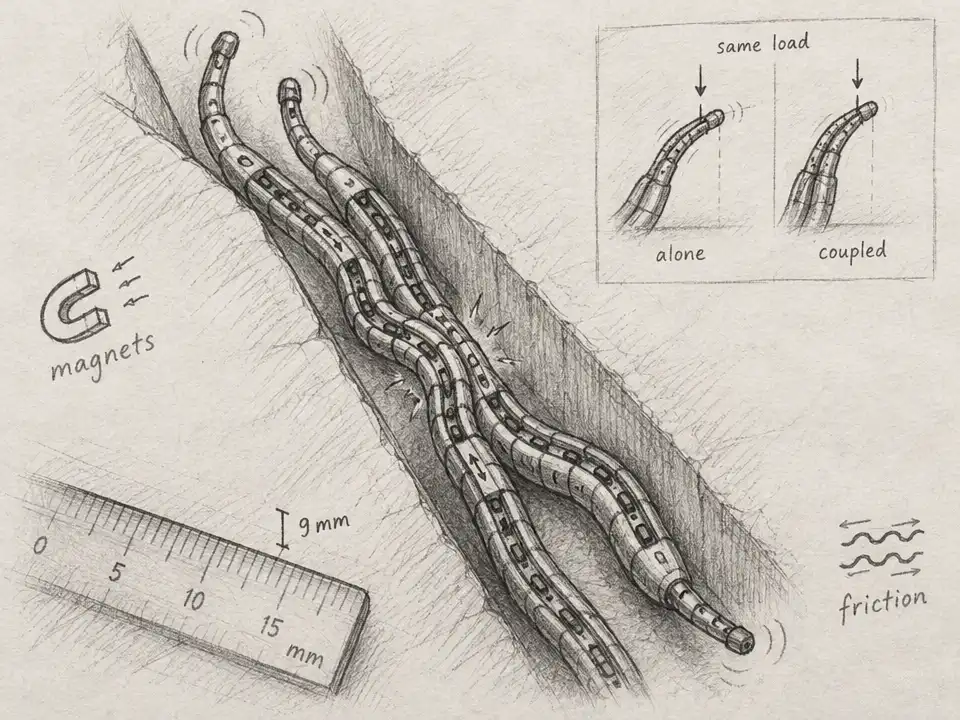
The prototype is a tendon-driven continuum robot: a 150 mm-long, 9 mm-diameter flexible shaft built around a thin backbone. The researchers fitted it with narrow conveyor belts that run along its body. Motors at the base can slide a belt up or down, bringing small functional elements to different positions along the robot’s length. The design can accommodate as many as three belts. For their demonstration, the team replaced belt teeth with tiny permanent magnets, creating movable docking points.
Put two such robots side by side, and magnets on their belts attract. The robots can then couple along their lengths, rather than joining only at their tips. Their working ends remain free. As the belts move, the magnetic contact points travel too—a little like a zipper closing or opening along two flexible shafts. The key idea is not merely that two robots can support each other. It is that they can change where that support happens while they are deployed.
To test what that support buys, the researchers hung a 10 g load from a robot’s tip and measured how far it deflected. Without a coupling point, the average tip deflection was 46.3 mm. With a coupling point at the tip, it fell to 1.7 mm. Moving the support farther from the tip reduced the benefit: the longer stretch beyond the coupling point could bend more. In one tested arrangement, adding coupling points also made the system behave more like a shorter, better-supported beam.
That pattern has a straightforward mechanical explanation. A flexible shaft bends most when a force acts far from where it is supported. Move the support closer to the working end, and the unsupported section shrinks. The team found that the change in stiffness followed the trend predicted by a simple beam model, though the model assumed a perfectly rigid connection and therefore underestimated the prototype’s actual deflection. In a second arrangement, moving the coupling points without moving the robots did not produce a significant stiffness trend. The result is promising, but the benefit depends on how the robots and their supports move together.
The moving belt has to do its own work without throwing the robot off course. Sliding it through a curved shaft creates friction, and pulling the belt can tug the robot’s tip. In tests, belt movement displaced the tip by less than 6% of the robot’s length across the shapes examined. The largest average displacement, 5.3 ± 1.0%, occurred when the robot was straight. Belt actuation required less than 5 N of force for bends up to 90° in the belt’s plane; the maximum measured force reached 10.2 N when the robot bent out of that plane. For comparison, bending the robot to 90° with a tendon took 6.3 ± 0.3 N. In other words, the extra mechanism is manageable in some configurations, but not friction-free.
That trade-off points toward the larger possibility. Flexible robots are attractive for work in tight, winding spaces, including some medical and industrial settings, because they can reach places a rigid arm cannot. Yet a robot that must both navigate and apply force faces competing demands: compliance helps it travel, while stiffness helps it hold steady. A movable brace could let a pair of robots adapt between those needs instead of relying on a fixed support position chosen in advance. The paper demonstrates a mechanical principle, not a clinical tool or a robot performing a complete procedure.
There is still a lot between this prototype and a machine that can reliably reconfigure itself during a demanding task. The experiments used a small number of robot configurations and a static tip load; the magnets were a proof-of-concept way to couple the robots. The team also notes that belt motion can disturb the tip, and that real coupling is not perfectly rigid. Longer, multi-segment robots, more complex shapes, and moving tasks will test whether the mechanism remains useful when everything is in motion.
For now, the belt’s most interesting contribution is a change in perspective: the length of a flexible robot need not be just a route from base to tip. It can also become a track for moving the robot’s tools, sensors, or supports. That may make future slender machines more adaptable—but only if they can reposition those useful parts without adding so much drag, wobble, and complexity that the flexibility they were built for disappears.