Imagine a humanoid robot walking without a camera view, a map, or a tracking system telling it where it is. It still has clues: a sensor measuring how its body turns and accelerates, and sensors reporting how its joints move. But every estimate is a little uncertain. Add those small errors step after step, and the robot’s picture of its path can wander far from reality.
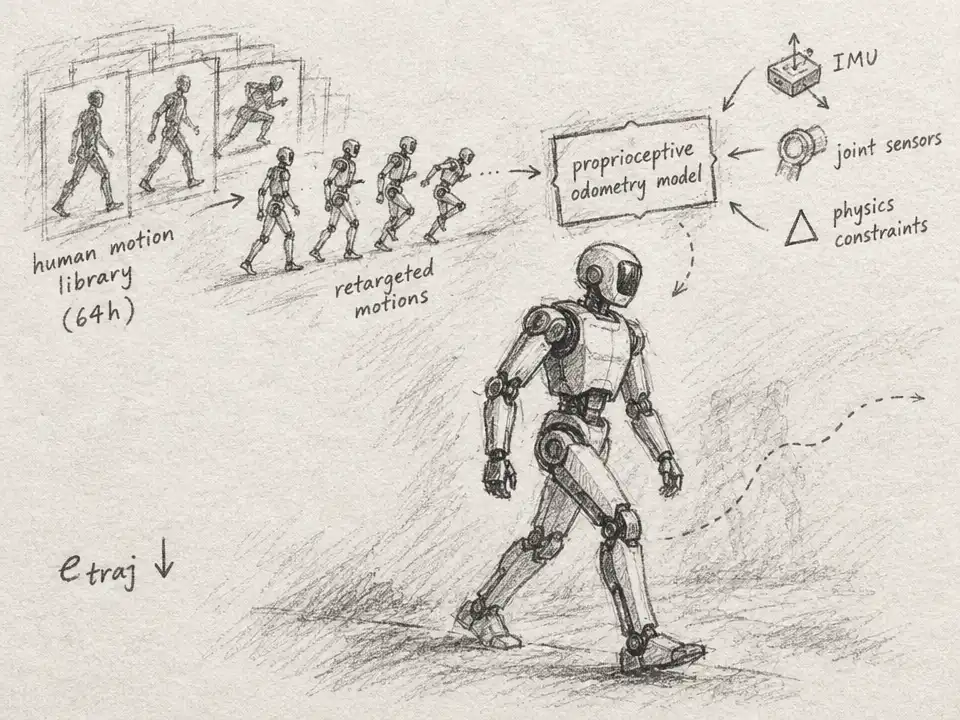
That problem is called odometry: estimating movement from measurements made along the way. A recent study takes an unusual route toward better odometry. Instead of teaching a robot only from its own routine walking patterns, researchers borrowed a resource from human-motion research: a large library of human movements. They retargeted those motions to a humanoid robot in simulation, then used the robot’s simulated rehearsals to train a system for tracking its movement from onboard sensors.
The crossover matters because the two fields bring different strengths. Human-motion libraries contain far more than a robot’s usual forward-and-back gait: they can include turns, crouches, kicks, jumps, and dance. Robotics contributes the physics-based tracker that tries to make a robot body perform those movements, and the estimation methods that turn sensor signals into a running account of where it has gone.
The researchers began with an approximately 64-hour library of human motion sequences. Software translated the movements into references suited to the robot’s body. A feedback controller then tried to follow those references in simulation. The researchers varied simulated conditions—including contact, actuator properties, sensor noise, and external disturbances—so the robot’s rehearsals included imperfect steps, impacts, slipping, and recovery.
Once trained, the controller was frozen and used to produce simulated journeys. The team recorded the robot’s inertial and joint-sensor histories alongside the simulated ground truth: how its body had actually moved. Those paired signals became examples for training the odometry model. Crucially, the motion-tracking data came from a controller separate from the locomotion policies the team later tested. The training source could therefore cover behaviors beyond the repertoire of any one walking controller.
At deployment, the model does not need to see the human motion library or follow a human in real time. It estimates movement using the robot’s own sensor history: readings from an inertial measurement unit on the pelvis, plus positions and velocities from selected joints. In effect, human motion supplies the variety of practice; onboard sensing supplies the evidence during the real walk.
The model also uses some structural hints about how bodies move. A gyroscope provides a starting estimate of rotation, and the model learns a bounded correction rather than inventing the rotation from scratch. A second idea comes from symmetry: a movement reflected across the robot’s left-right plane should produce a correspondingly reflected estimate. The researchers built that mirror relationship into the prediction process. They also kept a direct, lower-rate pathway for raw sensor context, rather than asking the model’s faster signal-processing layers to preserve every slow-changing clue.
Then came the real-robot test. The team evaluated its system on an AgiBot A3 Ultra humanoid, using 22 walking trajectories totaling 78.8 minutes and 10 dynamic trajectories totaling 9.4 minutes, drawn from five dance routines. To check the estimates, they used LiDAR-map localization for the walking tests and motion capture for the dynamic ones. These reference systems were used to score the results; PRIMO itself estimated movement from proprioceptive inputs.
Across six combinations of test domain and error measure, the complete system had lower mean error than four comparison methods, with reductions of 31.6% to 61.7% relative to the strongest external baseline in each comparison. The story behind that result is not simply “more data wins.” In tests of transfer between two revised locomotion policies, models trained on a single policy could stumble badly when tested on the other. Training on tracked human motions reduced that cross-policy error. But the authors also found that training on data from both known policies could be better on some tests when those were the exact policies expected at deployment.
That distinction gives the approach a practical edge—and a boundary. If a robot’s controller is fixed and its future motions are predictable, targeted training data may be advantageous. If its controller changes, or it must handle movement beyond a narrow gait, the broader motion library may help. The evidence is promising, but it comes from one humanoid platform and a relatively small set of real-world trajectories; it does not establish that the same gains will carry over to other robots.
Still, the idea changes what a robot’s movement library can do. Human motions are often used to teach robots how to move. Here, those motions also help teach a robot how to tell where its movement has taken it. A dance, a turn, or a recovery step becomes more than a performance to imitate: it becomes another way to practice keeping track.