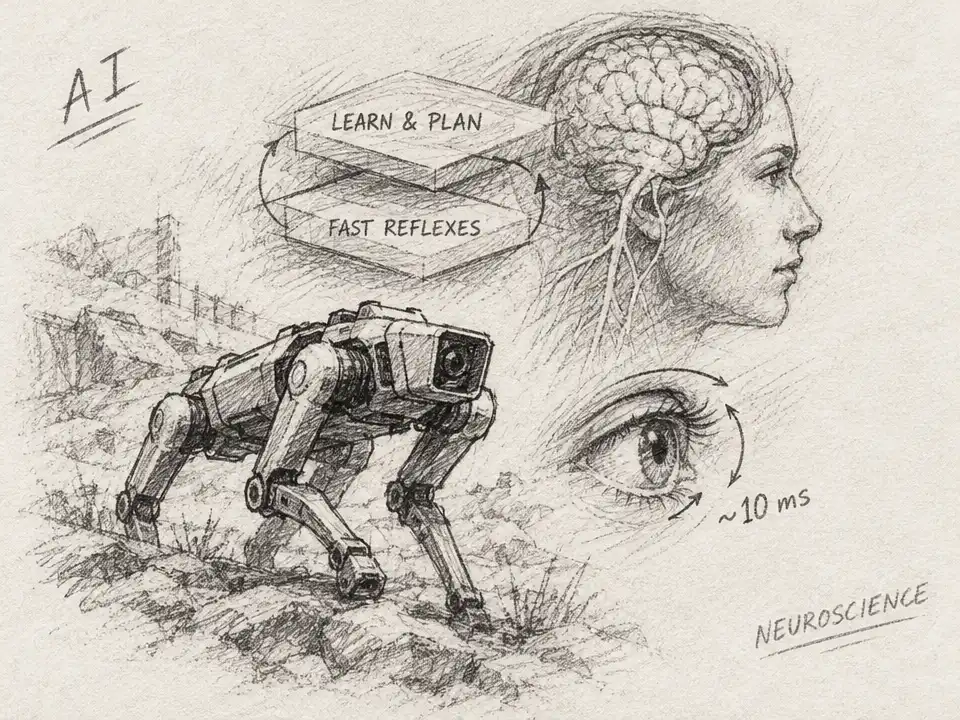
Turn your head to look at something, and your eyes swivel to keep it in view. The motion feels effortless. Underneath, a brain circuit is correcting for the head’s movement in about 10 milliseconds—far faster than deliberate thought could manage.
That tiny delay points toward a big design question for artificial intelligence: What if a robot had a fast, dependable layer that kept it safe while a slower, more flexible layer figured out what to do?
A recent neuroscience-and-AI roadmap argues that the brain’s layered control systems could help answer that question. The proposal brings together two fields that often speak different languages: neuroscience, which studies how living systems sense and act, and engineering, which builds machines that must operate reliably. It is not a report of a new robot or a demonstrated AI breakthrough. It is a synthesis of problems, biological clues, and promising directions for future work.
The problem is familiar to anyone who has watched machines excel at a screen-based task and falter in the physical world. AI can generate polished prose or solve formal problems, yet manipulating an unfamiliar object is a different challenge. A robot must act on incomplete information, adjust to changing surfaces and unexpected forces, and live with the consequences of a mistake. There is no reset button on a real kitchen counter.
Biology offers a striking counterexample to the idea that every response should wait for a central planner. When your head moves, the vestibulo-ocular reflex helps keep your gaze steady. If new glasses change how the eyes need to compensate, the system can recalibrate over hours to days. The immediate response and the slower adjustment are related, but they are not the same job.
That division of labor is the useful crossover. The roadmap suggests that AI-controlled machines could combine quick, local controllers with higher-level systems that learn and plan. A low-level controller might enforce limits on force or stabilize a joint before a slow planning system has time to weigh options. Above it, a learned policy could adapt to a new task or environment. The fast layer handles urgent constraints; the flexible layer decides where to go next.
This is not simply a matter of copying a brain circuit into software. The authors emphasize a hybrid: control theory, with formal safety guarantees, at lower levels, and learned systems, which can adapt to new situations, at higher ones. Today’s designs often lean toward one side. A hand-engineered controller can be reliable but inflexible; an end-to-end learned controller can be flexible without offering the same safety guarantees. Layering them could preserve the strengths of each.
The brain’s eye-stabilizing reflex provides a concrete illustration of how such layers can cooperate. The reflex acts in about 10 milliseconds, too quickly to depend on the cortex. When its response needs adjustment—for instance, after someone puts on new glasses—the cerebellum can gradually recalibrate it over hours to days. Once the adjustment is learned, the faster pathway can use it. In the roadmap’s telling, the broader pattern is: adapt slowly, then act quickly.
For a robot, the analogy might mean learning a safe grip gradually, then executing it rapidly when an object starts to slip. But the safeguard should not depend on the robot’s best guess about the whole scene. Local feedback could respond directly to pressure or movement, while a higher-level system handles the larger task. The proposal includes protective sensory channels for force, pressure, and temperature that could trigger a withdrawal response—something like a reflex that helps prevent damage. Those are proposed engineering goals, not capabilities the paper claims have already been achieved.
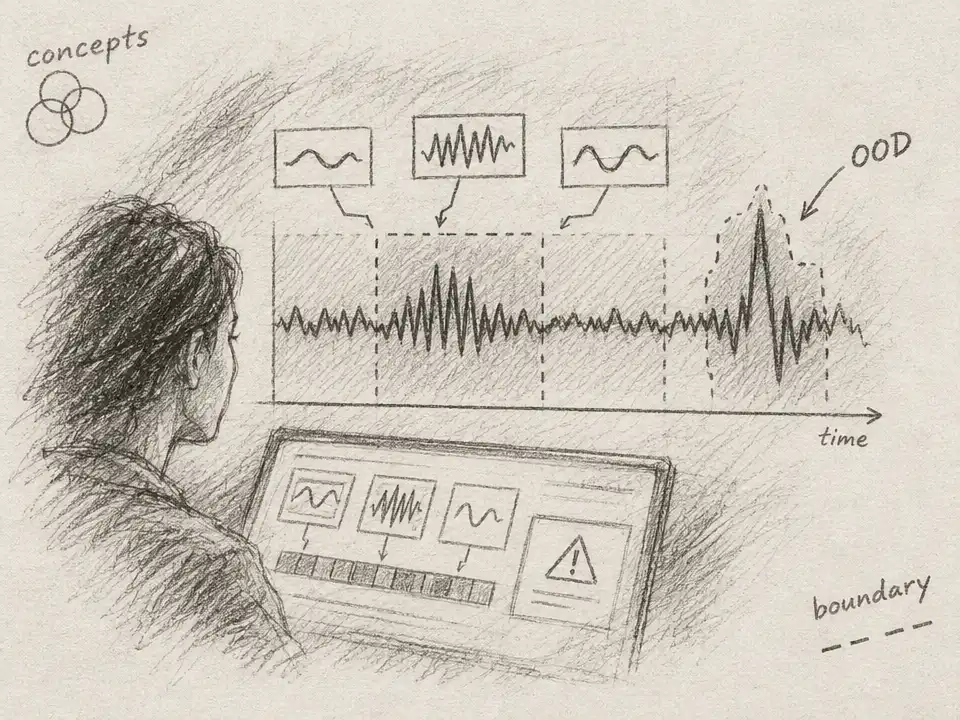
Layered control also raises a subtler possibility: a machine might be able to keep functioning when its higher-level reasoning is uncertain. A reflex does not need to understand the whole situation to stabilize gaze. By analogy, a robot could have simple, tested rules for maintaining balance or limiting force while a learning system works out what unfamiliar circumstance it has encountered. The roadmap identifies systems that represent their uncertainty as an important goal, especially for safety-critical uses. It does not establish that brain-inspired designs have solved the problem.
The researchers place these ideas in a broader NeuroAI agenda, based on an August 2025 workshop that brought together about seventy researchers and program managers from neuroscience, AI, robotics, neuromorphic engineering, and cognitive science. The resulting roadmap also discusses learning at multiple timescales and computing that activates only when needed—features the authors see as potential routes to more adaptable and efficient AI. They propose near-term work including robot studies in realistic simulations and continual fine-tuning, and call for benchmarks that test whether systems remain robust as conditions shift.
The deepest implication is that intelligence may not be a single, all-purpose calculation. In living bodies, immediate protection, practiced movement, and long-range planning are distributed across systems that learn and respond at different speeds. Engineering has its own tools for reliable control; neuroscience offers examples of how biological circuits divide the work. Their meeting suggests a fresh question for AI: instead of asking one model to handle every decision, can we build machines whose quick safeguards and slower learning systems cooperate?
That question is still open. A reflex-inspired architecture might prove difficult to engineer, and biological mechanisms do not automatically make better machines. But the eye-stabilizing reflex offers a useful starting point: a fast response can be reliable without being all-knowing, and a slow learner can improve it without taking over every instant. For AI that must act in the physical world, that division may matter as much as the next leap in raw capability.