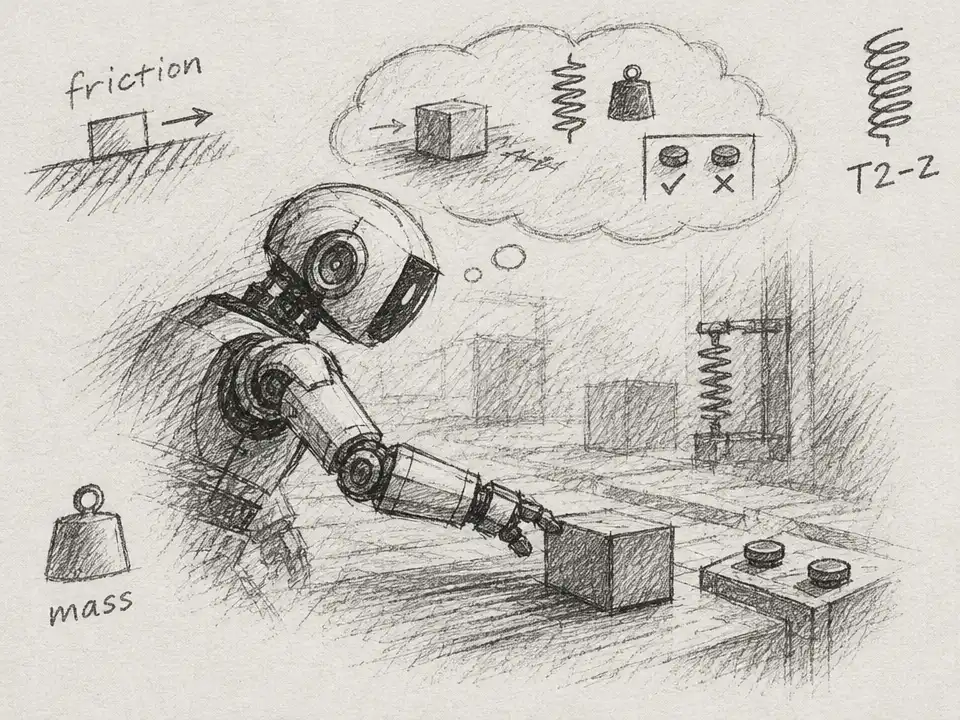
A block rests on a table. A robot gives it a nudge. The scene looks simple—but the block’s next move depends on facts the camera cannot see. Is the tabletop slick or sticky? Is the block heavy? A push that sends it gliding in one room may leave it barely moving in another.
That gap between appearance and behavior is a quiet problem for robots. A picture can show where an object is, but not necessarily how the world will respond when the robot touches it. In a recent study, researchers explored a way for a robot’s predictive model to learn those hidden conditions from what happens after an action.
Their system, called T2-z, works with a robot “world model”: software that predicts what a scene will look like after the robot does something. The researchers gave that model an additional, compact representation of its environment—a 32-dimensional latent, or numerical code. The code is not labeled “high friction” or “heavy object.” It begins without a specified physical meaning. Instead, the system adjusts it until the model’s predictions better match the outcomes it has observed.
That distinction matters. A conventional approach might first define which properties can vary, then train a system to estimate each one. But the real world does not always announce which hidden variable matters. T2-z’s goal is to let a useful representation emerge from prediction itself: if a push moves an object differently than expected, the system changes its environment code to account for the mismatch.
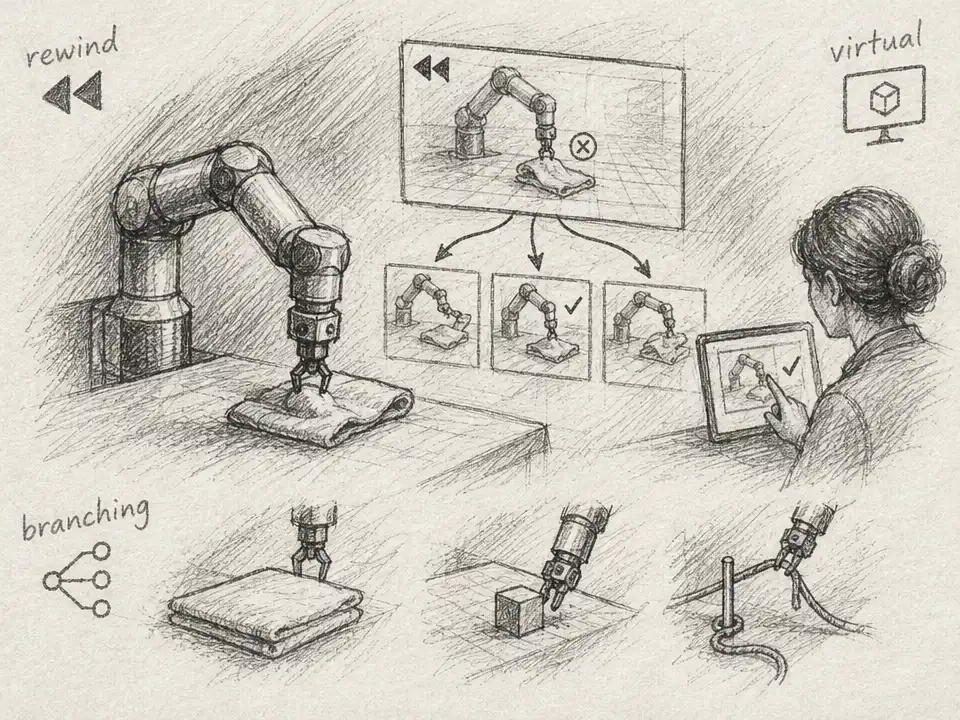
Training alternates between two jobs. First, the model learns general patterns in how scenes change when actions are taken. Then the researchers freeze the model and adjust the environment codes so each one better fits the outcomes from its particular setting. At test time, the shared model stays frozen. The system adjusts a newly initialized code using one or more observed interaction trajectories, then uses that code to predict what other actions might do.
Think of it as a robot getting a brief chance to probe unfamiliar ground—not by measuring the surface with a dedicated instrument, but by watching the consequences of a movement. A test push supplies evidence. The model updates its internal code, then uses that code to compare possible next moves. The code is not a verbal explanation, and the robot is not shown a label for the condition it must discover. Its job is to make predictions fit.
The researchers tested this idea across seven simulated settings. Some varied a physical property, such as friction, gravity, or the mass of an object in a collision. Others combined mass and friction. One varied a hidden rule about whether pressing a red button, a blue button, both, or neither would change a lamp. That last test moved the problem beyond mechanics: the concealed feature was a rule about how the setup worked, not a visible difference in the buttons.
In the combined mass-and-friction setting, the system was not told that two factors were changing, or what those factors were. Yet after training, the learned codes formed a two-dimensional pattern that researchers found corresponded to the two underlying factors. That pattern is an analysis of the model’s internal representations—not evidence that the system independently named mass and friction. Still, it offers a striking glimpse of structure emerging from the simple demand that predictions match outcomes.
The system was also tested in four real-world robotic tasks: closing a door whose spring-lock stiffness varied, predicting a ball’s motion, balancing a stick with different masses at its ends, and pulling a soft object so its shape changed. Across those tasks, the reported average action-success rate rose from 26.47% for a standard world model to 70.80% with T2-z. On the stick-balancing task, success rose from 20.00% to 83.33%.
These are results from a defined set of experiments, not a guarantee that a robot can instantly master any unfamiliar room. The trials used specific tasks and a limited number of observations: T2-z used one test-time interaction trajectory in some settings and two in others. It also required optimization—40 update steps in its reported test-time procedure—rather than magically recognizing a physical property in a glance. The researchers’ findings show that the approach helped in their tests; they do not establish how well it would work across every object, surface, or unexpected situation.
There is another useful detail in the experiments. In simulations with varied visual backgrounds, the system’s learned codes organized around shared dynamics rather than simply separating scenes by appearance. A block on a blue background and a block on a patterned table can look different while obeying the same friction conditions. The learned representation appeared to track what the scenes had in common for action prediction.
That points to a shift in what it means for a machine to “see” a room. Vision identifies the table, the block, the door. Interaction can reveal the less visible layer: how far the block slides, how stubbornly the latch catches, how a flexible object yields. T2-z treats those consequences as clues, refining a small internal map of the environment without requiring a list of hidden properties in advance.
The deeper idea is not that robots have discovered intuition. It is that useful knowledge can be built from prediction errors: try an action, notice what the world did, and adjust the model of what the world is like. For machines expected to work beyond carefully prepared demonstrations, that could make the difference between recognizing a scene and being able to act within it.