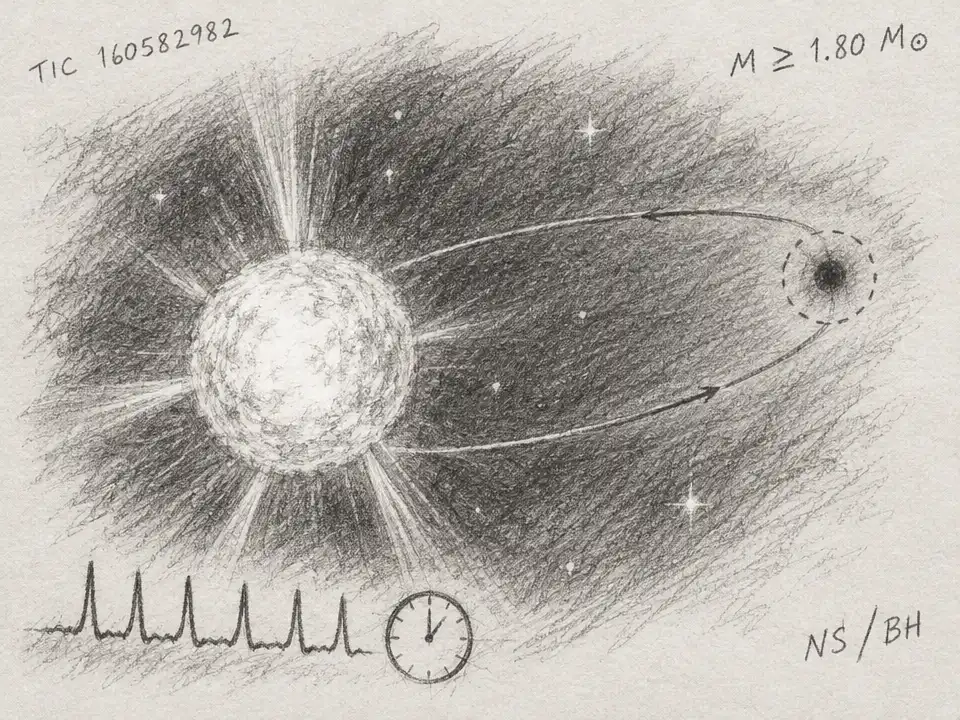
A star in a tight orbit around a pulsar should keep time like a well-made clock. As it circles, one side faces the pulsar’s radiation and warms; the star’s stretched shape also changes how much of its surface we see. Both effects ought to leave a repeating pattern in its light. But in one recently confirmed system, the pattern changes from year to year—and the usual explanations don’t quite fit.
The system, PSR J2053+6905, first drew attention as a possible “redback”: a millisecond pulsar paired with a low-mass star. The clue was a source that appeared in gamma rays and X-rays and seemed to brighten and fade in optical observations on a roughly 7.5-hour cycle. That combination suggested a compact binary, but it did not prove that a pulsar was there. The radio search had to catch the system in the act.
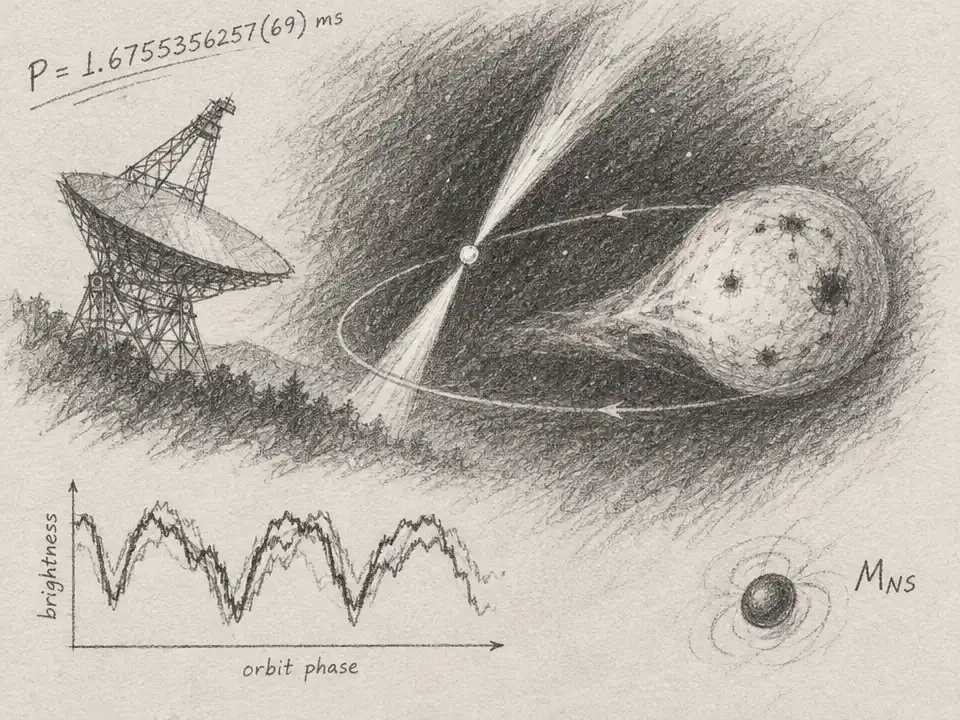
Researchers aimed the Green Bank Telescope at the candidate during four observing sessions between October 2025 and January 2026. In the data, a signal emerged: pulses repeating every 1.6755356257(69) milliseconds. The pulsar’s orbit takes 7.46657907(35) h. That period closely matches the one inferred independently from the optical variation, a key clue that the radio pulsar and the flickering star belong to the same binary rather than merely sharing a patch of sky.
The pulses did not arrive equally clearly throughout the orbit. In one session, the radio signal faded away near the point when the pulsar passed behind its companion. That is consistent with a redback system, where material driven from the companion can interfere with radio waves. The companion is not just a passive lamp circling a neutron star; it is part of a close, energetic exchange.
Then came the harder clue. The team gathered optical measurements in blue, visible, and red light over observing runs in 2023, 2024, and 2025. Folded around the orbital period, the data should line up into one repeating curve. Instead, the curve had a pronounced asymmetry, and the shape changed between observing years. One stretch—from orbital phase φ ≈ 0.25 to 0.75—stayed relatively steady. The rest grew substantially brighter from 2023 through 2025.
Why should only part of a star’s orbit change? The simplest picture combines direct heating by the pulsar with the companion’s tidal distortion. It explains some of the stable variation, but it cannot account for the changing sections. The investigators therefore fitted the simple model only to the stable part of the light curve, rather than forcing it to explain data it could not reproduce. That choice leaves an important part of the puzzle open—but keeps the estimates based on the reliable portion.
Several alternatives could make a star’s heated face look uneven. A shock where the pulsar’s wind meets gas around the companion might redirect energy. Particles could be channeled toward particular regions by the companion’s magnetic field. Heat could also spread across the star through convection and diffusion, shifting the brightness pattern away from the point directly facing the pulsar. These ideas can produce asymmetry, but the paper notes that some predict patterns that should remain more stable than the observed one.
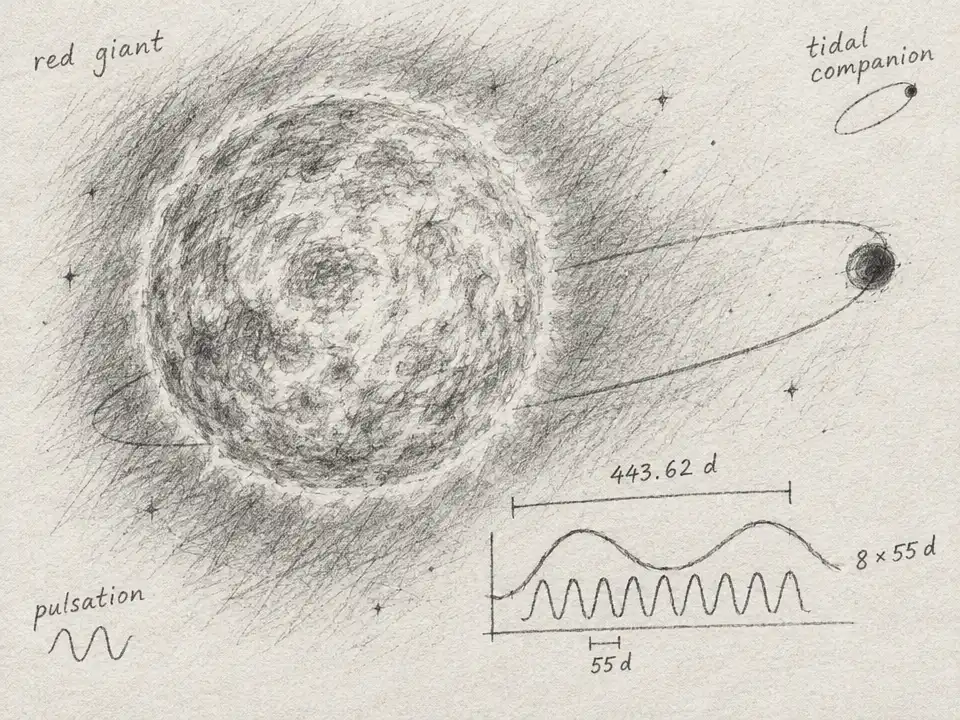
The authors’ leading suggestion is more local: large, relatively cool starspots may be changing position or fading. The companion is tidally locked, so it rotates rapidly as it keeps the same face turned toward the pulsar. Such rapid rotation could power a strong magnetic dynamo and long-lived spots. As a spot shifts or dissipates, it could change the light from one part of the orbit without erasing the steady pattern elsewhere.
That is a plausible explanation, not a confirmed diagnosis. The optical observations sample three main epochs separated by about a year, so they show long-term change but cannot rule out faster variations over weeks or months. Nor does the paper identify a spot directly. The changing light curve is a clue to the companion’s surface, and the spot idea is a way to make sense of it—not the end of the investigation.
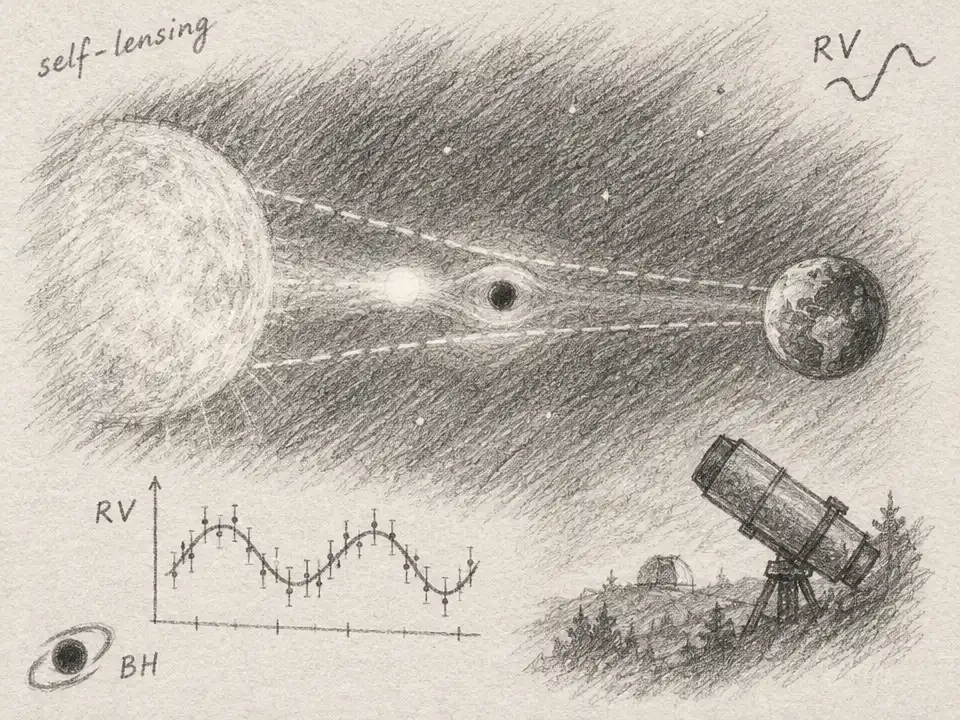
The uncertainty matters beyond the star’s weather. The researchers measured the companion’s orbital motion in spectra: its radial-velocity semi-amplitude is 337(4) km s⁻¹. Combining that with the pulsar’s radio timing and a model of the stable optical light curve gives a mass ratio of 7.05(8). The fitted system parameters suggest a pulsar mass of 2.12(11) M⊙ and a companion mass of about 0.30 M⊙. A neutron star that massive could help constrain how matter behaves at extraordinary densities.
But the optical model’s reduced χ² is high, a sign that it does not capture all the variability. The mass estimate therefore deserves follow-up, especially because it depends partly on the system’s geometry inferred from the light curve. If changing spots distort that curve, they can complicate the very measurements used to weigh the pulsar.
For now, PSR J2053+6905 offers two clocks to compare: the remarkably regular radio pulses and a companion star whose surface refuses to keep a perfectly repeatable glow. More radio timing and repeated optical monitoring can test whether the brightness changes track a migrating or fading spot, or point to a different kind of energy flow. Until then, the pulsar is confirmed—but the companion is still keeping some of its secrets.