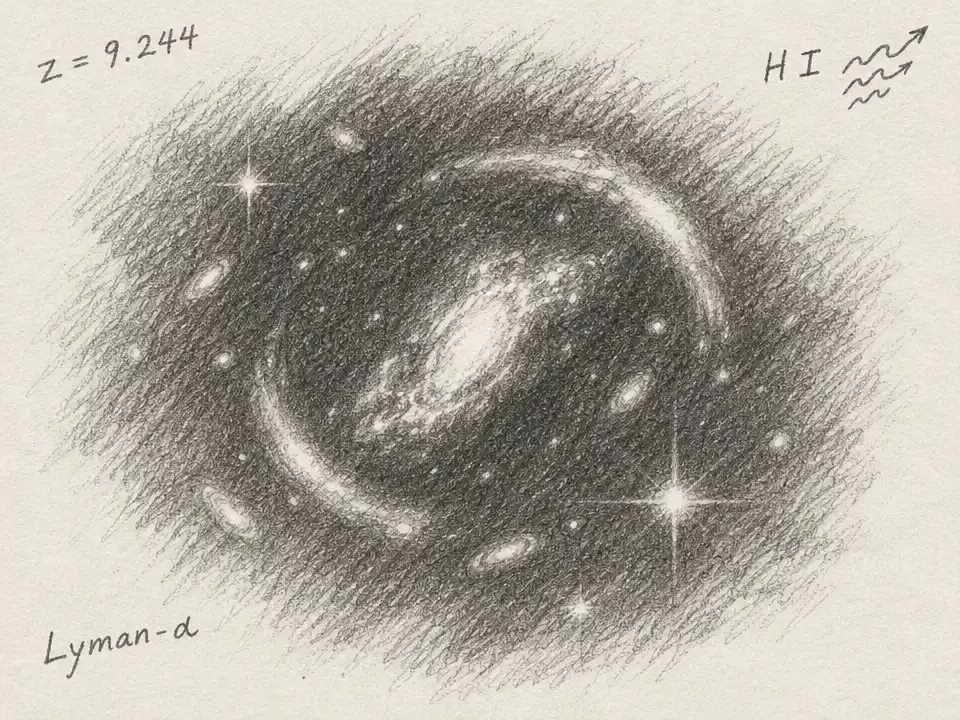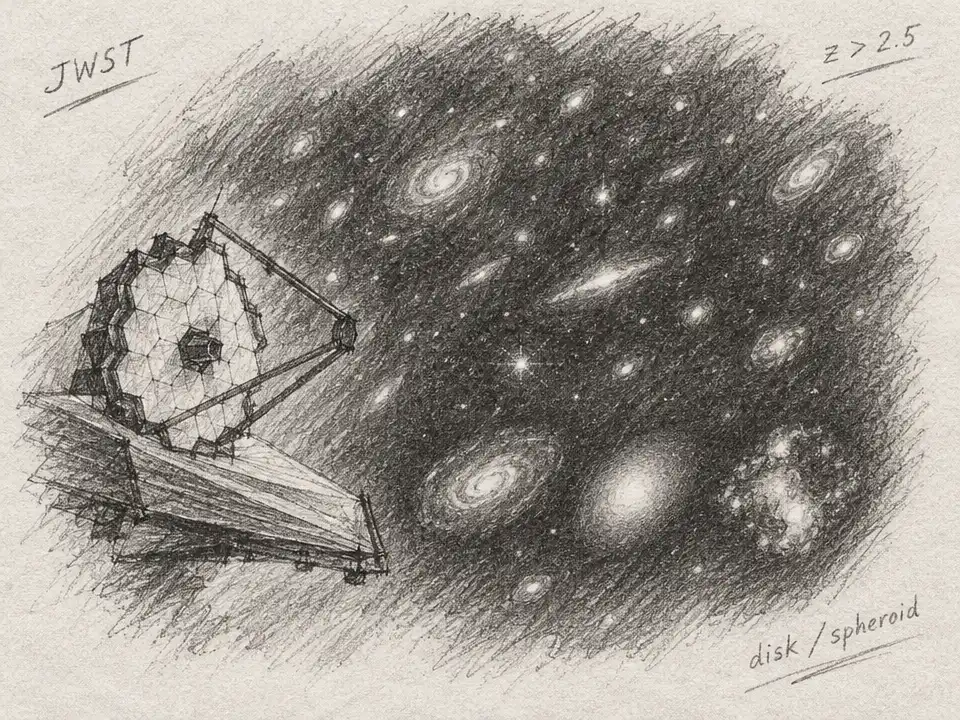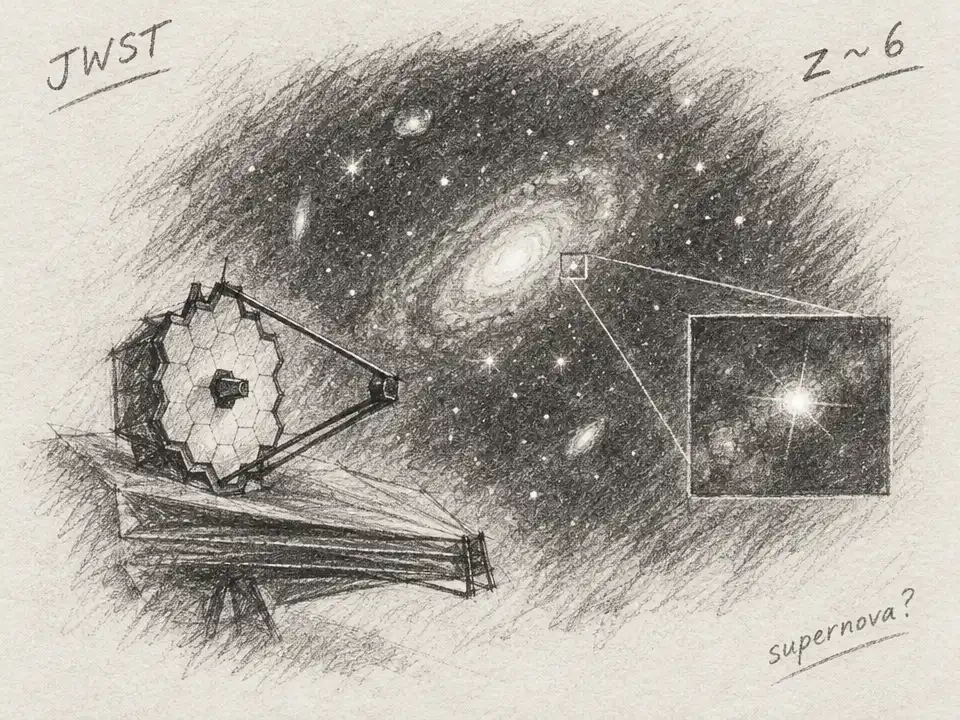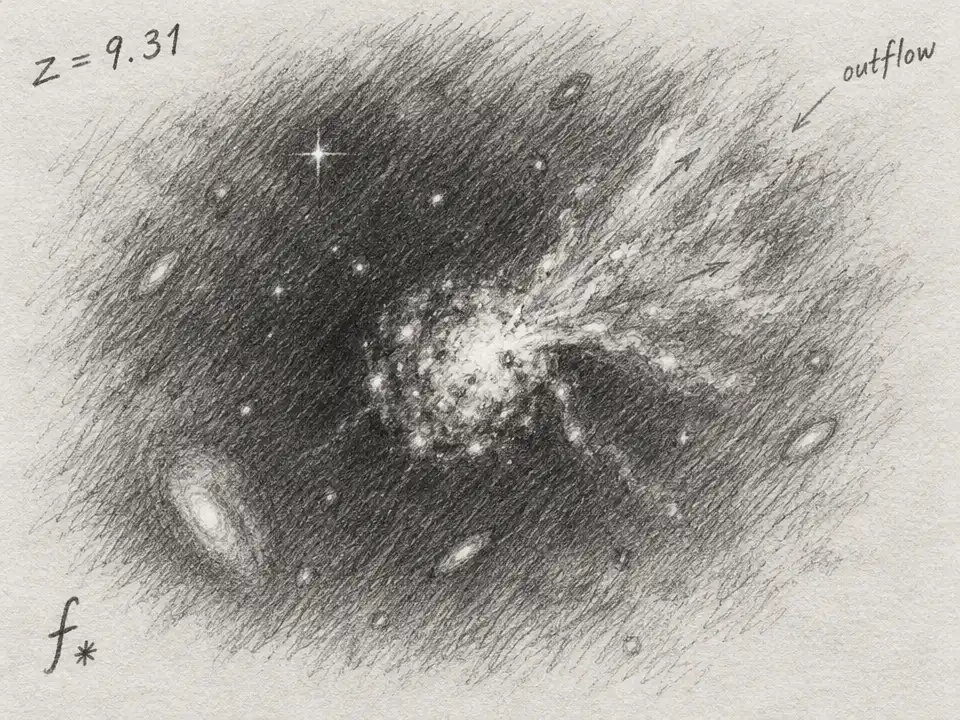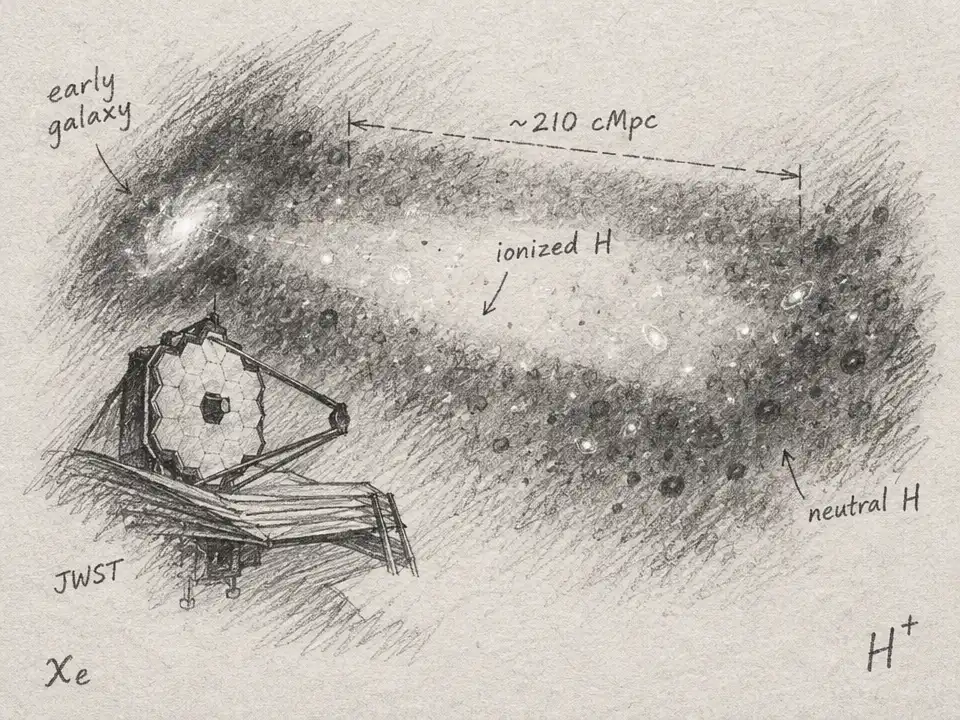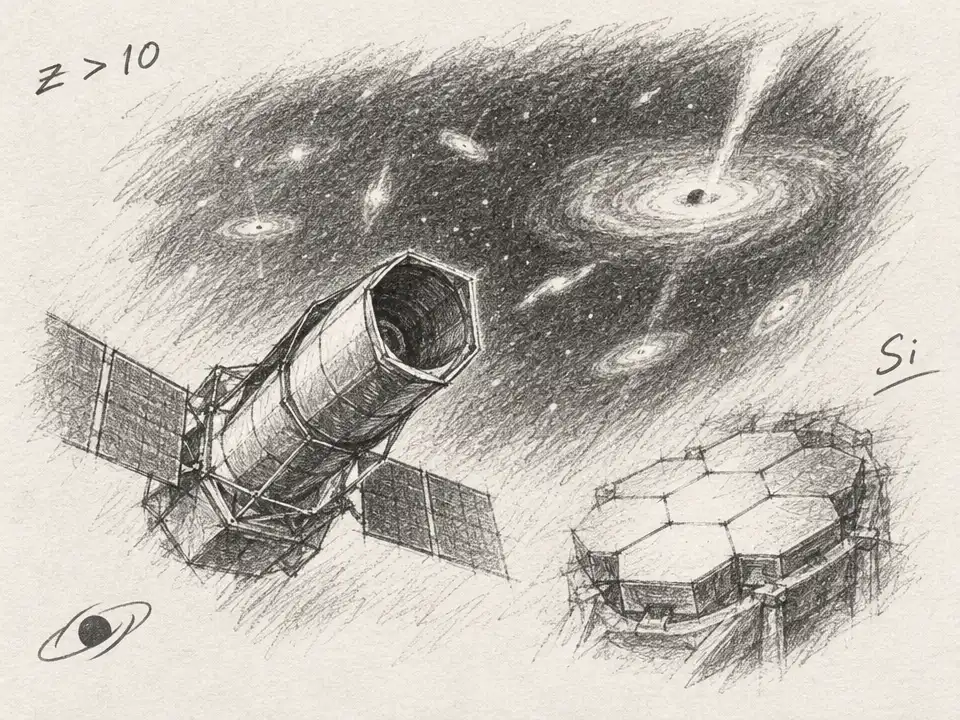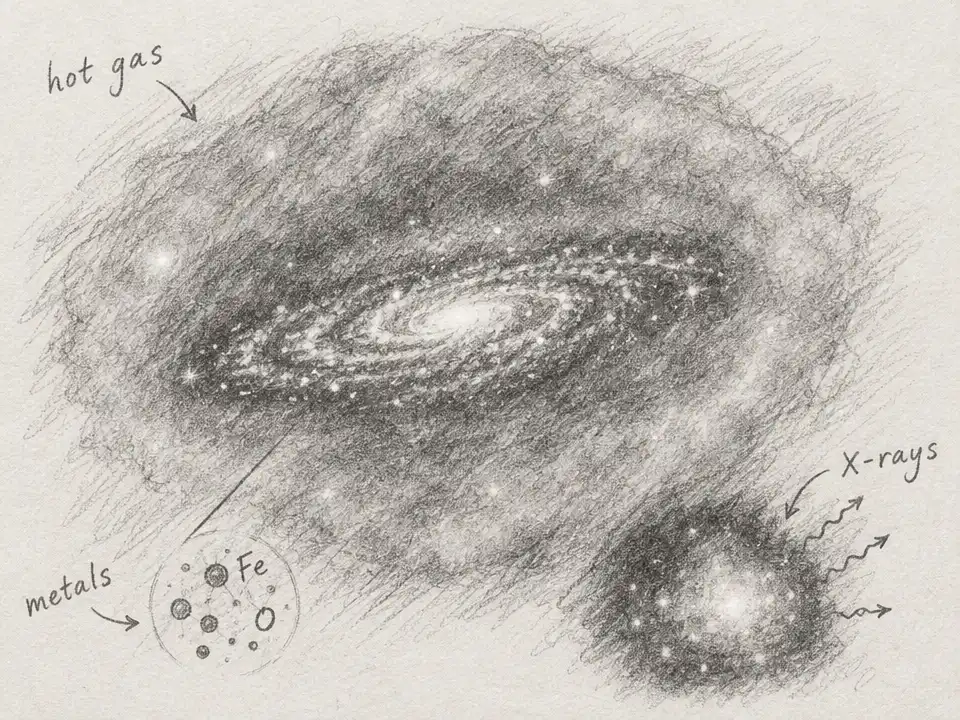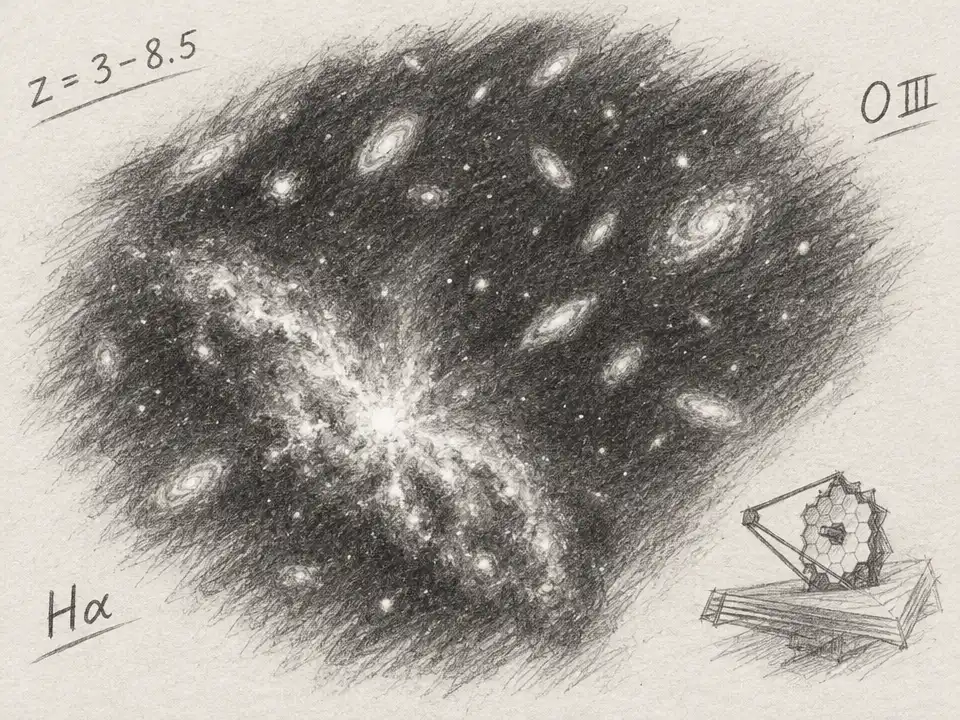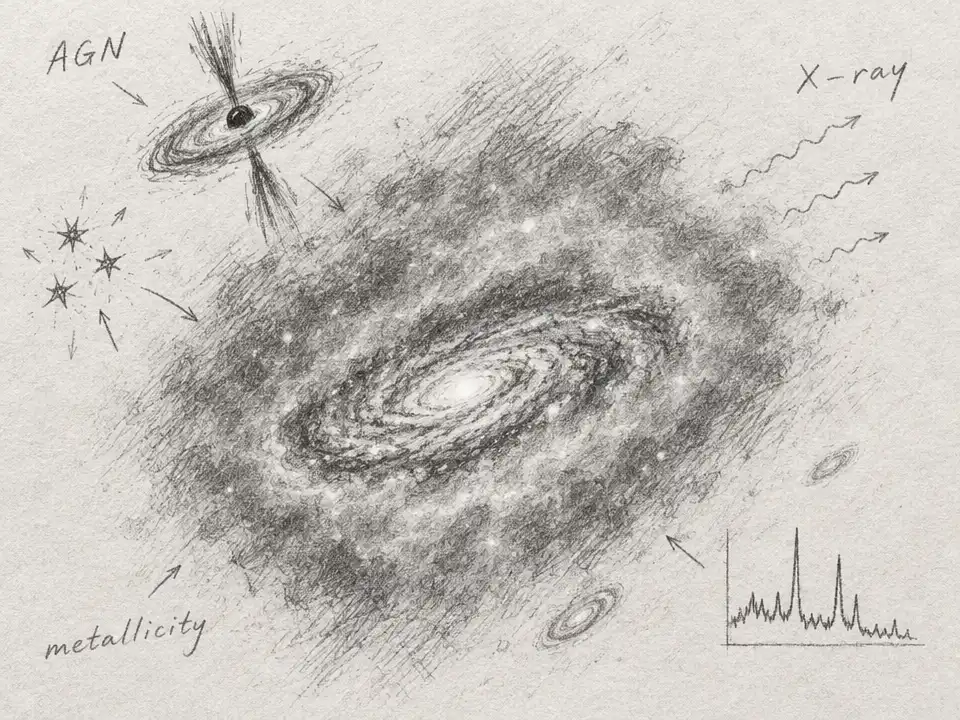
In the James Webb Space Telescope’s deep images, some faraway galaxies look like tiny red pinpricks. Their nickname, Little Red Dots, fits what the telescope sees—but not necessarily what’s happening inside. Their spectra carry an odd combination of clues: broad lines from fast-moving gas, a red glow, and features that can look more like a star’s atmosphere than a galaxy’s bright central engine.
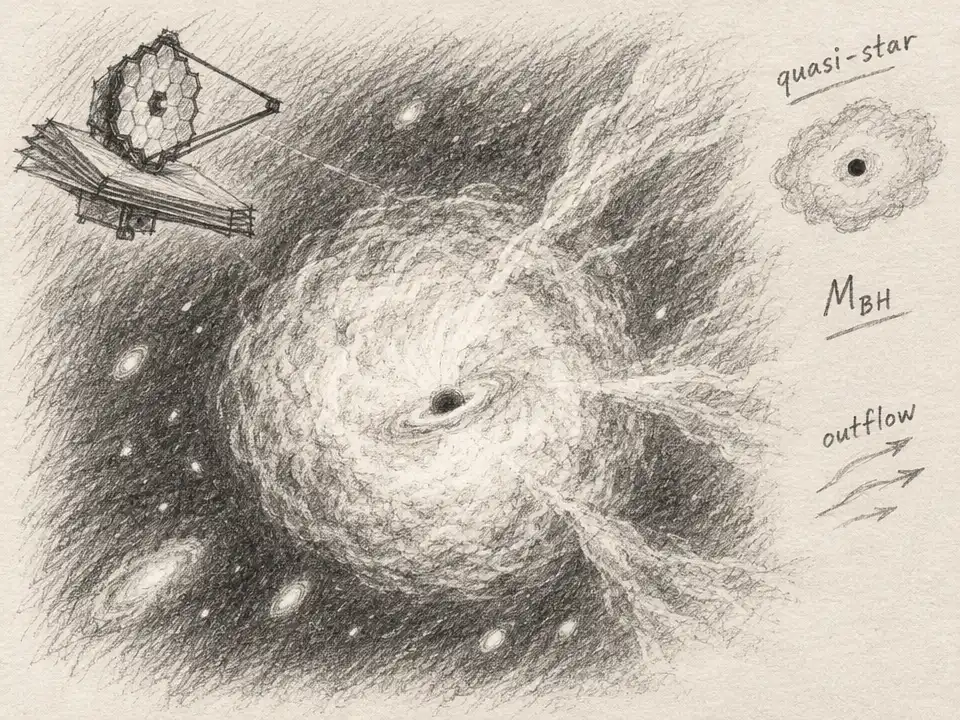
One possibility turns the apparent contradiction into a portrait of a hidden object. Imagine a black hole wrapped in a vast envelope of gas. The black hole feeds at the center; the surrounding material catches and reshapes much of the energy, presenting a star-like outer surface to the universe. Astronomers call this proposed arrangement a quasi-star. It is not an ordinary star with a black hole tucked inside. It is a possible stage in which a growing black hole and its massive envelope act as one strange, luminous system.
The idea could help explain how enormous black holes appeared so early in cosmic history. A stellar remnant starts small and must grow through many doublings. A black hole born inside a heavy, replenished envelope might have more fuel close at hand. But the cocoon has to do two jobs at once: feed the hole and hide its engine behind a surface that can resemble a star. Is that picture merely a clever fit to a strange spectrum, or can its physics keep the whole structure going?
To find out, researchers fitted observed spectra with models of both the host galaxy and a low-gravity stellar atmosphere, then compared the resulting properties with simulations of quasi-stars. Their close-up sample included five objects with especially strong atomic or molecular absorption: four distant Little Red Dots and a nearby object called The Egg. They also applied their approach to 82 archival sources. The team was not photographing a black hole inside an envelope; it was testing whether one physical model could account for the light that reached us.
The spectra point to surprisingly extended, low-gravity surfaces. For the hot components of their five main targets, the researchers derived Eddington-ratio values from 87 to 299. In everyday terms, this compares outward pressure from radiation with the inward pull of gravity. Values above one indicate a regime where radiation can help drive powerful outflows. The team’s models put the envelopes in the range of 700–15,000 M⊙. Those are not direct weighings of black holes: they are model-based estimates of the larger structures around them.
That distinction matters, but the proposed payoff is striking. In the quasi-star calculations, the central black holes could double their mass in about 0.05–3.5 Myr—million-year timescales. The researchers argue that, with continuing supplies of gas, this route could build intermediate-mass black holes within 30 Myr or less. It offers a possible bridge between smaller beginnings and the huge black holes seen powering some early quasars.
The model also changes how one puzzling object might be read. For GN-28074, known as the Rosetta Stone, the team’s framework places the black-hole mass estimate five orders of magnitude below a previously published estimate based on broad emission lines. If those lines are shaped by an extended atmosphere and its flows, rather than simply tracing gas orbiting close to the black hole, they may not provide the usual kind of mass estimate. The new interpretation eases the apparent mismatch—but it depends on getting the structure of the gas right.
In some of the spectra, the cocoon’s weather leaves a more delicate trace: water absorption. Three sources needed a two-component fit, with a hot surface plus a colder component. The researchers interpret the water as forming in dense clouds that cover roughly 4–16% of the visible surface. A partly covered source lets astronomers see both the hot glow and the cooler material, like a few clouds crossing a bright window.
That envelope, however, has a price. Radiation pushes gas outward in winds, and the researchers found that the highest-ratio, lower-mass sources can launch material at several times the speed needed to escape their own gravity. They interpret the trend as a possible life cycle: a young quasi-star begins with a heavy envelope and slower outflows; as winds strip material away, the remaining envelope becomes more vulnerable to rapid, eruptive loss. The same process that could feed a black hole can eventually remove the blanket and expose the engine.
The evidence is promising, not decisive. A black-hole-powered cocoon is not the only way to surround a black hole with dense gas, and the authors note that different setups can produce similar star-like spectra. Their atmosphere models also assume hydrostatic balance, an approximation that cannot capture every accelerating wind, cloud, or eruption. The fitted light does not reveal exactly where the black hole sits along its growth track; in the model, its mass can be only a fraction of the envelope’s, and that fraction remains uncertain.
The next step is to make the proposal harder to evade. Better spectra and improved measurements of the host galaxies could test whether the inferred surfaces, masses, and winds agree across a larger sample. The authors also point toward three-dimensional simulations that can follow radiation, magnetic fields, convection, and material rushing away from the envelope—processes a simpler, balanced model cannot fully reproduce.
If the quasi-star picture survives those tests, Little Red Dots may offer a rare glimpse of black holes still wrapped in the fuel that built them. The opportunity is extraordinary: to watch a possible seed of a future giant while it is still hidden in its own cocoon. The obstacle is equally clear. The cocoon changes the very light astronomers need to use as evidence, and its winds may dismantle the scene as it unfolds.