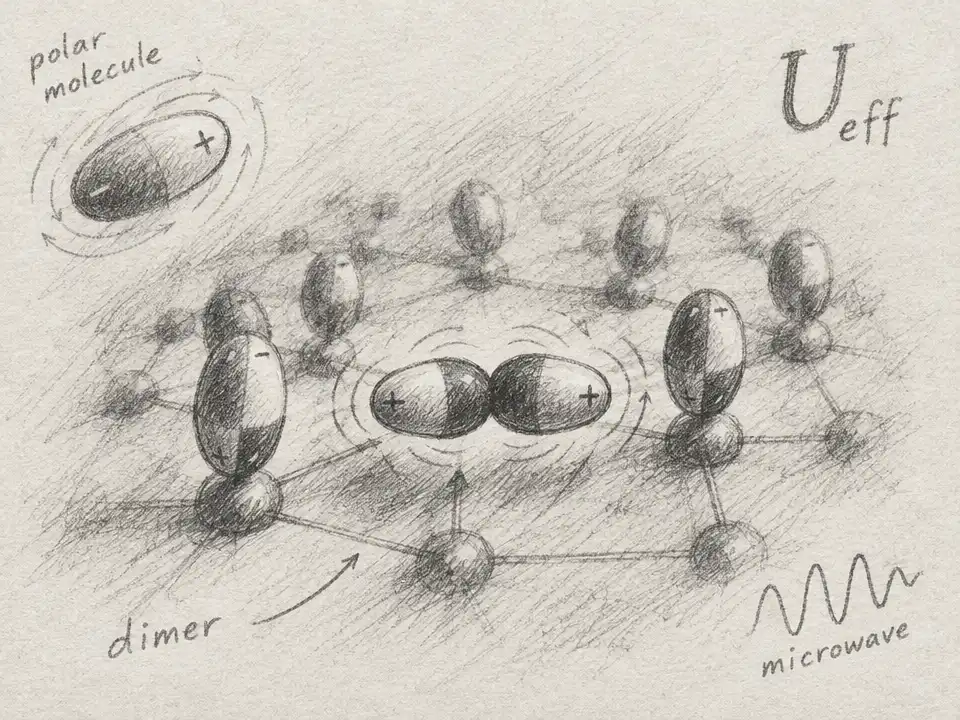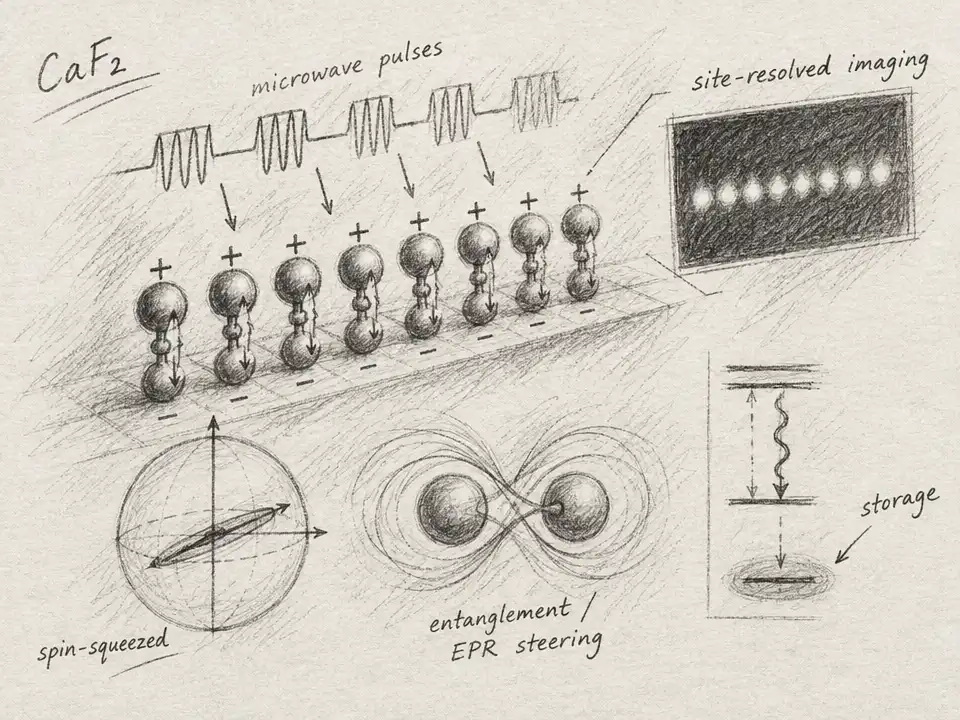
Eight molecules sit in a row, each caught in its own tiny optical trap. A microwave pulse tips their internal states into a carefully prepared quantum rhythm. Then the molecules begin to influence one another: their electric dipoles exchange energy, linking their rotations into a shared state. In a new experiment, that interaction did more than make an intricate quantum pattern. It squeezed uncertainty in a way that could help the array measure faint signals more precisely.
The molecules were calcium fluoride, or CaF, held in an optical tweezer array. The team encoded a two-state quantum bit in each molecule’s rotational levels. In one level, the molecule’s rotation is different from the other; together, the two options play the role of a tiny spin pointing in one of two directions. A microwave pulse put the eight spins into an initially unentangled state, and the researchers let the molecules’ natural dipolar exchange interactions build correlations between them.
Why bother making the spins interact? A sensor that uses many independent particles faces a basic limit: random quantum fluctuations blur its reading. Entanglement can redistribute those fluctuations. In a spin-squeezed state, uncertainty narrows along one direction, at the cost of growing along another. If a measurement is arranged to read out the quieter direction, the ensemble can distinguish a small change more clearly than an equivalent collection of unentangled particles. The strategy is established in other quantum systems; making it work in molecules has been difficult.
Molecules offer an unusual combination: their internal states respond to a broad range of electromagnetic signals, and their dipoles can interact over distances. But that rich internal structure also makes them challenging to control. Here, the team built the quantum state in a small, orderly array and used a sequence of microwave pulses called XY8 to suppress disturbances during the interaction. The spins were separated by 2.1 micrometers while they interacted. For readout, the researchers could identify each site and determine which rotational state its molecule occupied.
The first test was to look for the telltale shape of squeezing. After letting the molecules interact, the team rotated the spins by different amounts and measured how much their collective readings fluctuated. Instead of the same noise in every direction, the fluctuations varied with the rotation angle: one direction was quieter, another noisier. That angle-dependent pattern showed that the ensemble had developed the correlations needed for spin squeezing.
The researchers then compared the reduced noise with the strength of the collective signal, which matters as much as noise for a useful sensor. By this measure, the squeezed state achieved a maximum metrological gain of 3.0(3) dB; without correction for measurement errors, the gain was 2.2(3) dB. The standard quantum limit is the benchmark for unentangled particles. Falling below it means the state could, in principle, resolve a smaller signal with the same number of particles. The team measured the state’s metrological performance, rather than demonstrating a finished device detecting a new external signal.
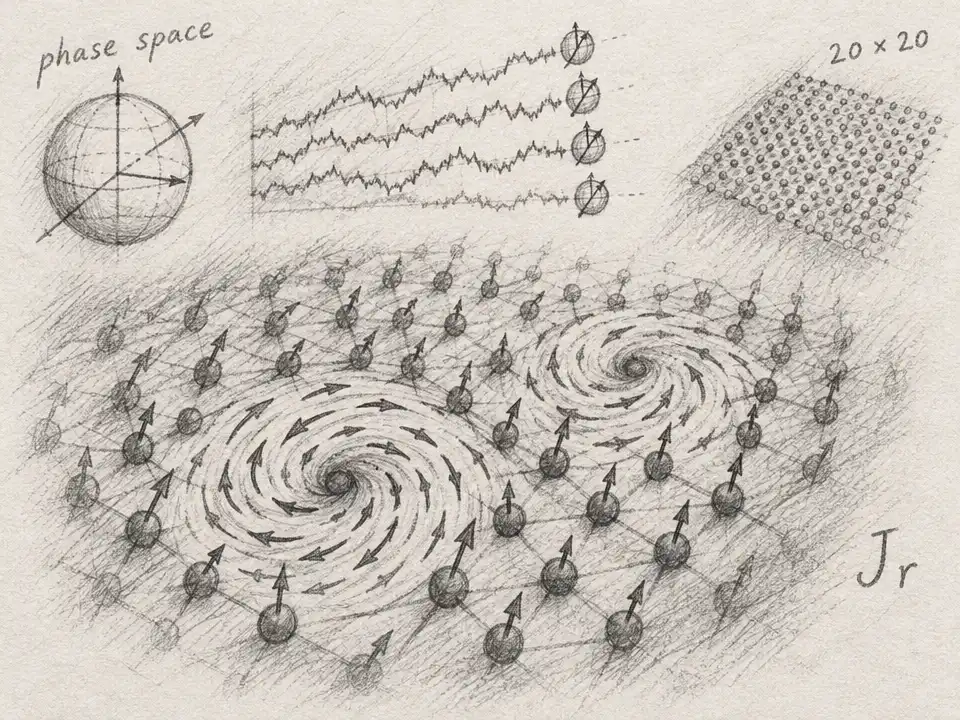
Because the traps reveal the molecules one by one, the researchers could ask where the correlations lived. With the array’s natural exchange interaction, the squeezing was dominated by correlations between neighboring molecules. That local structure led to a surprising twist: the state could also offer an advantage for detecting a field that alternates from one site to the next. This alternating pattern is different from a uniform field, which acts in the same direction everywhere. In the experiment, the array showed a 2.8(5) dB gain for this staggered-field measurement, along a different direction from the one used for the uniform-field sensitivity.
Next, the team changed the interactions rather than simply accepting what the molecules naturally provided. Carefully timed microwave pulses used Floquet engineering: a way of making a system behave as if it had a chosen interaction pattern by repeatedly driving it. This let the researchers tune how strongly different spin directions influenced one another. Near a special, nearly isotropic setting, correlations reached farther across the row and became more alike from one separation to another. The pulse-engineered states still showed metrological gain, but the longer sequences also accumulated more noise, and they did not surpass the best gain from the natural interaction.
The site-by-site view also let the researchers test a deeper kind of quantum connection. They divided the row into alternating sites, like two interleaved teams, and checked whether the fluctuations in one team were linked to those in the other. The measurements confirmed entanglement between the two groups with greater than six standard deviations of significance after measurement correction, and greater than 3.8 without that correction. For some settings, measurements on one group could even help predict two different, incompatible measurements on the other beyond the limit allowed by a non-steerable description. Physicists call this EPR steering. It is a statement about quantum correlations, not a way to send information faster than light.
A useful quantum state must also survive long enough to be used. The rotational levels that create the interactions are not ideal for quiet storage, so the researchers transferred the squeezed state into different molecular levels, where dipolar exchange is suppressed. In that protected encoding, the state remained below the standard quantum limit for more than 50 milliseconds. It retained a practical advantage over an unentangled comparison state for about 100 milliseconds. The transfer adds technical noise, and the advantage eventually fades as the state decoheres.
The advance is therefore not a molecule-sized sensor ready to outperform existing instruments. The experiment used only eight sites, and the pulse-engineered interactions reveal how control errors can eat into a quantum advantage. But it shows a new way to build and inspect metrologically useful entanglement in molecules: use natural dipole interactions to create it, tune those interactions with pulses, examine its spatial pattern one molecule at a time, and move it into quieter states for storage. Larger arrays could eventually explore more complex sensing patterns, but scaling up while preserving coherence is the next challenge.
For now, the key result is a working chain from interaction to measurement: the molecules make a shared quantum state, and the team can see how that state distributes its uncertainty and correlations. That combination matters because a sensor is only as useful as the state it can prepare, measure, and keep. These eight trapped molecules demonstrate that molecular complexity, carefully controlled, can become a resource rather than merely an obstacle.