Imagine trying to photograph a tiny object while an invisible hand nudges it differently every time the camera flashes. The object may follow the same instructions on each attempt, yet the resulting pictures blur together. Researchers working with a levitated nanoparticle face a quantum-scale version of that problem: small forces that drift between experimental runs can hide the delicate changes they are trying to make to the particle’s motion. A new three-stage control sequence, called an oscillator echo, uses timed changes to the particle’s trap to make those unwanted nudges cancel.
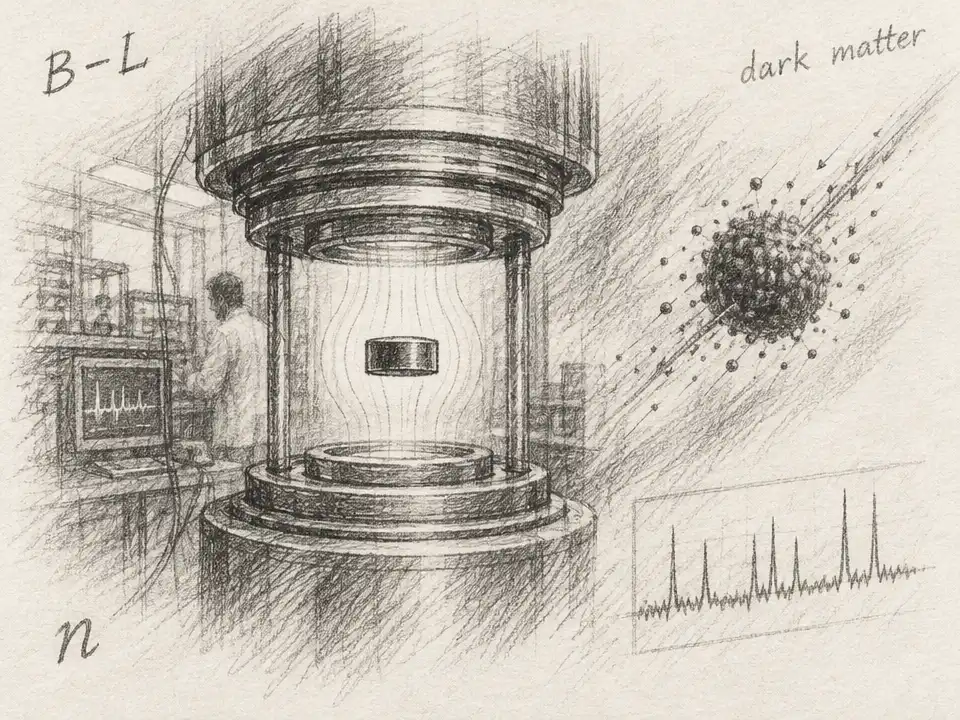
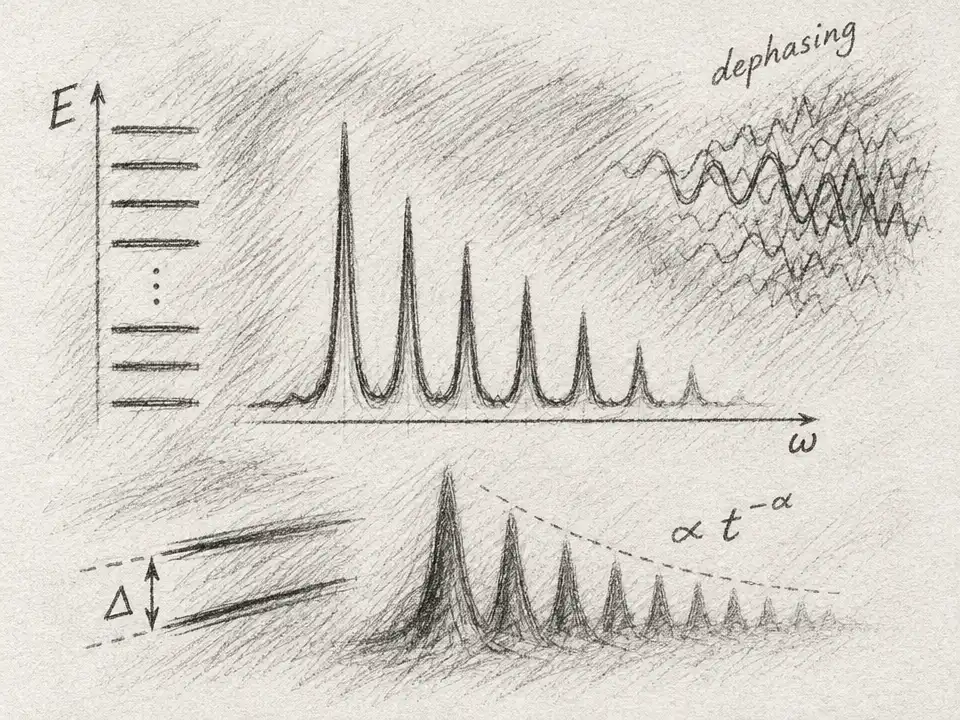
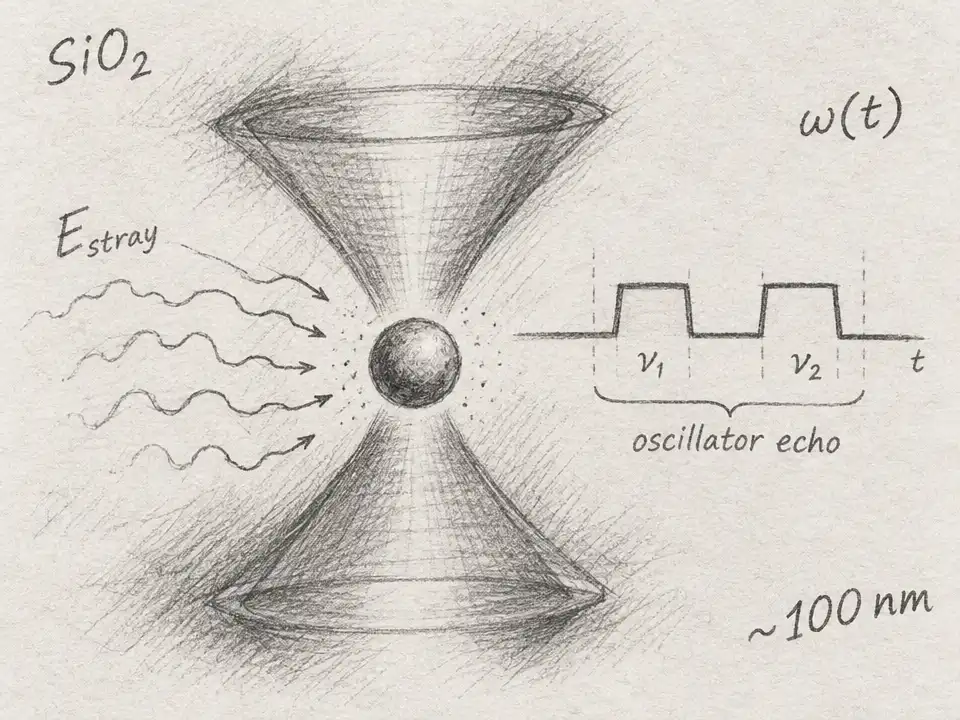
The target is a silica particle held in place by a focused laser, not by a physical support. Its motion resembles that of a tiny mass on a spring. Because it is suspended in vacuum, researchers can reduce many ordinary disturbances and bring its motion close to the quantum ground state. But the particle carries a few electric charges, so stray electric fields exert a force on it. Those fields can change slowly from one experimental run to the next while staying nearly constant during any single run. That timing matters: each run gets a different steady push, and averaging many runs makes the particle appear more uncertain than it is in any one of them.
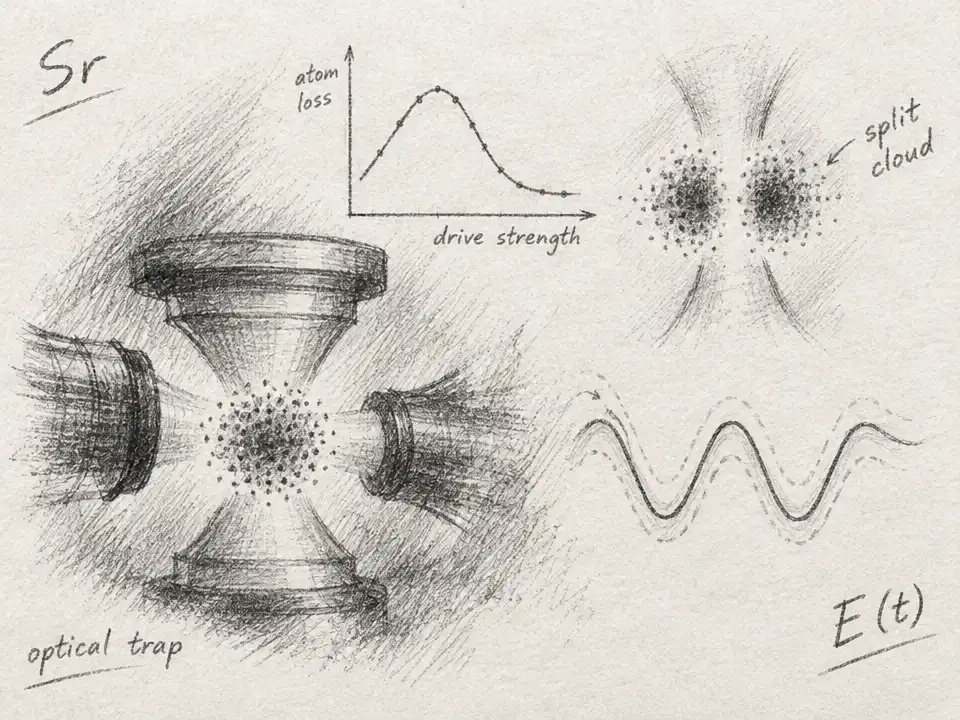
To manipulate the motion, the team changes the intensity of the trapping laser, which changes the trap’s stiffness and therefore the particle’s oscillation frequency. A sudden change in frequency can squeeze the motion: it reduces uncertainty in one aspect of the oscillation while increasing it in another, much like pressing a soft ball in one direction. That is useful for preparing unusual mechanical states and for sensing tiny forces. But the same frequency jump makes the particle’s trajectory sensitive to a steady external push. Different stray forces shift the motion along different paths, so their combined measurement cloud can swell enough to conceal the squeezing.
The researchers’ answer borrows a useful idea from a different arena of physics: the spin echo. In magnetic-resonance experiments, carefully timed pulses can make spins that have drifted out of step reassemble their rhythm. Here, instead of flipping spins, the researchers reshape the particle’s trap. They first lower its frequency for half an oscillation, then apply the frequency change intended to manipulate the state, and finally use a second half-oscillation at a carefully chosen intermediate frequency. The first and last stages act like bookends, undoing the displacement caused by the stray force while leaving the central operation available for the desired control.
The timing is the key. During the first stage, the steady force moves the particle’s average position in its oscillation cycle. The researchers choose the next trap frequency so that the particle’s new orbit is centered on that shifted position. The middle stage can then reshape the motion without adding another force-dependent displacement. In the final stage, a matched half-cycle carries the particle’s average position back toward where it began. If the unwanted force is effectively constant during the sequence, its imprint is canceled even though the team does not need to know the force’s value on any particular run.
That condition sets a boundary on what the method does: it is designed for forces that drift between runs but remain approximately steady during a run, not for arbitrary disturbances that change rapidly in the middle of the control sequence. And the echo is not free. Every extra change to the trap gives measurement backaction—random kicks associated with probing the particle—more time to add noise. The useful question is therefore not whether the protocol eliminates every source of uncertainty, but whether it trades a large, uncontrolled spread between runs for a smaller, predictable limit set by the measurement itself.
To test the idea, the researchers trapped a silica nanoparticle with a nominal diameter of 100 nm and a mass of 1.2 fg. They cooled its motion to a phonon population of 1.2 ± 0.6. The trap’s oscillation frequency along the measured direction was 52 kHz, and changes to the laser intensity could be made in about 200 ns. The team inferred the particle’s motion by comparing the phase of light scattered back from it with a reference light field, building a picture of its position and momentum across repeated trials.
For a clear test of the echo, they used a middle sequence that, overall, returned the motion to its original shape. In that central stage, the particle first underwent a squeezing-like change and then the reverse change. The researchers sampled the motion at eleven points in the sequence, repeating each sampling time 100 times. In the first half of the protocol, the data spread out as different runs experienced different stray forces. At the midpoint, the expected squeezing was so obscured by this run-to-run spread that it could not be cleanly distinguished. After the final echo stage, however, the particle’s average position and spread came back close to their starting values.
The quantitative result shows both the success and the limit of the approach. The fitted minimum of the total phase-space covariance metric was 8.03 ± 1.07, close to the theoretical expectation of 7.9 when measurement backaction and the particle’s measured properties are taken into account. In other words, the force variations that had been broadening the results no longer dominated the final spread; the residual was consistent with the backaction limit. The experiment therefore demonstrates noise cancellation, rather than a completed demonstration of a strongly squeezed final state. Its importance is that the troublesome, varying force no longer has to mask a squeezing operation when researchers try to prepare one.
That distinction makes the result a practical advance rather than a claim that every obstacle to quantum control has vanished. The additional echo stages introduce heating, and the measured particle still feels the unavoidable disturbance associated with monitoring its motion. But the method gives researchers a way to separate those fundamental limits from a more mundane problem: experimental conditions that shift slightly between repetitions. The team’s analysis suggests that the squeezing step can be chosen independently while the bookend stages are tuned to refocus the force-driven motion.
For levitated-particle experiments, the payoff could reach beyond squeezing. Researchers are exploring these free-moving mechanical objects as sensitive probes of brief forces and as platforms for testing how quantum mechanics behaves at larger scales. Those studies depend on distinguishing a real signal from changes in the apparatus and its surroundings. The oscillator echo does not make the nanoparticle immune to its environment; instead, it gives experimenters a way to make one persistent kind of environmental uncertainty cancel itself. Sometimes the route to a cleaner quantum experiment is not to eliminate every nudge, but to arrange the motion so that the nudges bring the object back.