Picture an electron skimming a gold wall inside a narrow channel. It never needs to leave a visible mark on the metal: the electric field of its passing wave can stir charges in the surface, and the metal’s response can, in turn, disturb the electron’s delicate quantum phase. In a recent experiment, that disturbance showed up as a blur in a diffraction pattern. The surprise was not simply that the electron lost coherence. It was that turning the channel made the effect grow, peak, and then fade.
In everyday Brownian motion, a speck of dust jitters because it is buffeted by surrounding molecules. Quantum Brownian motion has a subtler consequence. A quantum particle can travel along several possible paths at once. If its surroundings respond differently to those alternatives, the particle and environment become entangled, and the paths lose their ability to interfere. The electron may still be there; what fades is the organized relationship between parts of its wave.
For years, physicists had a proposal for how this could happen when a free electron moves close to a metal. The electron’s electric field induces an image charge in the surface. That charge responds with a delay, and its interaction with the metal’s lattice dissipates energy and creates fluctuations. Through the same broad link that connects friction and random jostling, those fluctuations can scramble the electron’s phase. Earlier attempts to see the effect clearly came up short, leaving open whether the theory or the experimental conditions were to blame.
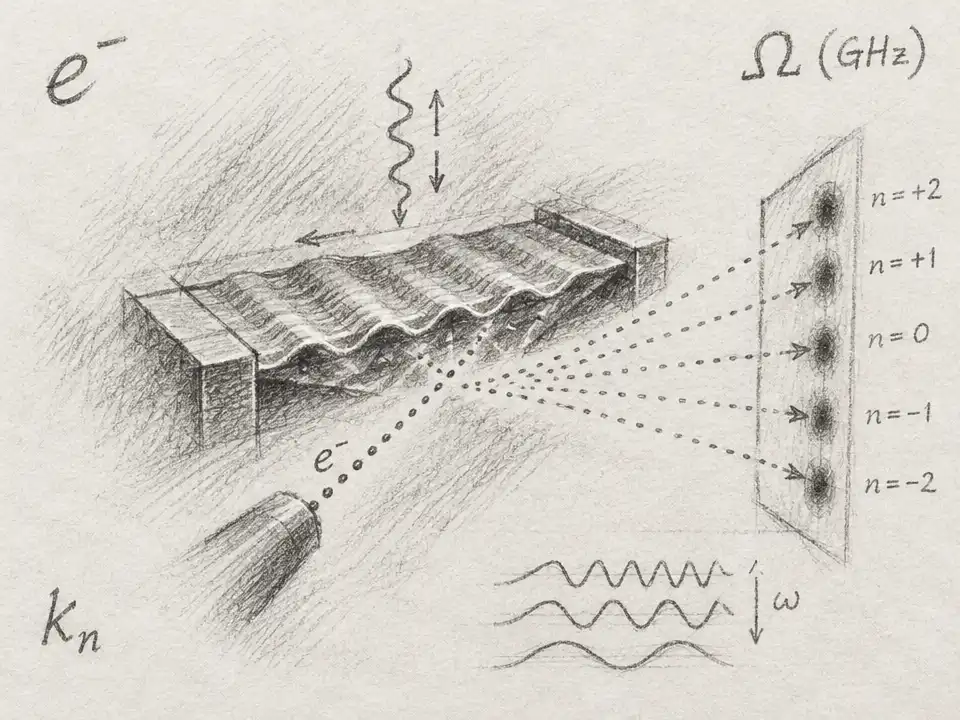
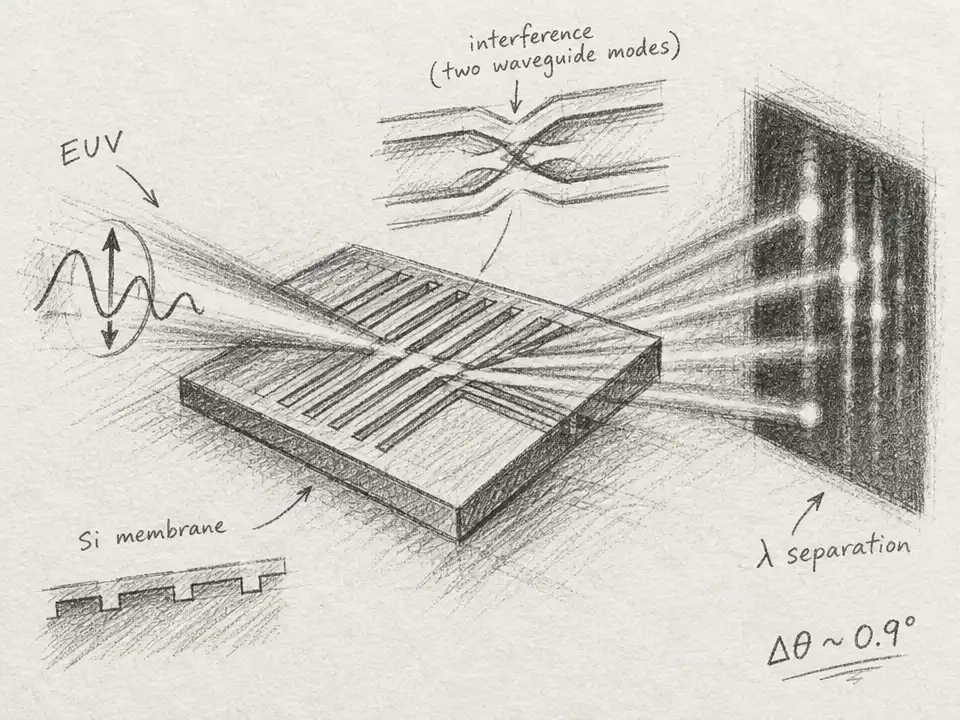
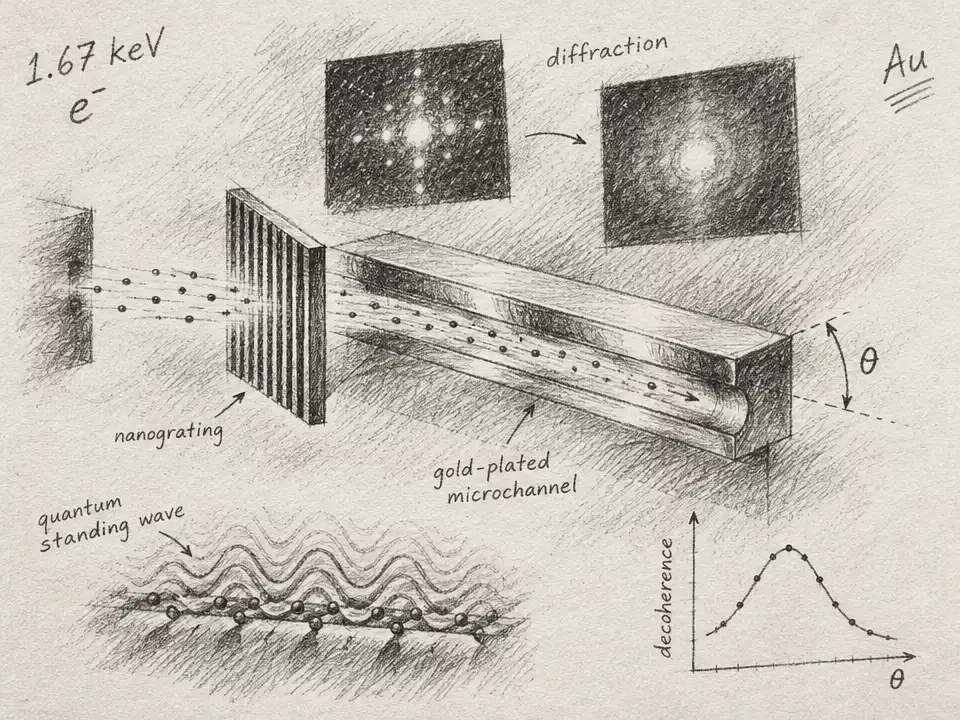
The new experiment, reported on arXiv on October 27, 2026, used a clever workaround. The researchers sent 1.67 keV electrons through a nanograting with a 100 nm period. The grating split the electron wave into a set of diffraction orders—like a fan of overlapping wave trains. Those orders then passed through a gold-plated microchannel just 1.7 μm tall. By tilting the channel, the team changed how the electrons grazed its walls and how long they interacted with the gold.
Rather than recombine separated beams and inspect interference between them, the researchers examined the shape of each diffracted beam. That matters because decoherence can blur interference within a beam, too. The team looked for two telltale changes: broader diffraction peaks and reduced fringe visibility. As they adjusted the channel’s tilt, the visibility changed continuously, falling to between 30% and 60%. The pattern gave them a way to track how strongly the electron’s motional state had lost coherence.
A simple expectation seemed reasonable: tilt the channel more, shorten the electron’s time near the gold, and the decoherence should steadily weaken. A classical-trajectory calculation did predict that decline. The data did not follow a smooth downhill path. The measured decoherence rate instead reached a maximum at a tilt of 4.6 mrad, where it was 182 μm−2, before dropping at larger angles.
That turnover is where the electron’s wave nature enters the story. Near the surface, the incoming and reflected parts of the electron wave can overlap briefly, forming a standing-wave pattern. Changing the tilt changes the wave’s effective spacing perpendicular to the wall. Because the interaction becomes much stronger at very short distances, even a small change in how the wave is distributed near the surface can change how much decoherence it experiences. The classical picture captures the overall scale and the decline at larger tilts, but not the unexpected peak.
A quantum model that includes this standing wave reproduced the peak in the measured rate. In the fit, the researchers obtained a surface-distance parameter of 5.4 Å and a gold-film resistivity of 37 ± 5 nΩm. The match between the observed pattern and the model provides experimental evidence for the proposed electron–metal decoherence mechanism: the metal’s fluctuating response acts as an environment that can erase coherence between an electron’s possible motions.
The result does not mean the researchers directly watched the electron lose energy to the metal. They inferred decoherence from the diffraction pattern and compared it with simulations. The theory also predicts an energy loss of 0.67 to 6.5 eV, but resolving that change against a 1.67 keV electron beam would require an energy analyzer with better than 10 meV resolution. Measuring it directly remains a future test.
Still, the experiment changes the status of a long-standing idea: electron–metal decoherence is no longer just a proposed obstacle for carefully controlled electron waves. The authors’ observations support the view that a nearby metal can both dissipate energy and blur a free electron’s motion, with the amount of blurring shaped by quantum interference itself. That makes the tiny gold channel more than a source of noise. It becomes a controllable laboratory for studying how quantum behavior gives way to the ordinary world.