At first glance, the aftermath of a young star’s outflow looks like a tangle of glowing knots. A fast stream of material has slammed into surrounding gas, heating it and making a set of bow-shaped shocks. About 700 pc away, in the object HH 168, the James Webb Space Telescope has now found a subtler story inside that commotion: two molecular ions shining in ways astronomers had never seen before.
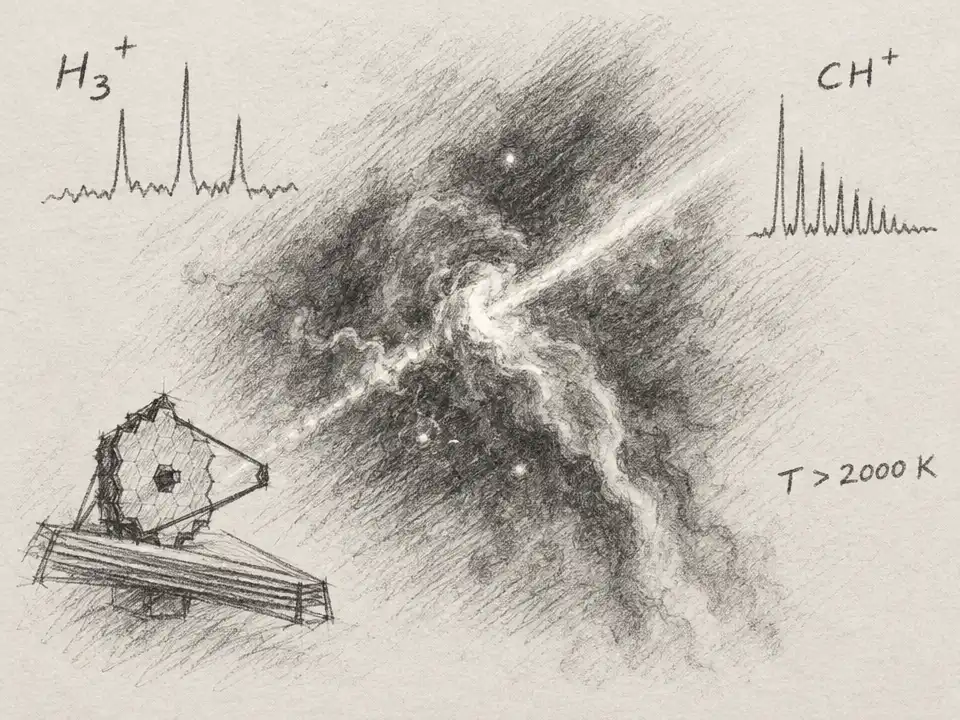
The clues are not broad flashes but thin lines in infrared spectra. One set belongs to H3+, an ion central to the chemistry of interstellar clouds. The other belongs to CH+, a molecule whose creation demands an input of energy. Together, their light turns a distant shock into something like a laboratory: it reveals not only which particles are present, but how they are being energized.
The H3+ detection is startling partly because the ion seemed to have no way to announce its rotation. Its three hydrogen atoms form a symmetrical triangle, giving it no permanent electric dipole—the usual handle that lets a rotating molecule emit a detectable rotational signal. In principle, though, rapid rotation distorts the triangle enough to create a tiny dipole. The resulting transitions are called “forbidden” because they are extraordinarily weak, not because nature forbids them outright. For decades, astronomers had predicted this spectral fingerprint without detecting it in the laboratory or in space.
JWST’s Mid-Infrared Instrument picked up 26 such H3+ lines above five times the measurement noise in at least one of two observed fields. The strongest, at 16.325 μm, stood out at 72σ in one field and 49σ in the other. More important than any single line was the pattern: the lines shared the position and velocity of hot molecular hydrogen in the shock, rather than those of the ionized gas. Their map followed the glowing hydrogen almost point for point. That agreement helps distinguish a real molecular signal from an accidental overlap with some other feature in the crowded light.
What does the pattern say about the gas? A simple plot of the H3+ lines suggests a rotational temperature of about 730 K. But that number is misleading if read as the gas’s actual temperature. The levels are not populated as they would be in a system that has settled into thermal balance. The best explanations instead point to subthermal excitation: collisions are stirring the ions, but radiation carries energy away before collisions can fully even things out. The gas doing the exciting is at least 2000 K.
That distinction matters. The spectrum is not merely a thermometer; it records how a shock’s energy moves between particles and light. The researchers compared it with two broad kinds of shock. In a J-type shock, conditions change sharply across a narrow front. In a C-type shock, magnetic forces cushion the passage and ions and neutral particles can move differently. Both models can reproduce the observed hydrogen lines. The J-type model comes closer to the H3+ brightness, but it has limitations; the C-type model underpredicts that emission by a factor of 5–6, and the relevant collision physics is uncertain. The new lines narrow the possibilities without yet settling the shock’s structure.
Then there is CH+, which adds a different kind of clue. This ion forms when carbon ions react with hydrogen molecules, but the reaction needs at least 0.40 eV of energy. In cold gas, that is a steep barrier. A shock can supply the energy, either through hot collisions or through motion between ions and neutral particles.
JWST revealed CH+ rotational lines from highly excited states, with the observed ladder reaching levels labeled J=32. Eleven lines were detected above 5σ in both fields. Their locations and velocities again track the hot molecular hydrogen. Here the surprise is not just that a high-energy molecule is present; it is that the light can preserve a trace of how it was born.
These CH+ states radiate quickly, with lifetimes of just 6–26 milliseconds. Under the conditions in HH 168, ordinary collisions are too infrequent to keep refilling them or reshaping their populations. Instead, a newly formed ion tumbles down through a sequence of rotational states, releasing a photon at each step. The brightness of the different lines therefore acts like a count of how often the reaction produced ions at different starting energies.
The measured cascade points to CH+ forming across a broad range of rotational levels, roughly up to J≈33. A model with a near-uniform formation rate across those levels describes the observations; a model in which the products follow a thermal-like distribution fits slightly better, with a formation temperature of about 6100–6300 K. That is not a direct measurement of the gas temperature. It describes the distribution of energy in the newly made molecules, and the observations constrain only the product of the reactant temperature and the fraction of energy that ends up in rotation.
Put the two ions side by side and the shock comes into sharper, stranger focus. H3+ lines expose how collisions excite a fragile molecular ion in hot gas. CH+ lines preserve the energy distribution imprinted at the instant a chemical reaction makes a new ion. Both kinds of signal emerge from the same broad region, yet they tell different parts of the story: the conditions in the gas and the energy hidden in its chemistry.
The view remains incomplete. Important collision rates for H3+ at the relevant energies are not known, and the CH+ spectrum does not yet reveal whether heat or ion-neutral drift supplied most of the reaction energy. But the old assumption that these faint rotational signatures were out of reach has changed. In HH 168, JWST has turned two molecular fingerprints into new ways to examine the otherwise invisible machinery of a star-forming shock.