At 41 nanometers, light can become a remarkably fussy messenger. This extreme-ultraviolet radiation can expose some of matter’s quickest changes, including shifts in magnetism. But the usual tools for sorting light by its polarization—the direction in which its electric field oscillates—are hard to use here. Many materials absorb extreme-ultraviolet light instead of letting it pass through. The result is a curious blind spot: scientists can make and study these brief flashes, yet measuring how their polarization changes is difficult.
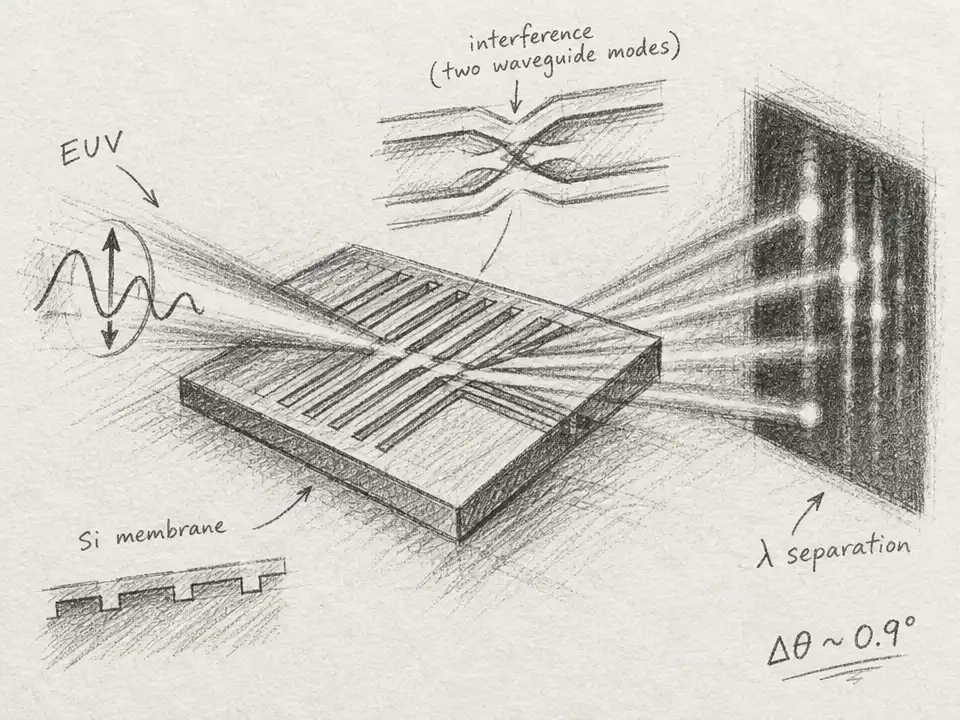
A team of researchers has found a way to make a thin sheet of silicon do some of that sorting. Their device is patterned with a dense array of tiny cylindrical channels. When extreme-ultraviolet light passes through, the channels redirect it into a diffraction pattern: a set of bright spots that shifts according to the light’s polarization. The sheet is not simply a filter. Its small channels coax light into different paths, then let the paths interfere, turning an invisible property of the incoming beam into a pattern a camera can read.
The trick begins with a surprising comparison. A channel etched into silicon can act, for this light, much like a miniature optical fiber. The light is guided along the channel, where only a few of its possible wave patterns—called modes—are excited. In the researchers’ model, two modes matter most. One has a relatively simple shape; the other has a more complex pattern, with a central region and an outer ring. As they travel, they accumulate phase at different rates. Their relative timing changes with distance, much as two ripples can alternate between reinforcing and partly canceling one another.
That shifting interference reshapes the light at the channel’s exit. For one polarization direction, the reshaped field sends more light toward one pair of diffraction spots. Turn the polarization, and the balance shifts toward another pair. The channel’s length therefore becomes a design control: a difference of a few tenths of a micrometer can change which direction receives more light. In a model of a single channel, the researchers found that the preference reverses as the guided modes move between different stages of their interference.
To turn that idea into an analyzer, the team arranged many channels in a square grid etched into a crystalline-silicon membrane. Each channel is 0.14 micrometers wide; the grid repeats every 0.19 micrometers. The channels extend 0.26 micrometers into a membrane 0.5 micrometers thick. That repeating pattern helps the redirected light from separate channels add up into distinct diffraction spots, rather than scattering in a jumble. The fabricated analyzer covers an area of 100 by 100 micrometers.
The measurement is a little like reading a compass from the way a crowd moves. The researchers compare the light landing in spots along two perpendicular directions. If the two sets are balanced, the polarization lies near the angle where the instrument is most sensitive to small rotations. If one side brightens, the difference indicates the direction of the polarization axis. Because the comparison is differential, the result depends on the relative brightness of the spots, not simply on how much light the source produced.
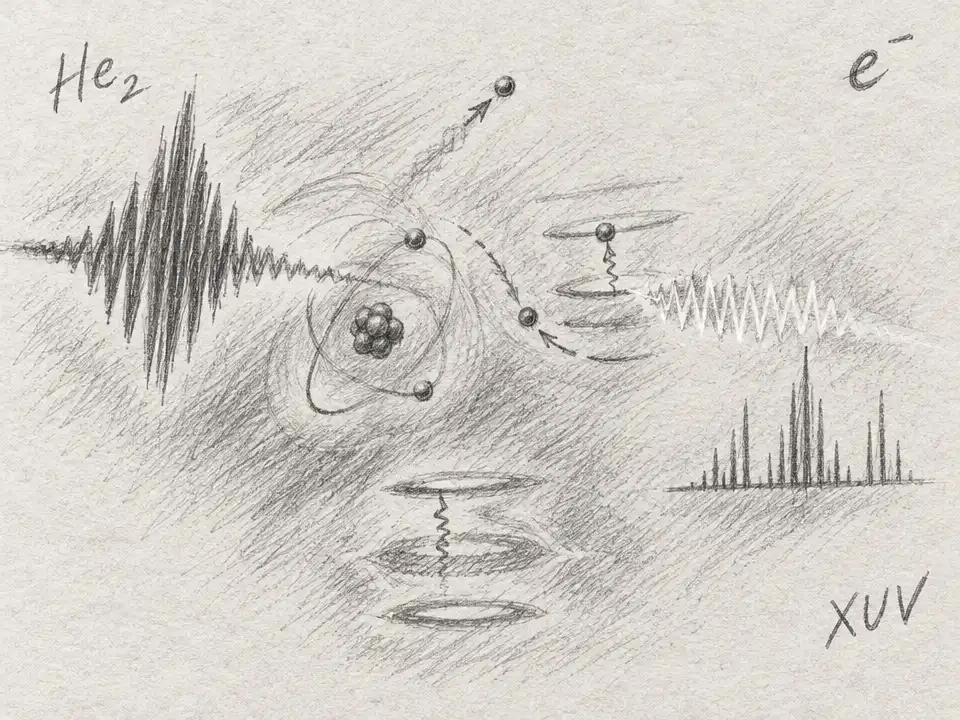
The team tested the membrane using extreme-ultraviolet pulses made by sending near-infrared laser pulses into argon gas. The resulting light included a range of photon energies, so the camera recorded a spectrum as well as a diffraction pattern. At 30 electron volts, the analyzer produced a measured polarization contrast of 9.6 percent. In practical terms, about 21 percent more light went into the diffraction orders associated with one direction than into those associated with the perpendicular direction. The device also resolved polarization at photon energies above 44 electron volts, corresponding to a wavelength of 28 nanometers.
At its most sensitive setting, the experiment could distinguish polarization rotations as small as 0.9 degrees in a one-second measurement. That is a notable scale of precision for a device working with light that ordinary optical elements struggle to transmit. The authors point to possible uses in studies of ultrafast magnetism, where polarization changes can reveal what electrons and magnetic moments are doing after a brief pulse of light. Since different elements interact with different parts of the extreme-ultraviolet spectrum, combining polarization and spectral information could help researchers follow changes with element-specific detail.
There are limits to what has been demonstrated. The team tested linear polarization and used one-second camera measurements; the paper’s single-shot capability depends on having a sufficiently bright source. The light redirected into the first diffraction orders amounted to about 12 percent of the power transmitted through an unpatterned part of the membrane. A thinner membrane is predicted to transmit more, but the authors did not report that as a result of this experiment. They also describe a hexagonal channel pattern that could reveal additional information about polarization, but that design remains a proposal.
Still, the important change is one of scale and perspective. Extreme-ultraviolet optics often confront a hard material problem: light is absorbed before a conventional transparent element can shape it. Here, a patterned membrane makes the channels themselves do the guiding, and their interference does the sorting. A field that once seemed to demand moving assemblies or indirect measurements now has a compact, transmissive route to reading polarization. The device does not make extreme-ultraviolet light easy to handle. It gives researchers a new way to see what that light is carrying.