Imagine trying to spot a ripple by looking at a pond from far above. One patch rises as another falls; viewed together, their motions can cancel. A similar blind spot can affect optical measurements of a vibrating membrane: if neighboring regions move in opposite directions, a light beam averaging across them may barely register the motion.
A theoretical study proposes a different kind of probe: send free electrons skimming past the membrane, then read the momentum changes they carry away. The twist is that the membrane’s vibration does not merely provide something to measure. It reshapes nearby light into a pattern that can steer the electrons—and, in the process, make otherwise dim mechanical motions easier to detect.
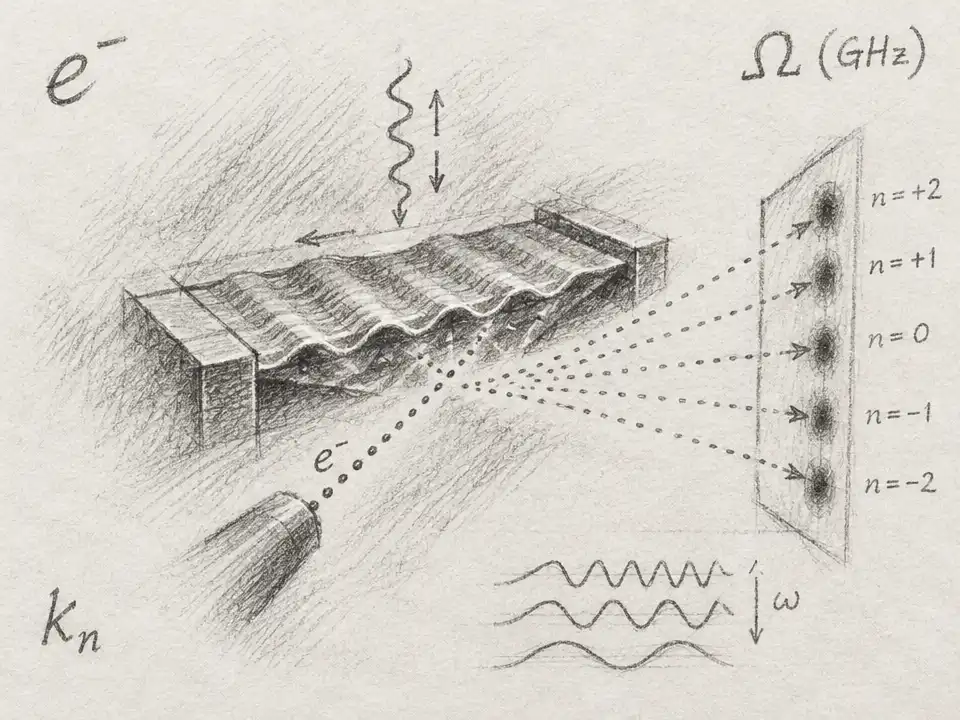
The idea rests on a finely matched handoff. Light shines on a membrane while it vibrates. The moving surface scatters some of that light into a sideband: light shifted slightly in frequency and carrying a sharply patterned spatial wave. For the high-frequency modes studied, this pattern has more sideways momentum than a freely traveling light wave can carry. It therefore fades rapidly away from the surface, forming what physicists call an evanescent field.
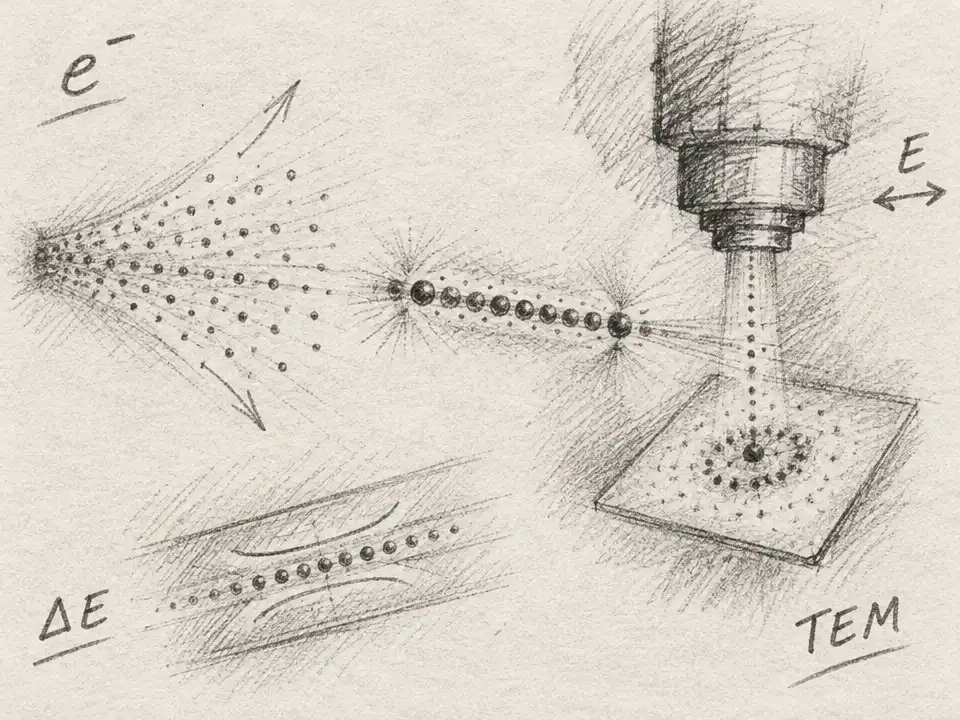
An electron need not touch the membrane to encounter that field. Passing through it, the electron can exchange energy and momentum with the light. But the exchange becomes effective only when the electron’s motion stays in step with the field’s traveling pattern. That is phase matching: contributions gathered along the electron’s path reinforce one another instead of canceling. Change the electron’s kinetic energy, and a different membrane pattern can come into tune.
In the researchers’ model, the electron emerges in distinct recoil orders—like a set of momentum steps. The membrane’s vibration sets the spacing between those steps, while the vibration’s amplitude controls how broadly the electron population spreads across them. Turn up the modeled motion, and higher recoil orders become more populated. A momentum-resolving detector could read that distribution as a record of the membrane’s motion.
The example is ambitious in scale. The paper models a square membrane 20 micrometers across and examines a high-order vibration near 3.27 gigahertz. For one selected pattern, called mode 50, an electron with kinetic energy of about 341 keV is phase-matched when it passes 70 nanometers from the membrane. These are design calculations, not measurements from a built device. The authors estimate that the electron crosses the interaction region in about 80 femtoseconds—short compared with the vibration’s 0.31-nanosecond period.
Making the membrane move in the desired pattern is a challenge of its own. A broad, uniform push can excite neighboring regions in opposite directions, causing their effects to cancel. The paper offers two ways to shape the push: focus a modulated beam near a moving antinode, or overlap two angled beams so their interference creates a traveling pattern matched to the membrane’s vibration. For mode 50, a beam aimed at the membrane’s center lands on a node, where displacement is zero; shifting it by about 0.20 micrometers toward a nearby antinode improves the overlap.
That spatial matching matters for power. In the paper’s reflecting-boundary calculation, increasing the overlap from 0.10 to 0.50 reduces the local optical modulation power needed to produce a 2.5-nanometer displacement from approximately 2.45 to 0.49 kilowatts. The authors also consider piezoelectric or acoustic actuation. They caution that the power figures describe light delivered locally to the membrane, not the power required from a laser before coupling losses.
The sensing possibility becomes clearest for a mode that ordinary optical readout nearly misses. A centered light beam averages over the mode’s alternating positive and negative displacements. For mode 50, those contributions can cancel. The electron, by contrast, responds to the phase accumulated along its path through the near field, so the modeled interaction remains appreciable. Tuning the electron energy can help select a mode, though it does not by itself remove possible responses from neighboring modes in a real, multimode measurement.
Under the study’s modeled conditions, electron readout beats a Gaussian optical homodyne benchmark by approximately 16 decibels for mode 49 and 34 decibels for mode 50, at a 5-gigahertz integration bandwidth and equal detected probe rates. The larger advantage for mode 50 reflects its weak optical visibility. But the comparison needs an important qualifier: the absolute signal-to-noise ratio remains below one for the assumed signal calibration. The result is a relative advantage in a theoretical comparison, not a claim that the proposal has already detected a force.
There is a demanding route between this calculation and an experiment. It calls for a high-order gigahertz membrane mode, a nearby electron beam, precise energy selection, and careful control of alignment, thermal noise, and unwanted coupling to other modes. The moving-boundary model also assumes a strong coherent vibration and negligible disturbance from each passing electron. The authors suggest a sensible first step: drive the membrane with a known signal and check whether its recoil pattern changes before trying to identify an unknown force.
If the approach works, it would turn a familiar obstacle—oppositely moving patches that disappear in an averaged optical view—into a reason to probe differently. The electron does not simply watch the membrane shake. Its momentum distribution becomes a readout channel shaped by the membrane’s own motion, one that may reveal mechanical patterns that light alone struggles to see.