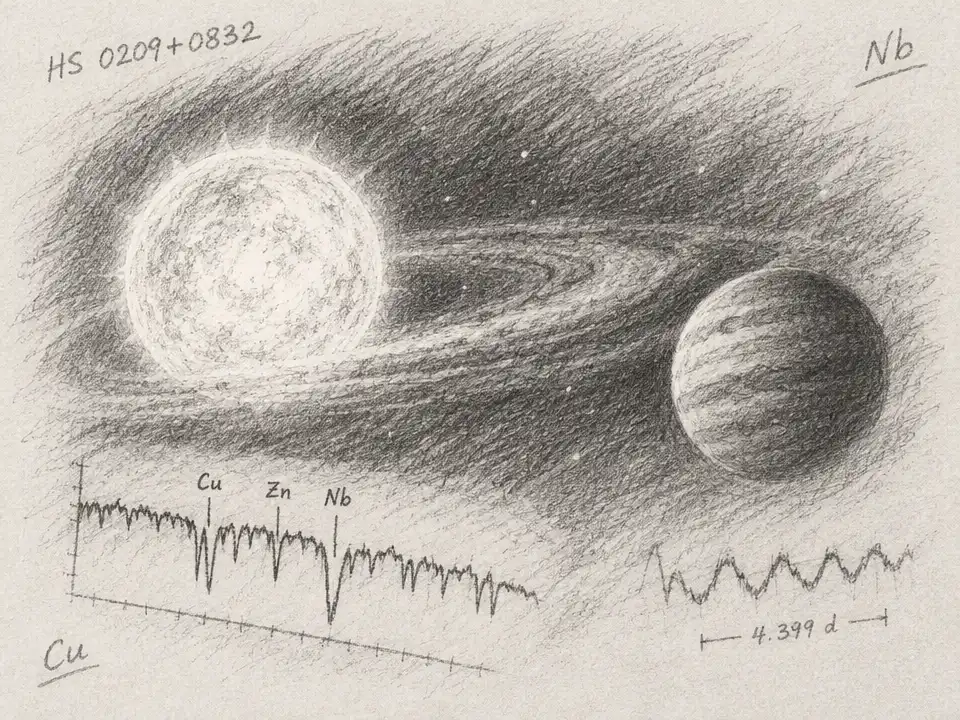
The clue arrived not as a picture of a planet, but as a set of faint marks in ultraviolet light. In an old spectrum of the white dwarf HS 0209+0832, dozens of lines had resisted identification. A fresh analysis of the archived observations matched many to copper and niobium—elements that helped turn an obscure stellar puzzle into a possible glimpse of a world with an unusual origin.
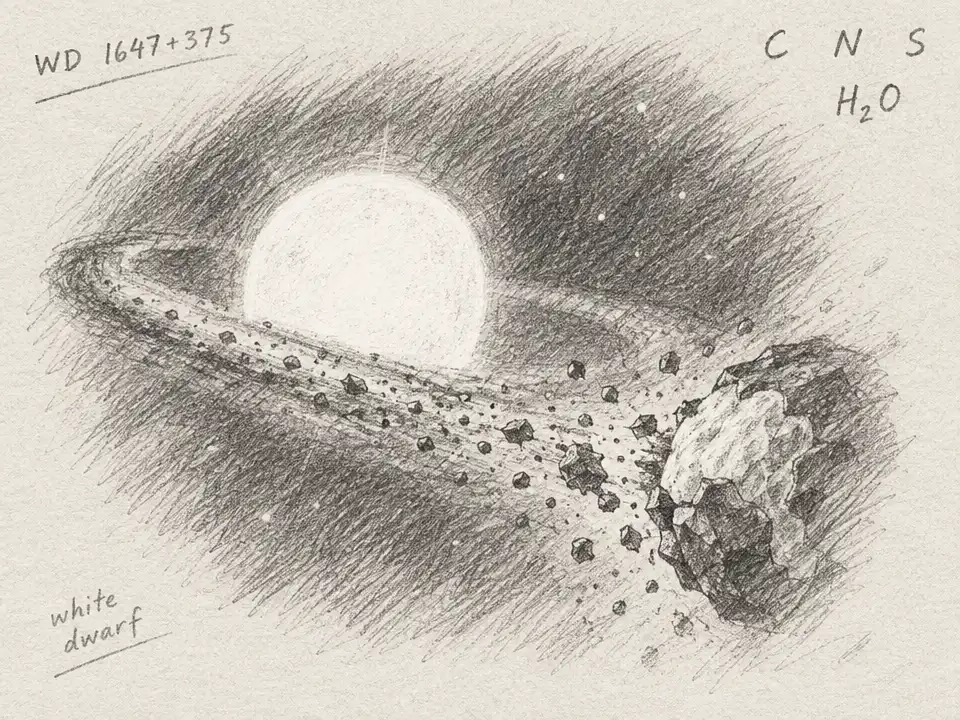
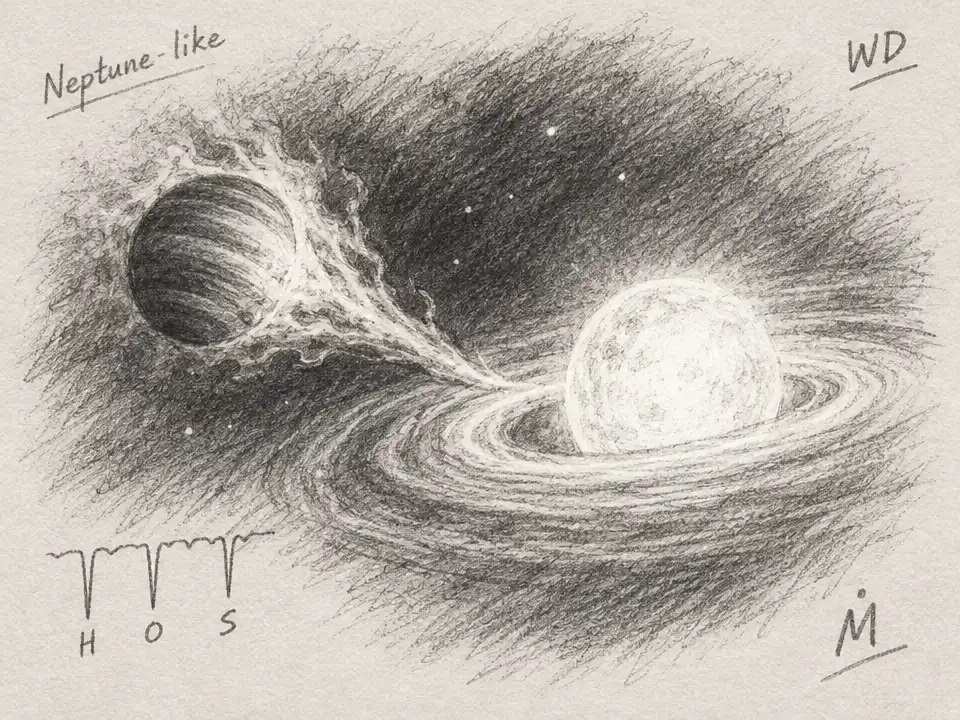
A white dwarf is the compact, hot remnant left when a star like the Sun exhausts its fuel and sheds its outer layers. HS 0209+0832 is about 82.6 parsecs away, with a surface temperature of 35,800 ± 500 K. It has been cooling for only 5.1 ± 0.2 million years. The star is not swallowing a rocky planet whole, the researchers argue. Instead, it may be collecting gas escaping from a giant planet close by.
That interpretation begins with the white dwarf’s atmosphere. Gravity should pull heavy elements downward, and helium should sink on a timescale of months. Yet helium and several metals remain detectable. The team therefore treated them as evidence of a continuing supply from outside the star. To work out what that supply might be, they revisited observations made with Hubble in 1999 and the FUSE space telescope in 2002, then compared the spectra with detailed models of the white dwarf’s atmosphere.
The task was a kind of chemical fingerprinting. Atoms absorb light at particular wavelengths, leaving lines that reveal which elements are present. Updated atomic data let the researchers identify copper and niobium among the previously mysterious features. They also measured zinc and other metals, while checking how the white dwarf’s intense radiation might hold some elements aloft and how quickly others would sink. Those effects matter: the atmosphere is not a simple, unaltered sample of the material arriving at the star.
Even with those complications, the mixture looks unlike familiar Solar System rocks. The researchers found no iron and only traces of silicon, while the inferred niobium abundance is more than three orders of magnitude above the Sun’s. Niobium is a trans-iron element associated with the slow capture of neutrons, or the s-process. That makes it a possible clue not just to what the object is made of, but to where its ingredients were cooked.
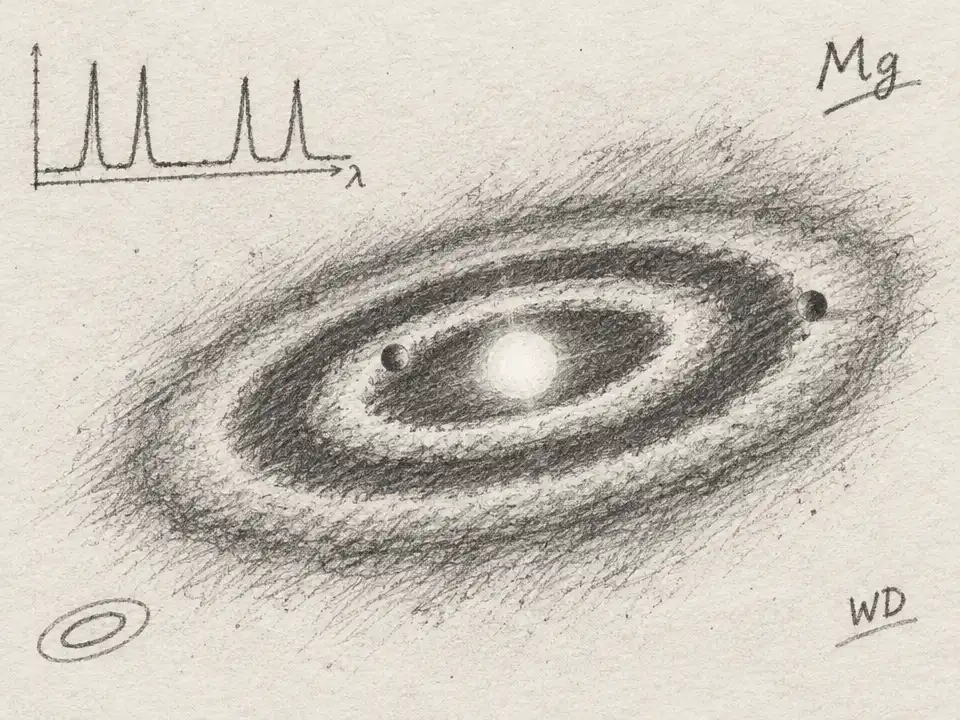
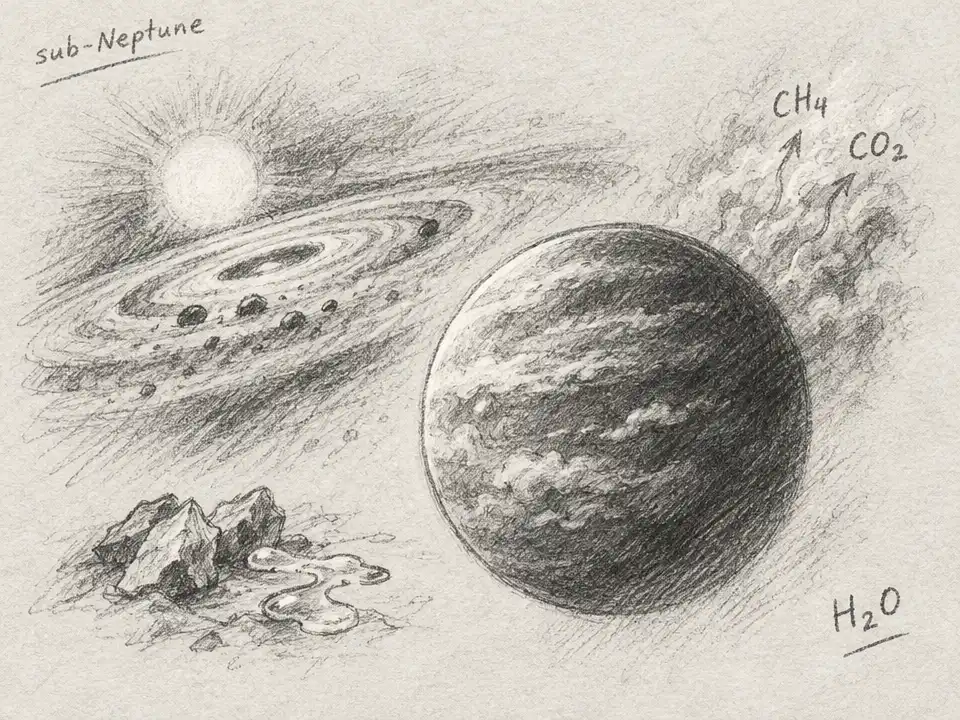
Here the scale of the story shifts backward, from a small, hot stellar remnant to the swollen star it used to be. Before becoming a white dwarf, the progenitor passed through a late giant phase, shedding gas enriched by nuclear reactions inside the star. In the researchers’ scenario, some of that lost material gathered into a disk. A planet forming from the disk would be “second-generation”: assembled from stellar matter expelled after the star’s original planetary-building era, rather than from the first disk around its young main-sequence star.
The idea is not that the star’s discarded shell automatically became a planet. The researchers discuss ways a disk might form, including interactions involving a companion star or material that later falls back toward the white dwarf. Once a disk exists, it could build planets, or enrich an older planet with a new atmosphere. The chemical evidence cannot reveal whether the possible world’s core formed in the first generation or the second. What it may preserve is the history of the gas now escaping from it.
A second, much fainter clue comes from the star’s brightness. TESS observations show a repeating variation with a period of 4.399 ± 0.026 days and an amplitude of 0.120 ± 0.018 percent. If that cycle tracks an orbit, a companion would circle at about 0.044 AU. The researchers suggest that the changing light could come from a planet’s hot side rotating into view—or from a tail of gas and dust trailing an evaporating planet.
But the flicker is not a planet photograph, or even a confirmed orbital signal. The white dwarf itself could vary as it rotates, perhaps because its surface is uneven. The period is unusually long for a typical white dwarf spin, which makes that explanation less straightforward, but does not eliminate it. No transits were detected. The planet remains a candidate, supported by a possible brightness cycle and by the chemical evidence of accretion.
And the chemistry has its own loose thread. Stellar models predict that niobium should be accompanied by strontium, another s-process element. The team did not detect strontium, and its measured niobium abundance exceeds even the maximum values in the model grid they examined. The researchers note that some enriched stars show a similarly puzzling imbalance, hinting that the relevant neutron-capture chemistry may be more complicated than current models capture. Planetary processing could also alter the mixture.
That tension is part of what makes HS 0209+0832 valuable. Its spectrum may be recording the afterlife of a star and the possible birth, heating, and erosion of a world in the same system. The strongest conclusion is not that astronomers have directly confirmed a planet born from stellar ashes. It is that the white dwarf is accreting material with an extraordinary composition, and a second-generation planet is a compelling explanation. Better spectra could test the missing elements; further observations could show whether the faint rhythm belongs to a companion. For now, the distant world is hidden in the light it leaves behind.