A white dwarf can be a star’s worth of matter squeezed into a world-sized body—and, from Earth, it can look impossibly small. Sirius B, one of the nearest examples, spans only about 28.5 microarcseconds across in the sky. That is an angular measurement, not a physical width: imagine trying to pick out a tiny mark from an enormous distance. A new instrument design proposes a different way to measure that mark, not by making a conventional picture, but by timing the subtle flicker in starlight.
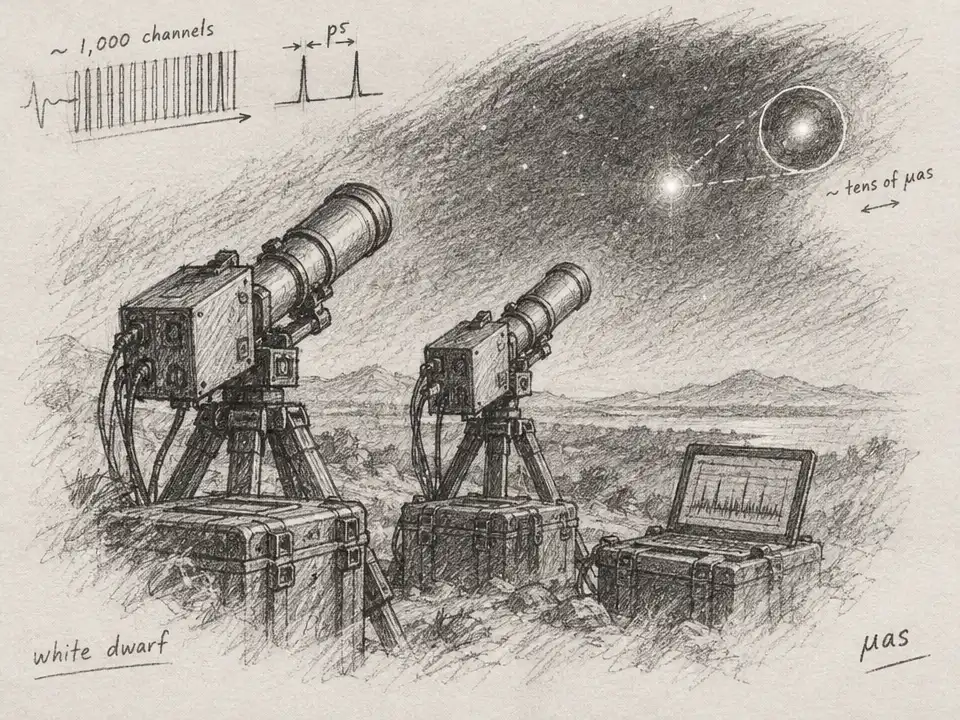
The project, called EON-SII, pairs two transportable telescopes, each with a 4-meter mirror, and places them 1.5 to 3 kilometers apart. That long separation gives the pair a reach no single mirror could provide. But the telescopes are not meant to combine their light into one sharp image. Instead, they will record the changing brightness of a star at each site and look for tiny, matching fluctuations in the two streams.
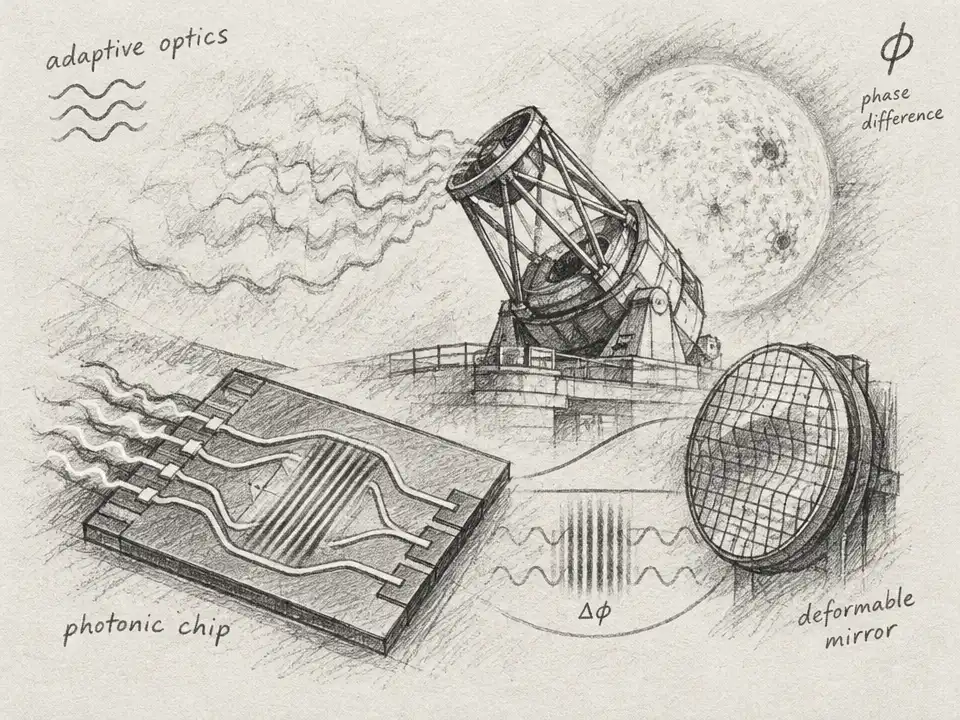
That distinction is the key to the approach. In conventional optical interferometry, researchers combine light waves and need to preserve their relative phase—the carefully aligned peaks and troughs of those waves. Earth’s atmosphere continually distorts the incoming wavefronts, making that alignment difficult. Stellar intensity interferometry asks a different question: do fluctuations in the light arrive together at both telescopes? The correlation between them contains information about the star’s apparent size. Because it does not depend on preserving the waves’ phase, the technique is largely insensitive to atmospheric turbulence.
There is a trade-off. The useful correlation signal is weak, so the instrument must collect and process a great many photons with exquisite timing. EON-SII’s design tackles this by splitting visible starlight into roughly 1,000 narrow spectral channels. Each channel supplies its own measurement; taken together, they can strengthen the result. The proposed spectrograph covers light from 400 to 550 nanometers, while fast detectors and electronics aim to time photon arrivals on scales of 12 to 30 picoseconds. A picosecond is one trillionth of a second.
Think of the two telescopes as listening for a very quiet rhythm, while the channels let them listen in many parts of the light spectrum at once. The telescope optics are designed to concentrate the light efficiently onto the detector, not to produce diffraction-limited images. The proposal uses actively aligned mirror panels and a direct, fiber-free route into the spectrograph to avoid losing precious photons. A digital system would correct for the time light takes to travel across the baseline, then compare the streams.
That timing is demanding: even the optical paths inside each telescope must avoid spreading photon arrival times by more than a few picoseconds. The researchers describe laboratory tests of components, including timing electronics, but the full instrument has not yet demonstrated its predicted performance on a star. Its sensitivity estimates come from an end-to-end model of photons passing through the atmosphere, telescope, spectrograph, detector and correlation system. In other words, EON-SII is a carefully engineered plan—not a new measurement of a white dwarf.
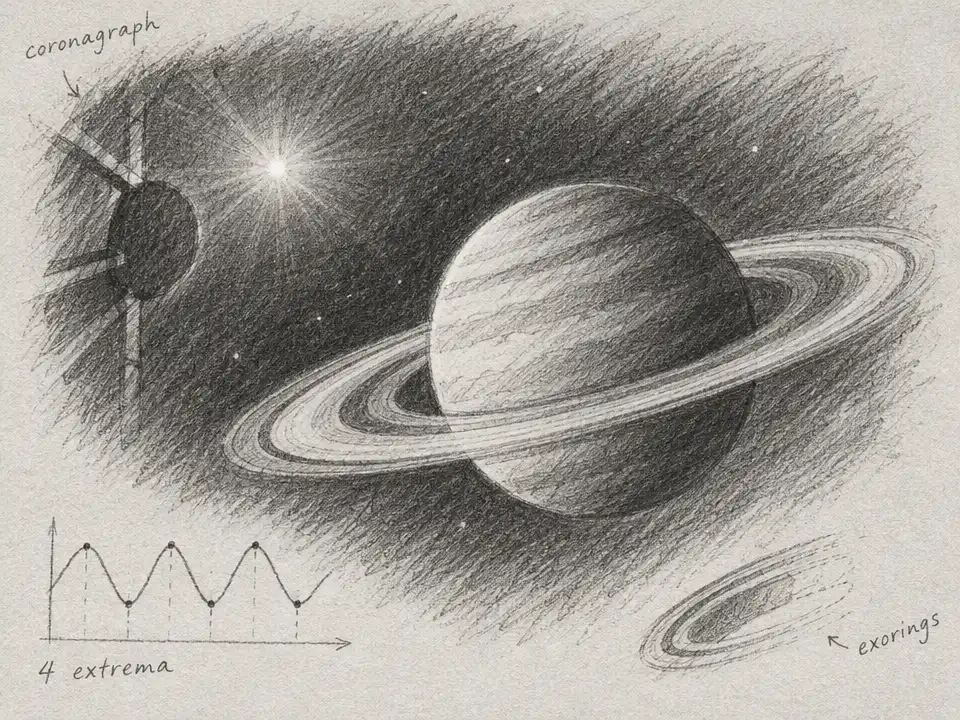
The model’s reference target is Sirius B. Its proximity makes it a valuable test, but also creates the design’s most awkward glare problem: Sirius A is about 9,000 times brighter in visible light, despite lying roughly 11 arcseconds away. Even a small amount of scattered light from the brilliant companion could overwhelm the white dwarf’s signal. The design therefore treats suppressing that contamination as a critical test, setting a target of no more than one part in 100,000 of Sirius A’s light leaking into the Sirius B measurement.
If the design reaches its modeled sensitivity, it could measure Sirius B’s angular diameter to 10 percent in about 1.5 hours with one detector option, or about 20 minutes with a proposed faster detector array, under favorable conditions. Those are predictions, not guaranteed observing times. The paper also identifies two other nearby white dwarfs as possible targets: 40 Eridani B, with an expected diameter of 24.3 microarcseconds, and Procyon B, at 32.6 microarcseconds. Fainter targets and imperfect calibration would demand longer observations.
Why go to such lengths to measure a speck? Combine a star’s angular diameter with its distance, and the result gives its physical radius. Pair that radius with a mass measured by other methods, such as the motion of a companion or gravitational redshift, and astronomers can test the white-dwarf mass–radius relationship. That relationship is a window into matter packed to extraordinary density: the pressure and structure of a collapsed star depend on how its matter behaves under conditions no laboratory can reproduce.
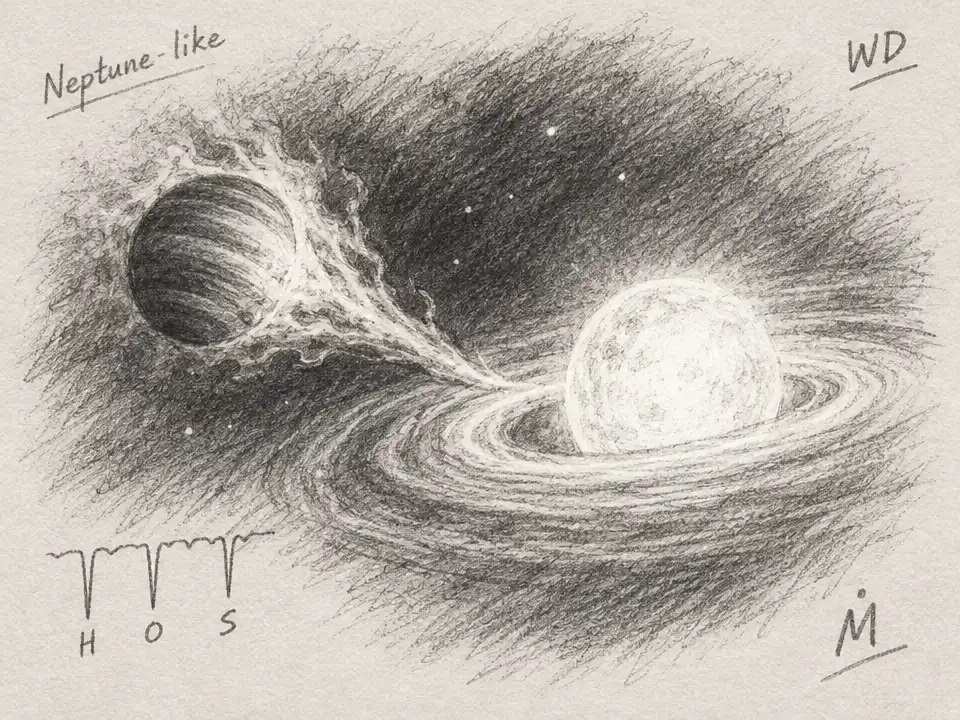
The same technique could also follow changing structures around compact stars. During an outburst, a cataclysmic variable or nova brightens, but brightness alone does not reveal where the light comes from. Measurements across different wavelengths and times could show whether emission is coming from a compact inner disk, a more extended impact region or expanding ejecta. With two telescopes, EON-SII would not reconstruct detailed images; it would measure angular scales and fit relatively simple models. More telescopes would be needed for fuller image-making.
That restraint is part of what makes the proposal interesting. EON-SII does not try to solve every challenge by building a flawless optical image-maker. It changes the measurement: let atmospheric shimmer scramble the waves, then search for the statistical trace the star leaves in their arrival times. The next adventure is practical—prove that the mirrors hold their focus, the spectral channels remain independent, and the glare can be controlled. If those pieces come together, a pair of separated telescopes could turn starlight’s faint flicker into a ruler for some of the smallest stars in the sky.